Ever since the reality-shattering, bittersweet chords of Stone Ocean faded into Netflix’s release catalog, the collective consciousness of the global anime community has been locked on a single, inevitable event horizon: Steel Ball Run. Within the broader canon of Hirohiko Araki’s multi-generational epic, Part 7 does not simply occupy the space of another sequential installment. It sits atop a mythic pedestal, currently locked in a perpetual duel with Berserk for the highest-rated manga spot on platforms like MyAnimeList. For longtime fans and industry observers alike, the question surrounding an adaptation is no longer a matter of “if,” but rather a high-stakes calculation of “how” and “when.”
The murmurs surrounding David Production’s next steps have grown deafening. Between cryptic trademark filings, anniversary retrospectives, and the studio’s evolving production slate—which has balanced projects like Urusei Yatsura and Undead Unluck—the appetite for the trans-American odyssey has reached a fever pitch. Yet, adapting Steel Ball Run is a monumental undertaking unlike anything the Tokyo-based studio has tackled before. It represents a stylistic rebirth, a thematic maturation, and, most terrifyingly for production committees, one of the most notorious technical hurdles in modern commercial animation.
A Hard Reset on Destiny: Araki’s Magnum Opus and the Western Frontier
To understand the sheer magnitude of the Steel Ball Run buzz, one must appreciate its unique historical and creative context. Serialized initially in Weekly Shonen Jump before migrating to the monthly, seinen-oriented pages of Ultra Jump in 2005, Part 7 liberated Hirohiko Araki from decades of editorial constraints. The weekly grind gave way to sprawling, cinematic double-page spreads, nuanced pacing, and a gritty, morally ambiguous sandbox set against the sun-baked backdrop of late 19th-century North America.
The premise is deceptively accessible yet intoxicatingly bizarre: a grueling, 4,000-mile coast-to-coast horseback race from San Diego Beach to New York City, bankrolled by eccentric promoter Stephen Steel. With a staggering $50 million purse on the line, the contest draws outlaws, prodigies, assassins, and foreign royalty. Beneath this celebration of manifest destiny and industrial bravado lies a metaphysical conspiracy: the clandestine search for the mummified relics of a divine figure known simply as the Holy Corpse.
By transplanting the saga into an alternate timeline, Araki uncoupled his narrative from the baggage of previous lineages while simultaneously paying homage to them. It is a work that bridges Sergio Leone spaghetti westerns with classic American folklore, body horror, and high-concept physics. For David Production, which has meticulously shepherded the franchise since Jonathan Joestar first clashed with Dio Brando in 2012, Part 7 represents both a victory lap and a terrifying reinvention.
The Broken Jockey and the Executioner: Character Alchemy of Johnny and Gyro
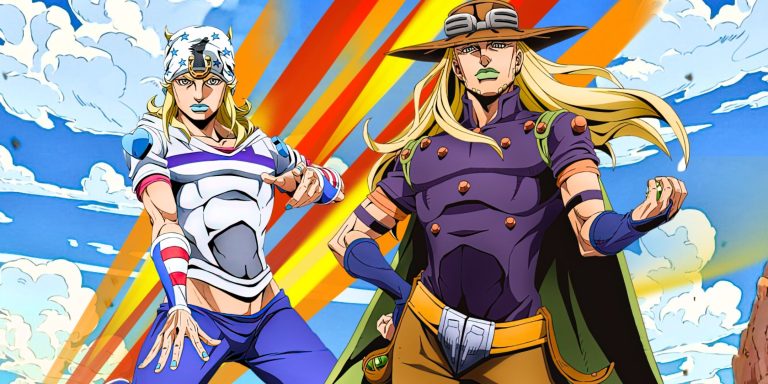
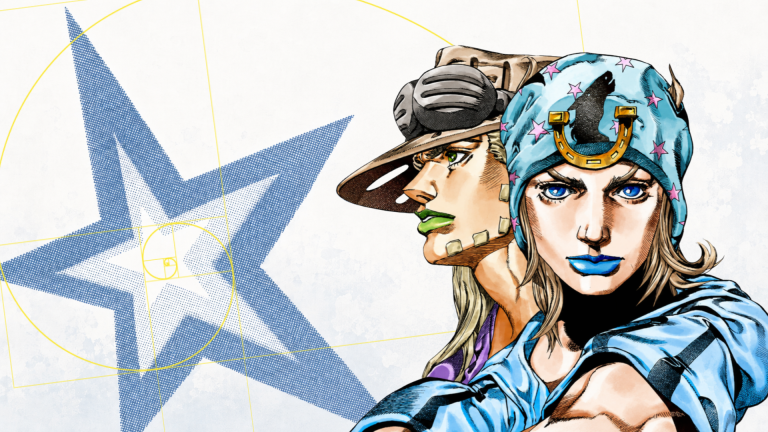
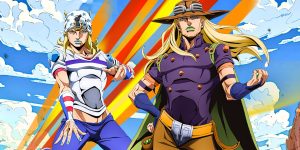
At the beating, bruised heart of Steel Ball Run is a dynamic that many consider Araki’s finest narrative achievement: the symbiotic partnership between Johnny Joestar and Gyro Zeppeli. The anime adaptation’s ultimate success will rest largely on how faithfully David Production captures the emotional resonance between these two deeply wounded men.
Johnny Joestar: The Morally Ambiguous Anti-Hero
Unlike the chivalrous Jonathan or the righteous crusader Jotaro, Johnny Joestar begins his journey at absolute rock bottom. A former equestrian prodigy whose vanity and arrogance resulted in a gunshot wound that left him paraplegic, Johnny is cynical, resentful, and utterly stripped of purpose. He is not motivated by altruism or a desire to save the world; he is driven by a desperate, burning urge to achieve “negative to zero”—to reclaim his dignity and stand on his own two feet.
Johnny’s notorious “dark determination”—manifested in the manga through terrifying, flame-lit eyes—paints him as an anti-hero who is fully prepared to commit horrific acts if it means pursuing his salvation. Animating Johnny requires a delicate touch: his physical limitations demand nuanced, expressive upper-body choreography, while his psychological descent challenges standard shonen conventions.
Gyro Zeppeli: Eccentricity, Duty, and the Path of the Spin
Balancing Johnny’s brooding desperation is Gyro Zeppeli, a disgraced executioner from the Kingdom of Naples whose boisterous exterior hides a profound moral dilemma. Gyro enters the race to win royal clemency for an innocent child sentenced to death. Adorned with steel-grilled teeth spelling out “GO! GO! ZEPPELI” and a fondness for terrible puns about cheese and opera, Gyro quickly becomes the emotional anchor of the journey.
Crucially, Gyro introduces the overarching metaphysical mechanic of Part 7: The Spin. Grounded in the mathematical beauty of the Fibonacci sequence and the Golden Ratio, the Spin is a supernatural martial art passed down through generations of Zeppeli executioners. When Gyro hurls his signature steel balls, they bend space, distort flesh, and tap into infinite kinetic energy. Visualizing the Golden Spiral in motion will test the visual effects department’s ability to turn abstract geometry into visceral, kinetic spectacle.
The Horse Problem: David Production’s Greatest Technical Reckoning
While the narrative is undisputed, the industry hushes over the logistical nightmare at the core of the project: horses. In traditional hand-drawn animation, quadruped anatomy in continuous movement is an animator’s worst nightmare. The complex musculature, the shifting centers of gravity, and the rhythmic cadence of gallops have broken production schedules on legendary productions ranging from Attack on Titan to Vinland Saga.
Steel Ball Run is not merely an anime that features horses; it is an anime that takes place on them. Characters converse, draw weapons, engage in Stand skirmishes, and navigate treacherous terrain—all while maintaining high-speed equestrian movement across thousands of miles. Rumors within the sakuga community suggest that the prolonged wait for the Part 7 adaptation stems precisely from David Production working to establish a viable pipeline. Will the studio rely on high-end, cel-shaded 3DCG models for the mounts, similar to Studio Orange’s groundbreaking work, or will they utilize a hybrid system that preserves Araki’s razor-sharp, cross-hatched line art? The answer will dictate whether the adaptation ascends to modern classic status or buckles under visual inconsistency.
Corpse Parts, Geopolitics, and Metaphysics: Beyond the Typical Stand Battles
The progression of Stand design in Part 7 reaches an avant-garde peak. Gone are the days of simple punch-ghost brawls; Stands in Steel Ball Run are metaphysical extensions of landscape, biology, and intention. Johnny’s evolution through the “Acts” of his Stand, Tusk, mirrors his psychological maturation, transforming from a basic spatial-rotational projectile into a dimension-shattering force of absolute infinity.
Standing in their way is perhaps the most captivating antagonist in franchise history: Funny Valentine, the 23rd President of the United States. Armed with the dimensional-hopping Stand Dirty Deeds Done Dirt Cheap (D4C), Valentine’s villainy is terrifying because it is cloaked in genuine, uncompromising patriotism. His desire to acquire the Holy Corpse to secure an eternal golden age for America forces viewers into an uncomfortable moral space: who is more righteous—a head of state committing atrocities for his nation, or two outlaws slaughtering dozens for personal salvation?
Verdict: The Long Ride Ahead
The buzz surrounding JoJo’s Bizarre Adventure: Steel Ball Run is not merely internet hype; it is the collective anticipation of an artistic milestone. David Production stands at the threshold of their most defining legacy project. Handled with the reverence, technical ambition, and budget it deserves, this adaptation could transcend the seasonal discourse and set a high-water mark for contemporary anime as a whole.
The path will be grueling, the production hurdles vast, but the reward is undeniable. The starting gun is waiting to be fired, and when it does, the anime world will bear witness to the greatest race ever drawn.
What are your expectations for the Steel Ball Run anime? Do you want a hybrid 2D/3D approach for the horses, or should David Production take all the time they need for pure hand-drawn sakuga? Sound off in the comments below!