
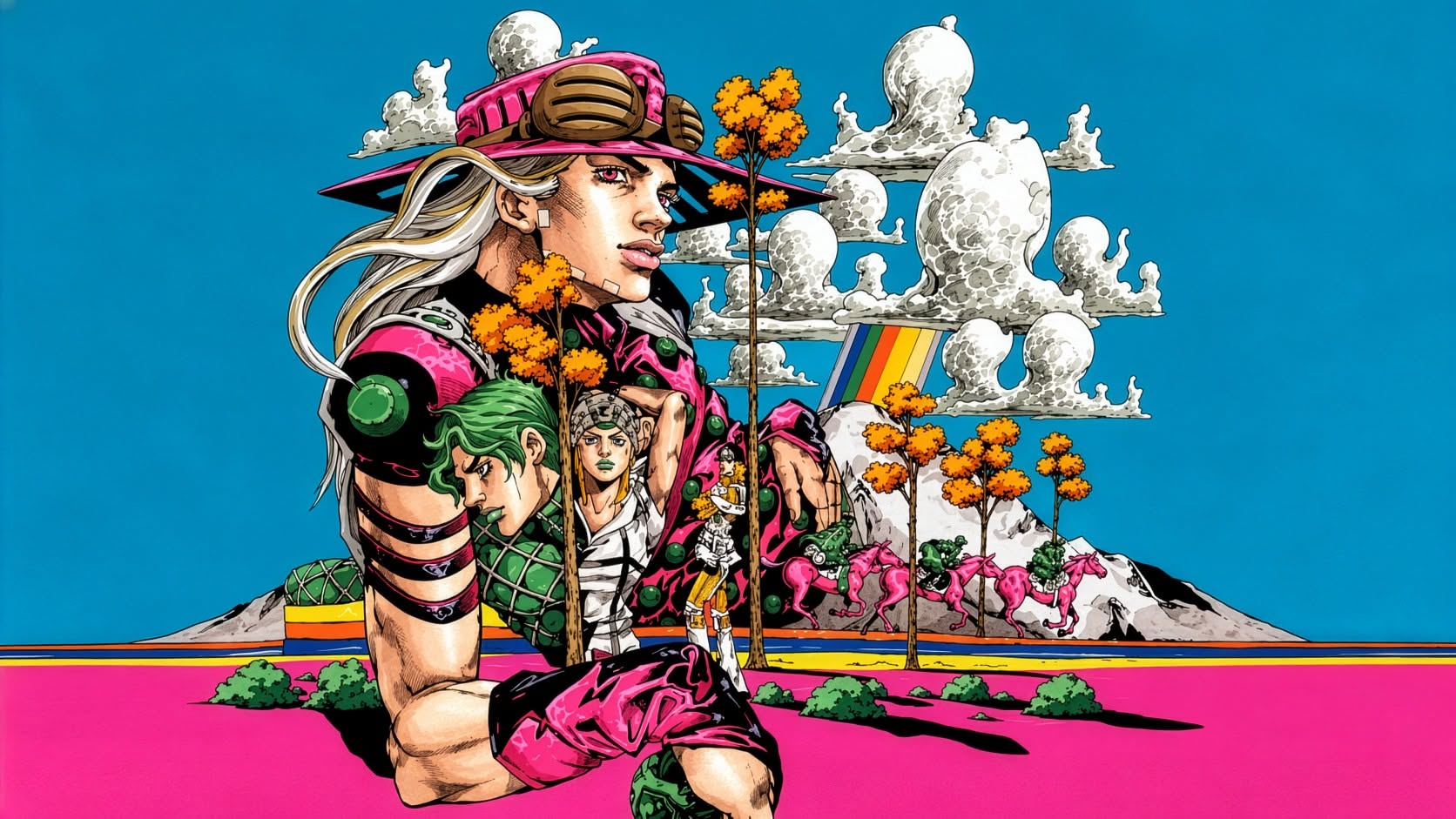
Ever since the melancholic, bittersweet chords of “Distant Dreamer” faded over the rebooted universe of Stone Ocean, the global anime community has collectively held its breath for a single, earth-shattering announcement: the adaptation of JoJo’s Bizarre Adventure: Steel Ball Run. Long hailed as Hirohiko Araki’s magnum opus, Part 7 isn’t merely another entry in an iconic, generational lineage. It represents a monumental creative rebirth—a tectonic shift from shonen eccentricity to raw, seinen grandeur. For years, the prospect of animating this sweeping, six-thousand-kilometer trans-American race was deemed a pipe dream, whispered among animators as an insurmountable production nightmare. Yet, as David Production wraps its other marquee projects, the rumble of hooves on the American frontier has never sounded louder.
The cultural buzz surrounding Steel Ball Run is unprecedented. Fans don’t just anticipate an anime adaptation; they demand a masterpiece worthy of a manga frequently parked at the upper echelons of MyAnimeList and critical literary roundtables. Adapting Part 7 is the ultimate trial by fire for David Production. To bring this legendary western odyssey to life, the studio must navigate complex character psychologies, revolutionary power systems, and the single most notorious technical hurdle in modern 2D animation: running horses.
The Shift to Seinen: Araki’s Masterwork and the Trans-American Odyssey
To understand the religious fervor surrounding Steel Ball Run, one must understand its tumultuous creative origin. Serialized in 2004 in Weekly Shonen Jump before migrating to the monthly, mature pastures of Ultra Jump in 2005, Part 7 decoupled itself from decades of continuity baggage. Free from the breakneck weekly release schedule and editorial restrictions of standard shonen, Hirohiko Araki unlocked an astonishing level of narrative nuance, panoramic paneling, and thematic grit.
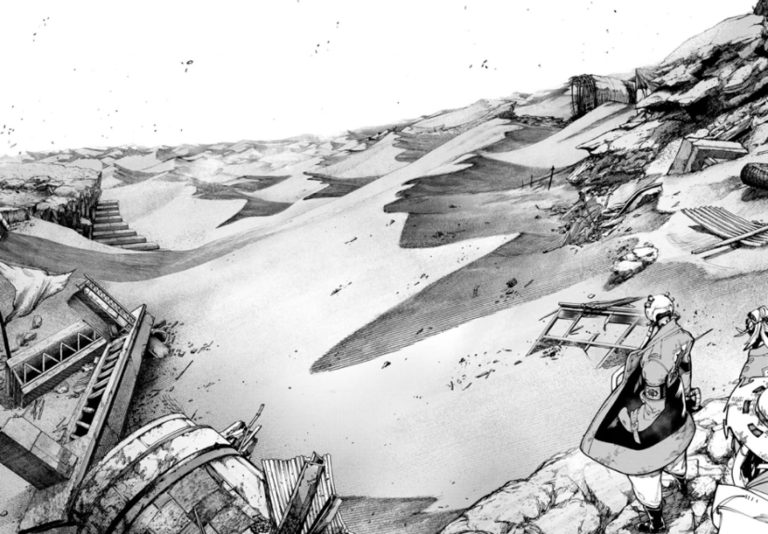
Set against the sprawling, mythic backdrop of 1890s America, the Steel Ball Run race is a breathless marathon stretching from San Diego Beach to New York City. A grand prize of fifty million dollars lures outlaws, aristocrats, assassins, and mystics from across the globe. Yet beneath the dust, gunpowder, and roaring steam engines lies a far more cosmic struggle: a desperate, covert hunt for the scattered mummified relics of the Saint’s Corpse. Araki transformed a high-stakes historical sports epic into a dark theological thriller, intertwining manifest destiny, patriotism, and supernatural horror into a cocktail that reconfigured the genetic code of the franchise.
The Paraplegic and the Executioner: Deconstructing Johnny and Gyro
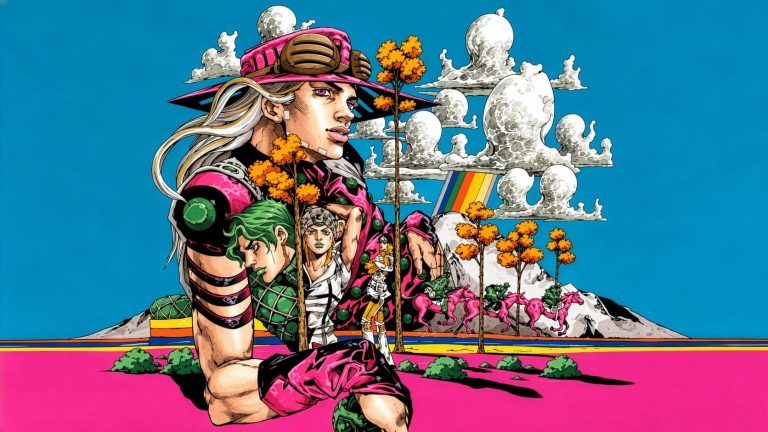
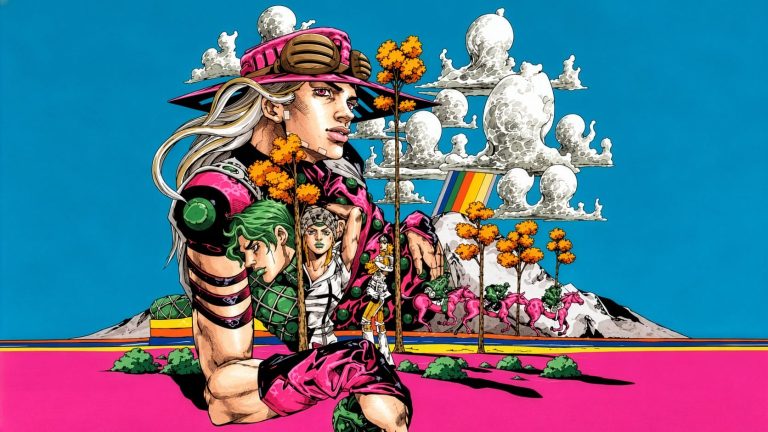
At the center of this continent-spanning journey is what is widely celebrated as Araki’s most profound dual character study: the partnership between Johnny Joestar and Gyro Zeppeli.
Johnny Joestar’s Dark Determination
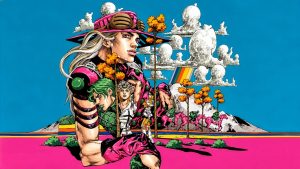
Johnny Joestar is deliberately divorced from the traditional chivalry of his namesake Jonathan, the rebellious flair of Joseph, or the untouchable cool of Jotaro. A former horse-racing prodigy whose hubris and arrogance led to a shooting that left him paralyzed from the waist down, Johnny is introduced at his absolute nadir. He is bitter, broken, and psychologically hollow. When he witnesses Gyro Zeppeli’s mystical Steel Balls cause his dormant legs to twitch with involuntary motion, Johnny’s motivation isn’t to save the world or defend family honor—it is an intensely selfish, agonizing drive to simply regain the ability to walk.
Johnny possesses what the manga famously terms “dark determination”—the pitch-black, predatory gaze of a man willing to kill, sacrifice, and compromise his soul to crawl out of the abyss. This emotional realism gives the narrative an intoxicating, morally gray edge that sets Part 7 fundamentally apart from its predecessors.
Gyro Zeppeli and the Weight of Execution
Serving as Johnny’s reluctant mentor, foil, and deuteragonist is Gyro Zeppeli, a disgraced royal executioner from the Kingdom of Naples. Behind Gyro’s grill-toothed grin, theatrical Italian eccentricities, and bizarre dad jokes lies a severe personal crisis of conscience. Entering the race to win imperial clemency for an innocent boy sentenced to death, Gyro bears the crushing weight of state-mandated murder and ancestral duty.
The dynamic between Johnny and Gyro evolves from transactional cynicism into one of the most poignant, brotherly bonds in manga history. Their late-night campfires, absurd shared songs about mozzarella and pizza, and philosophical debates on luck and fate anchor an otherwise brutal, unforgiving narrative in genuine warmth.
From Hamon to Stand Evolution: The Physics and Philosophy of the ‘Spin’
Combat in Steel Ball Run is a radical departure from the punch-ghost slugfests of Parts 3 through 6. While Stands remain integral—showcasing some of Araki’s most surreal concepts like Scary Monsters, Mandom, and Dirty Deeds Done Dirt Cheap—the narrative foundation is built upon The Spin.
Serving as the spiritual, elevated successor to early JoJo’s Hamon (Ripple), the Spin is a discipline centered on generating rotational energy derived from the natural world. Rooted in the mathematics of the Golden Ratio and the Fibonacci sequence, this technique transforms Gyro’s spherical steel orbs into terrifying kinetic weapons capable of distorting anatomy, warping light, and manipulating space itself.
For Johnny, mastering the Spin is synonymous with spiritual healing. His Stand, Tusk, doesn’t emerge fully formed; it evolves across distinct ACTs that directly mirror his psychological maturation and mastery of rotational mechanics. Moving from firing spinning fingernails like low-caliber bullets to tearing through dimensional barriers, Johnny’s progression provides a methodical, deeply earned mechanical arc rarely witnessed in supernatural action anime.
The Equestrian Dilemma: Can David Production Conquer the Horse Problem?
While narrative hype is at an all-time high, the biggest shadow hanging over the Steel Ball Run anime is logistical: the animation of horses. In the traditional 2D animation industry, four-legged animals—specifically muscular, galloping horses—are universally recognized as an animator’s nightmare. Their complex anatomical articulation, dynamic center of gravity, and constantly shifting musculature make drawing even a single horse intensely time-consuming. Steel Ball Run features dozens of them, sustained across hundreds of chapters, constantly galloping through desert storms, rocky canyons, and dense forests.
Industry speculation heavily revolves around how David Production will tackle this challenge. Relying strictly on hand-drawn 2D animation for the equine sequences would completely cannibalize production timelines and balloon budgets beyond sustainability. Conversely, turning to jarring, low-frame-rate CGI could risk repeating the visual catastrophe of projects like Berserk (2016), alienating a fiercely loyal audience that expects David Production’s signature pop-art fluidity.
Insiders suspect a hybrid visual pipeline will be necessary: advanced 3D cel-shaded models for the horses during wide-angle, high-speed pack runs, seamlessly blended with artisan 2D key animation for close-ups, character interactions, and dramatic, frame-freezing hero shots. Furthermore, the fandom remains anxious about the distribution model. After the controversial, momentum-killing batch-release schedule that Netflix inflicted upon Stone Ocean, there is immense public pressure for Warner Bros. Japan and David Production to return Part 7 to a traditional, weekly event-television format.
Verdict: The Horizon of a Masterpiece
JoJo’s Bizarre Adventure: Steel Ball Run is far more than the next seasonal anime trend; it is the holy grail of modern adaptation projects. It represents the nexus where Hirohiko Araki’s creative maturity as a writer and David Production’s decade-long stewardship of the franchise must culminate. The technical hurdles are towering, and the artistic expectations are virtually unprecedented. Yet, if David Production can harness the kinetic thunder of the race, capture the melancholic beauty of the American frontier, and faithfully portray Johnny and Gyro’s transcendent brotherhood, Steel Ball Run has every ingredient required to not only dominate the anime landscape, but redefine it entirely.
How do you think David Production should handle the infamous horse animation challenge? Should Part 7 stick to a weekly release or follow the streaming batch model? Sound off in the comments below, and stay tuned to Wibux.com for all your breaking anime updates!