


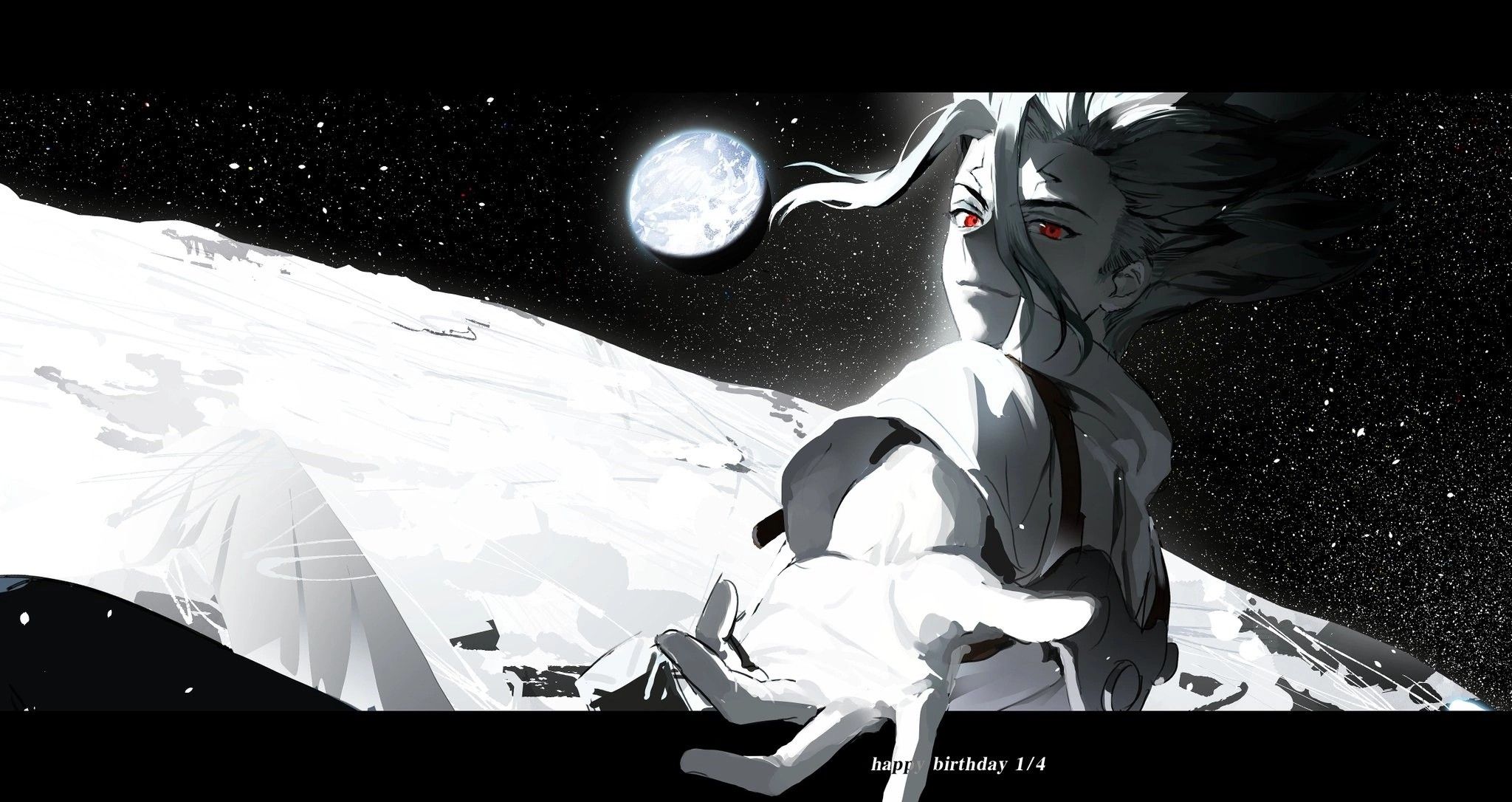
When Senku Ishigami first woke up in the year 5738, naked against the moss of an overgrown Earth with nothing but an encyclopedic memory of the periodic table, the idea of an interstellar voyage belonged to the realm of delirious fantasy. Modern shonen protagonists usually measure their growth in power levels, cursed energy, or mystical transformations. Senku, however, measured his ascent in pottery kilns, sulfuric acid synthesis, and filament lightbulbs. Now, with the curtain rising on Dr. STONE: Science Future—the fourth and final television season helmed by TMS Entertainment—the franchise is preparing to pull off the most audacious, logarithmically scaled endgame in contemporary anime history: sending a ragtag band of resurrected post-apocalyptic survivors to the surface of the Moon.
This is not merely another seasonal continuation; it is the culmination of Riichiro Inagaki and Boichi’s grand thesis on the indomitable nature of human curiosity. For years, the overarching mystery of the petrification event has hovered over the series like an omnipresent executioner’s blade. With the Kingdom of Science finally setting their sights on the source of the global disaster, Science Future transitions the series from an earthbound survivalist sandbox into a high-stakes, hard-science cosmic thriller. The stage is set for an ideological and technological showdown with the universe’s most chilling broadcast operator: the entity known only as Why-Man.
The Great Leap Forward: From Stone Age Smelting to Rocketry
What has always separated Dr. STONE from its contemporaries is its profound reverence for the linear progression of human engineering. Most post-apocalyptic stories linger indefinitely in tribal desolation, wallowing in dystopian decay. Senku treated the collapse of civilization as a temporary latency issue. Across three seasons, we watched the Kingdom of Science claw its way out of the Stone Age, leapfrogging through the Bronze and Industrial Ages with breathless kineticism.
In Science Future, the narrative scale expands exponentially. Before three human souls can set foot on the lunar regolith, the series must reckon with the absolute leviathan of modern aerospace engineering: the supply chain. Audiences will witness Senku, Ryusui Nanami, and Chrome orchestrate a truly global industrial network, circumnavigating continents to secure aluminum, rubber, precision electronics, and rocket propellant. It is a masterclass in logistical storytelling, turning the gathering of raw elements—traditionally the most mundane aspect of RPG-style plotting—into a nail-biting race against societal entropy.
The Architecture of a Moonshot
The technical authenticity that author Riichiro Inagaki cultivated with scientific consultant Kurare reaches its zenith here. The anime doesn’t gloss over the terrifying physics of rocketry. Viewers are treated to the micro-calculations of liquid fuel versus solid boosters, the harrowing tolerances of heat-shield ceramics, and the brutal reality of weight limits. Building an Apollo-grade spacecraft without modern computerized factory automation isn’t just an uphill battle; it is an act of sheer technological defiance that gives this final saga its jaw-dropping momentum.
The Haunting Frequency: Deconstructing Why-Man
No discussion of Dr. STONE: Science Future can overlook the existential dread injected by its primary antagonist. When that synthetic, perfectly replicated vocal frequency of Senku’s own voice interrupted the Kingdom of Science’s primitive radio communications back in Season 2 with a rhythmic, unceasing query—“WHY? WHY? WHY?”—the tone of the franchise irrevocably shifted. It transformed a cozy, optimistic rebuilding narrative into an unsettling cosmic mystery.
Why-Man is one of the most conceptually fascinating adversaries in modern anime because their threat is fundamentally philosophical. Unlike Tsukasa Shishio’s initial martial ideology or Hyoga’s ruthless Darwinism, Why-Man represents an absolute unknown. Is the petrification beam a planetary weapon of mass destruction, or is it, perversely, an act of bizarre preservation? The broadcast originating from the Moon’s surface paints Why-Man not as an invading warlord, but as an impassive celestial watchdog observing humanity’s struggles from afar.
The psychological friction between Senku’s unyielding faith in empirical science and Why-Man’s mysterious, seemingly supernatural bio-technology forms the emotional backbone of this final confrontation. When the lunar lander finally touches down, the audience isn’t just waiting for an action spectacle; we are waiting for an explanation that reconciles millennia of human suffering with cold, cosmic logic.
Byakuya’s Ghost and the Human Equation: The Psychology of the Mission
While the rocket engines provide the spectacle, the emotional core of Science Future rests heavily on the generational baton passed between father and son. Byakuya Ishigami spent the final years of his life on the International Space Station looking down at a petrified blue marble, dedicating his existence to leaving behind the resources and village that would one day sustain his adoptive son. For Senku to break Earth’s gravitational pull and look back down at the planet from space is to complete a trans-generational orbit decades in the making.
This dynamic enriches the psychological stakes of the final crew selection. The lunar voyage is essentially a suicide mission. The resource constraints mean there are no redundancies, no rescue protocols, and zero margin for mechanical error. Deciding who steps into that cramped, claustrophobic capsule forces the narrative to examine what humanity values most when standing on the brink of extinction:
The Trinity of Competence: The expedition demands an absolute equilibrium of specialized human brilliance. Senku brings the computational intellect; Ryusui supplies the fearless spatial navigation and indomitable greed for the future; and the operational muscle—whether it manifests in Tsukasa’s lethal defensive instinct or Kohaku’s peerless sensory acuity—must protect the minds that can reboot the species. Witnessing these disparate characters transition from tribal primitives and hyper-specialized moderns into bona fide astronauts is an intensely rewarding character study.
TMS Entertainment’s Production Challenge: Animating the Void
From an animation standpoint, TMS Entertainment faces its steepest uphill climb yet. Past seasons thrived on lush greenery, vibrant pastoral landscapes, and the warm, earthy palette of a reclaimed Earth. Science Future demands a stark, terrifying aesthetic departure: the cold, airless, monochromatic void of outer space.
Capturing the microgravity environment, the disorienting perspective of orbital mechanics, and the hyper-detailed mechanical draftsmanship of Boichi’s original manga illustrations requires meticulous technical direction. The studio must balance Boichi’s trademark exaggerated, muscular expressions with the clinical, silent terror of space travel. Furthermore, the auditory design—led by returning composers Tatsuya Kato, Hiroaki Tsutsumi, and Yuki Kanesaka—needs to pivot from folksy, adventurous orchestral fanfares to eerie, atmospheric synthesizer landscapes that evoke the hollow solitude of the lunar surface.
Given the pacing of the manga’s final acts, the creative team has the monumental task of adapting a dense, fast-moving narrative without sacrificing the poignant breathing room that made earlier milestones, like the discovery of electricity or the first telephone call, hit with such emotional resonance.
The Ultimate Triumph of Human Curiosity
In an anime landscape often dominated by cynical anti-heroes, nihilistic dark fantasies, and endless power-fantasy escapism, Dr. STONE has always stood out as an unapologetic beacon of humanist optimism. It dares to assert that humanity’s greatest virtue isn’t our capacity for violence or our mystical destinies, but our collective, stubborn desire to ask “How does this work?” and build a better tomorrow through empirical trial and error.
Dr. STONE: Science Future promises to be a celebratory, pulse-pounding conclusion to a journey that began with two teenagers knapping flint in a petrified forest. As Senku straps into the cockpit and points his sights toward the lunar sky, anime fans are about to witness one of the most intellectually thrilling, emotionally earned grand finales of the decade. We aren’t just going to the Moon to defeat an enemy; we’re going there to prove that as long as humanity can think, we can never truly be beaten.
Are you ten billion percent ready for Senku’s final voyage? Who do you think Why-Man truly is, and how will the Kingdom of Science pull off the ultimate lunar heist? Drop your best theories in the comments below, and keep your transceivers locked to Wibux.com for full episodic recaps and deep-dive lore breakdowns!