
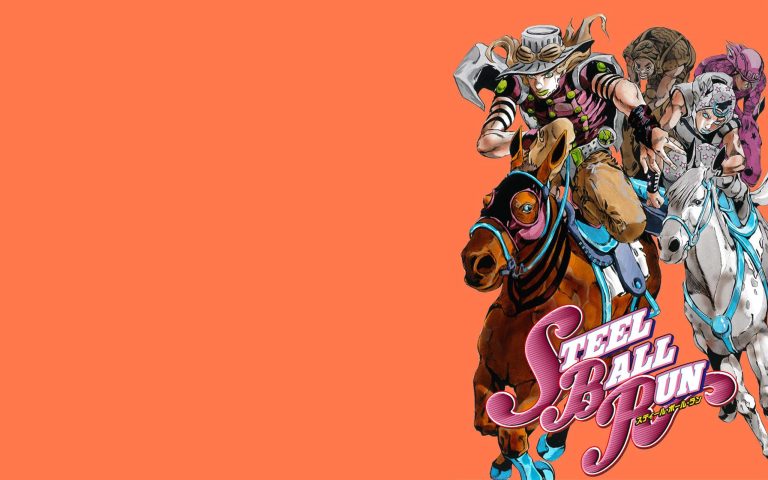
Ever since the cosmic, string-spun crescendo of Stone Ocean collapsed the original timeline in David Production’s 2022 adaptation, the global anime ecosystem has lived under the shadow of a single, inescapable question: When does the race begin? For two decades, Hirohiko Araki’s JoJo’s Bizarre Adventure: Steel Ball Run has occupied an almost mythical stratum within pop culture. Consistently hovering near the apex of MyAnimeList’s top-rated manga of all time—often trading blows with the late Kentaro Miura’s Berserk—the series represents both the zenith of Araki’s creative genius and the ultimate trial by fire for any studio audacious enough to touch it.
The buzz surrounding a potential Steel Ball Run anime is no longer a matter of idle Reddit fan-casting; it is an industry-wide event waiting for a green light. Adapting Part 7 is not merely about picking up the next chronological franchise installment. It demands translating an unapologetically gritty, philosophically dense, horse-drawn American odyssey that entirely rewrites the JoJo mythos. For David Production, it stands as the ultimate frontier—a high-stakes convergence of staggering visual ambition, shifting demographics, and logistical nightmares.
The Trans-American Odyssey: Araki’s Reinvented Frontier
To understand the ravenous hunger for a Steel Ball Run adaptation, one must appreciate the radical reinvention that birthed it. Serialized initially in Weekly Shonen Jump before migrating to the monthly, mature pastures of Ultra Jump in 2005, Part 7 freed Hirohiko Araki from the blistering sprint of juvenile serialization. The transition was seismic. With 40 to 50 pages per chapter and an older demographic to entertain, Araki stripped away the traditional “Monster of the Week” formula in favor of a sprawling, 6,000-kilometer cross-country endurance race across an alternate 1890s America.
The premise is intoxicating in its audacity: eccentrics, outlaws, and supernatural savants compete for a staggering fifty-million-dollar purse, galloping from San Diego Beach to New York City. Yet, beneath the dust of the frontier lies a Machiavellian conspiracy engineered by the chillingly patriotic 23rd President of the United States, Funny Valentine. The race is a front—a geopolitical excavation mission designed to assemble the mummified pieces of the miraculous “Saint’s Corpse.” By weaving late-19th-century Americana, pulp historical fiction, and supernatural theological horror, Araki created a masterwork that transcends standard battle shonen conventions, presenting David Production with an adult, prestige drama masquerading as an action manga.
Johnny Joestar and Gyro Zeppeli: The Alchemy of Dual Protagonism
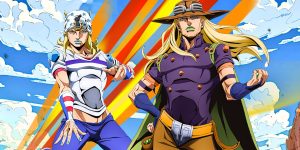
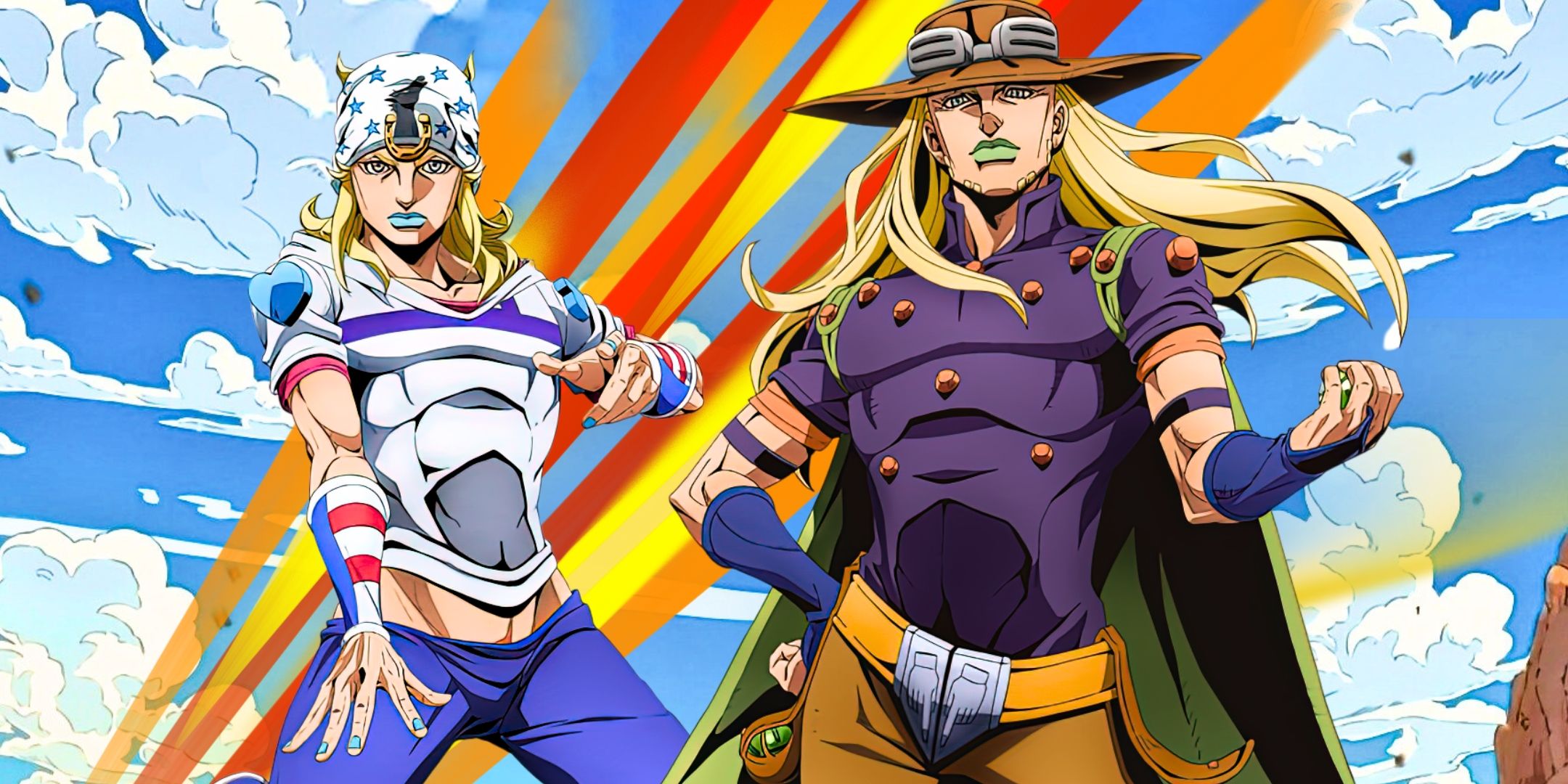
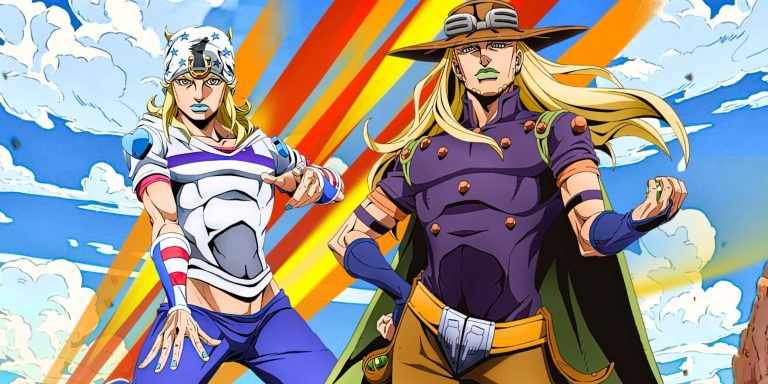
At the beating heart of Steel Ball Run is what many consider the single greatest character dynamic in modern sequential art: Johnny Joestar and Gyro Zeppeli. Unlike the immediate moral fortitude of Jonathan Joestar or the unshakable cool of Jotaro Kujo, Johnny represents a profound subversion of the JoJo lineage. A former horse-racing prodigy whose vanity, arrogance, and subsequent spinal gunshot wound left him paralyzed from the waist down, Johnny is not a hero seeking to save the world. He is a broken, cynical outcast seeking self-reclamation.
From Negative to Zero: Johnny’s Dark Determination
Johnny’s quest is fundamentally existential. As he famously laments, he does not care about reaching “positive”—he simply wants to climb out of the negative and get back to zero. This leads to what Araki visualizes as Johnny’s “dark determination”—a pitch-black, flame-like gaze signifying his willingness to slaughter anyone who impedes his path to recovery. Adapting this requires immense emotional range; Johnny is frequently unlikable, vindictive, and desperate, yet his vulnerability makes his gradual spiritual resurrection utterly breathtaking.
The Executioner’s Song: Gyro as Master and Foil
Balancing Johnny’s brooding gravity is Gyro Zeppeli, a disgraced Neapolitan executioner who enters the race to win royal amnesty for an innocent child condemned to death. Flamboyant, absurdly theatrical, and armed with golden grillz that spell out “GO! GO! ZEPPELI,” Gyro provides infectious comedic levity. Yet, behind his nonsensical ditties about cheese lies an intricate ethos of aristocratic duty, surgical precision, and crushing guilt. The relationship between Johnny and Gyro shifts seamlessly from mentor and student to co-dependent brothers-in-arms. Their campfire banter, philosophizing on the human condition while brewing coffee in the desert, offers David Production an opportunity to produce some of the most intimate, character-driven storytelling the anime medium has seen in years.
The Mechanics of the Golden Spin: Elevating the Power System
While Stands naturally return in Steel Ball Run, Araki fundamentally overhauled his combat language by introducing The Spin—a mystical martial art rooted in anatomical mastery and sacred geometry. Distinct from Part 1 and 2’s sunlight-fueled Hamon, the Spin utilizes the Fibonacci sequence and the Golden Ratio (1:1.618…) to create infinite rotational energy through spherical projectiles.
The visual and kinetic implications for an anime adaptation are intoxicating. Gyro’s spinning steel balls warp flesh, redirect kinetic shockwaves, and alter surrounding environments via pure biomechanical physics. Meanwhile, Johnny’s Stand, Tusk, maps directly onto his psychological and physical maturation. Beginning as a pathetic, nail-spinning fairy in ACT 1, Tusk gradually ascends through four distinct evolutions as Johnny masters the geometry of horseback riding, ultimately transforming into ACT 4—a colossal, interdimensional engine of perpetual energy capable of breaching the fabric of time and alternate universes. Animating these clashes requires more than flashy visual effects; it demands a kinetic understanding of spatial dimension, momentum, and mathematical aesthetics that could push David Production’s compositing team to its absolute limit.
The Equestrian Nightmare: David Production’s Technical Rubicon
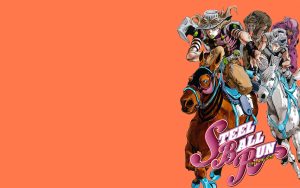
If the narrative potential of Steel Ball Run is limitless, its production feasibility is notoriously precarious. Inside anime production pipelines, horses are universally recognized as an animator’s graveyard. The complex quadruped anatomy, shifting muscle groups, galloping leg cycles, and perspective shifts make realistic, hand-drawn equine animation wildly expensive and agonizingly slow. In Steel Ball Run, the horses are not static background set pieces; they are primary characters that run, bleed, jump, and collapse across dozens of consecutive volumes.
David Production, legendary for their artisanal dedication to capturing Araki’s distinct color shifts, sound effects, and hyper-detailed cross-hatching, faces a structural crossroad:
- The Pure 2D Route: Glorious, but industrially suicidal without an unprecedented budget and an agonizingly prolonged multi-year production cycle.
- The Hybrid 3D CGI Approach: Integrating cel-shaded CGI horses alongside hand-drawn riders—similar to methodologies seen in MAPPA’s Attack on Titan or Wit Studio’s Vinland Saga.
The danger of the hybrid path lies in the dreaded “uncanny valley.” If Johnny and Gyro appear flatly pasted onto synthetic, floaty, computer-generated stallions, the grounded grit of the American frontier evaporates. Insiders speculate that David Production’s recent projects, along with advancements in modern rendering engines, are quiet testing grounds for developing a pipeline capable of blending dynamic 3D rigs with heavy, ink-textured post-processing. Taming this technical beast is almost certainly the primary reason why the race has not yet officially commenced.
A Paradigm Shift Awaiting the Starting Gun
The enduring buzz surrounding JoJo’s Bizarre Adventure: Steel Ball Run is not standard franchise momentum—it is a collective cultural reverence for Hirohiko Araki’s absolute peak. Part 7 is a tragedy, a triumph, a spaghetti western, and a grand philosophical discourse on human frailty and destiny, all wrapped in a high-octane race across 19th-century America. It demands world-class sound design, breathtaking landscape compositing, fearless vocal performances, and animation choreography that honors its iconic panels.
Whenever David Production finally releases that fateful teaser—whether it opens with the dust clouds rising above San Diego or the simple click of a steel ball spinning between Gyro’s fingers—it will signal an unprecedented new era for the JoJo legacy. Until then, the hype will continue to mount, circulating like the Golden Ratio itself: infinite, unbreakable, and gathering momentum with every passing day.
What are your biggest hopes and fears for the Steel Ball Run anime? Do you think David Production can pull off the horses with hybrid CGI, or should they take a multi-year hiatus to animate it in pure 2D? Sound off in the comments below!

One thought on “JoJo’s Bizarre Adventure: Steel Ball Run Anime Buzz: Johnny Joestar, Gyro Zeppeli, and David Production’s Next Frontier”