

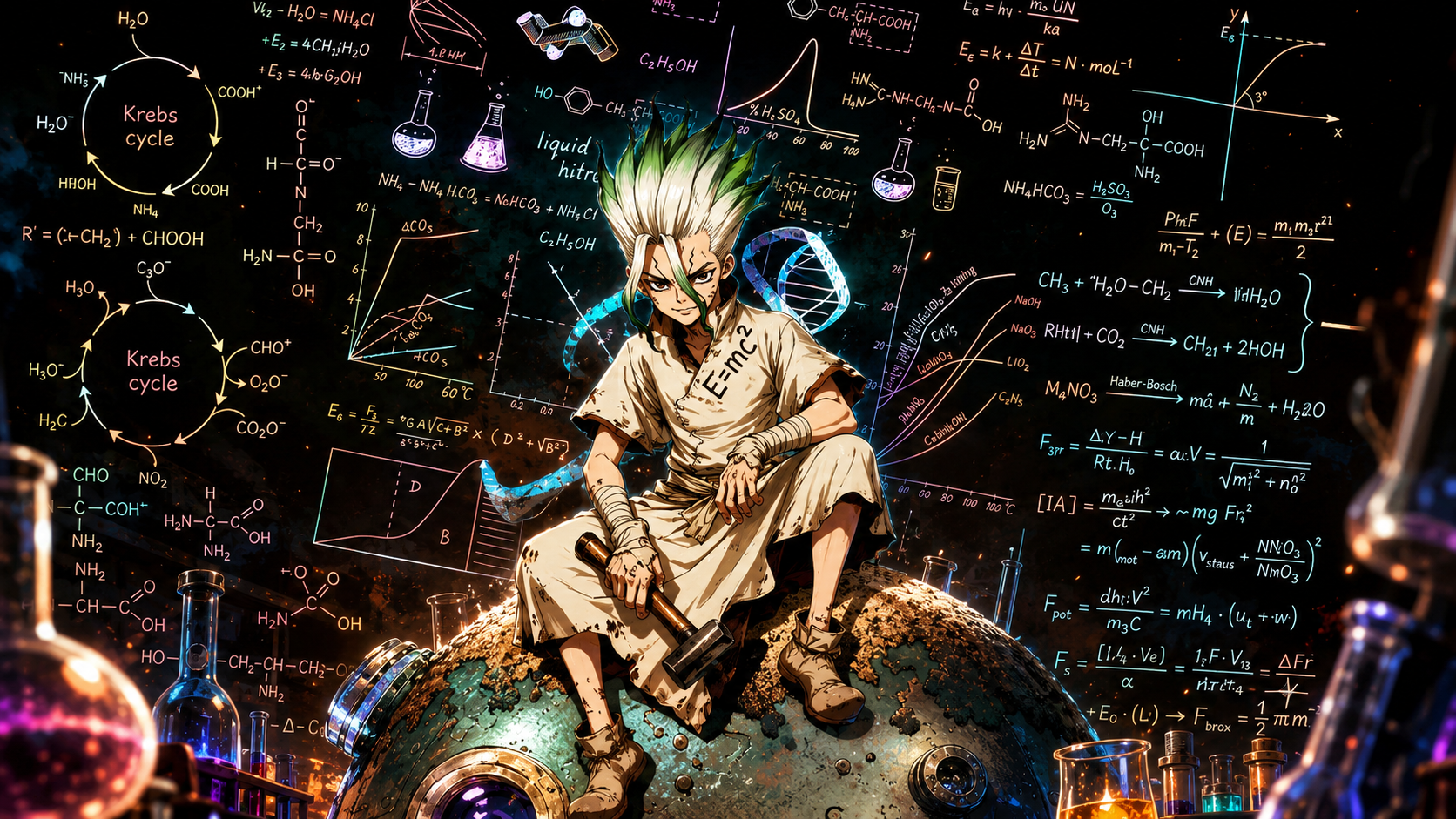
When Senku Ishigami first woke up in a vine-choked post-apocalyptic wilderness 3,700 years after a blinding green flash petrified humanity, his immediate objective was painfully modest: synthesize nitric acid, ignite fire without matches, and survive the winter. Fast forward through four seasons of tactical industrialization, and Dr. STONE is preparing for its most audacious flex yet. The announced fourth and final season, officially subtitled Dr. STONE Science Future, leaves behind the pastoral battlegrounds of mainland Japan and the piratical high seas of treasure hunts. Its ultimate destination? The stark, airless regolith of the Moon, where humanity’s petrifiers have been waiting in terrifying silence.
For an anime that carved out its identity as Shonen Jump’s premier love letter to empirical science, Science Future marks an existential elevation. It transforms an inventive survival comedy into a full-scale aerospace odyssey. At the center of this cosmic sprint sits an inevitable confrontation with the series’ grand enigma: the synthesized voice known only as “Why-Man.” As studio TMS Entertainment ramps up production for this multi-cour conclusion, the stakes have escalated from rebuilding society to justifying the very existence of the human species.
The Blueprint of Humanity: From Stone Spears to Apollo Pedigree
The structural genius of Riichiro Inagaki’s writing has always been its exponential acceleration. What started as pottery and hand-cranked generators systematically compounded into cell phones, steam engines, and transoceanic sailing vessels. Now, the Kingdom of Science faces the absolute zenith of human engineering: chemical rocketry, precision telemetry, and life support systems built from absolute scratch.
Industrial Escalation: The Logistics of a Stone-Age Space Program
To reach the Moon, Senku and his ever-expanding collective cannot simply forge a chassis and ignite solid fuel; they must build the modern world in microcosm. The narrative machinery of Science Future necessitates an aggressive global resource expedition. We are no longer watching isolated forest skirmishes; this is a story of globalized supply chains. Constructing a viable lunar module and the massive staging rocket requires hundreds of thousands of tons of refined steel, rare-earth metals, supercomputers, and liquid propulsion components.
This industrialization curve carries a profound narrative weight. In an anime landscape often dominated by sudden power-ups, chosen-one destinies, and metaphysical awakenings, Dr. STONE continues to champion the slow, unglamorous power of collective labor. Senku doesn’t leap into the cosmos because he is supernatural; he reaches orbit because centuries of dead scientists left a trail of breadcrumbs, which his coalition follows with unyielding discipline.
The Enigma of Why-Man: Existential Dread Behind the Static
Ever since the crew of the Perseus first picked up that chilling, mechanized Morse code signal on their crude radio transceiver—repeating the word “WHY” in an unrelenting cadence—Why-Man has hung over the series like an algorithmic guillotine. The horror reached its absolute zenith when the entity hijacked radio frequencies using Senku’s exact synthesized voice, attempting to trigger the Earth-wide petrification perimeter via remote command.
A Voice in the Darkness: The Evolution of an Unseen Antagonist
Why-Man is one of modern anime’s most compelling narrative anomalies. The entity does not act out of bloodlust, territorial conquest, or classic megalomania. The petrification beam, horrific as its consequences were, preserved the human race in immaculate stasis rather than vaporizing it. The central ideological clash between Senku and Why-Man is not simply a contest of firepower; it is an interrogation of philosophies.
Is the petrification a weapon, a curse, or a perverse offer of immortality? Senku’s worldview relies entirely on the premise that life requires movement, friction, struggle, and discovery. To freeze humanity in eternal stone to save them from their own mortality is, in the eyes of the Kingdom of Science, the ultimate form of death. When the lander finally touches down on the lunar surface, the confrontation will not be settled purely by who strikes first, but by who presents the superior argument for what consciousness is meant to achieve.
Psychological Crucible: Who Boards the Rocket?
The technical hurdles of rocketry are matched only by the emotional toll of the crew selection. Space travel in the real world is a grueling, perilous venture; in a resurrected Stone World with single-use tolerances and zero safety margins, a lunar launch is borderline suicidal. The narrative pivots on a deeply dramatic axis: who takes the seats aboard the spacecraft?
The Lunar Vanguard: The Burden of the Chosen Three
The mission architecture demands an irreducible minimum of roles: the pilot with supernatural spatial awareness, the fighter capable of neutralizing physical threats on the lunar surface, and the scientific mind capable of troubleshooting unforeseen anomalies in real-time. The interplay between Senku, the swashbuckling aviation mogul Ryusui Nanami, the lethal primitivity of Tsukasa Shishio, and the razor-sharp instincts of Kohaku creates a high-wire psychological dynamic.
Moreover, the journey to space is deeply generational. For Senku, passing through the stratosphere is not merely a strategic maneuver; it is a sacred pilgrimage. It closes the loop on the heartbreaking legacy of his adoptive father, Byakuya Ishigami, who watched Earth turn to stone from the cupola of the International Space Station thousands of years prior. Byakuya left behind the platinum, the records, and the foundational seeds of the Kingdom of Science. Senku returning humanity to the void Byakuya occupied is the series’ most profoundly moving emotional throughline.
TMS Entertainment’s Monumental Task: Animating the Infinite Void
Adapting the final chapters of Boichi’s breathtaking manga art requires TMS Entertainment to shift its visual vernacular entirely. Boichi’s hyper-detailed, muscular character designs and sweeping architectural double-page spreads were monumental on paper; translating that kinetic density into fluid, dynamic television animation across multiple cours is a titanic undertaking.
The visual contrast will be stark. Dr. STONE has historically flourished in vibrant Earth tones: lush emerald canopies, rustic earthen furnaces, and brilliant azure ocean vistas. The Moon sequence, by contrast, demands absolute atmospheric austerity. TMS must master the terrifying, silent beauty of deep space—deep contrast ratios, stark directional lighting unfiltered by an atmosphere, and a sense of suffocating claustrophobia inside the landing module. If the production team pairs this isolation with an evocative, minimalist score that trades the franchise’s boisterous folk-rock brass for ambient, haunting electronica, Science Future could easily stand as the visual peak of the entire adaptation.
The Scientific Gospel: Why Dr. STONE’s Climax Matters
We live in an entertainment era heavily saturated by dark fantasy deconstructions and hyper-cynical multiverse narratives. In this environment, Dr. STONE has stood as a beacon of radiant, unapologetic optimism. It dares to suggest that humanity’s defining virtue is not our capacity for destruction, but our insatiable, collaborative drive to understand the laws of the universe and bend them toward survival.
As Science Future gears up to launch, it carries the weight of a franchise that never betrayed its core thesis. The battle against Why-Man is not about wielding cosmic super-weapons; it is about proving that two million years of human civilization, distilled into trial, error, mathematics, and raw grit, was worth fighting for. When Senku finally looks down at the blue marble from the lunar regolith, it won’t just be a victory for his kingdom—it will be a triumphant, ten-billion-percent catharsis for the human spirit.
Are you emotionally prepared for the final launch, or do you have your own wild theories about the true identity of Why-Man? Sound off in the comments below, and keep your transceivers tuned to Wibux.com for full episodic breakdowns and production updates!