

When the opening chords of “Jaka Jaan”—composed by Grammy-winning producer Zedd alongside Japanese duo C&K—erupted across television screens worldwide, a rare, collective shiver ran through the global anime community. The premiere of Dragon Ball Daima arrived under circumstances nobody could have predicted when Toei Animation first announced the project at New York Comic Con in late 2023. The untimely passing of franchise creator Akira Toriyama in March 2024 transformed what was already an ambitious 40th-anniversary celebration into something profoundly sacred: Toriyama’s definitive swansong, his final comprehensive gift to the medium he revolutionized.
Far from a cynical corporate extension or a retread of familiar ground, Dragon Ball Daima’s premiere episode establishes itself immediately as an auteur-driven triumph. By thrusting Son Goku, the Z-Fighters, and the broader cosmological hierarchy into an uncharted, fairy-tale-tinged abyss known as the Demon Realm (Makai), the series delivers an exhilarating return to Toriyama’s foundational loves: mechanical whimsy, tactile martial arts, sharp comedic timing, and an irrepressible sense of boyish adventure.
The Makai Unveiled: Decoding Toriyama’s Expanded Cosmology
For decades, the Demon Realm existed as a tantalizing footnote in official Dragon Ball lore. Originating tangentially with characters like the Demon King Piccolo and later expanded with Dabra in the Majin Buu saga, the inner workings of the Makai were largely left to non-canon video games like Dragon Ball Heroes and Xenoverse. Daima rectifies this with characteristic Toriyama ingenuity, using its premiere to formally codify the dark underbelly of the universe into primary canon.
The premiere’s opening act serves as a masterclass in retrospective narrative stitching. We are introduced to King Gomah, the newly elevated sovereign of the Demon Realm, alongside his scheming supreme aide Degesu (the estranged brother of Shin, Universe 7’s Supreme Kai) and the eccentric scientist Dr. Arinsu. Gomah’s reaction to the defeat of Babidi and Dabra at the hands of the Earthlings highlights a brilliant inversion of stakes: the Z-Fighters are not reacting to an invasion; their past victories have inadvertently destabilized an entire interdimensional empire.
A Direct Bridge to Dragon Ball’s Mythological Roots
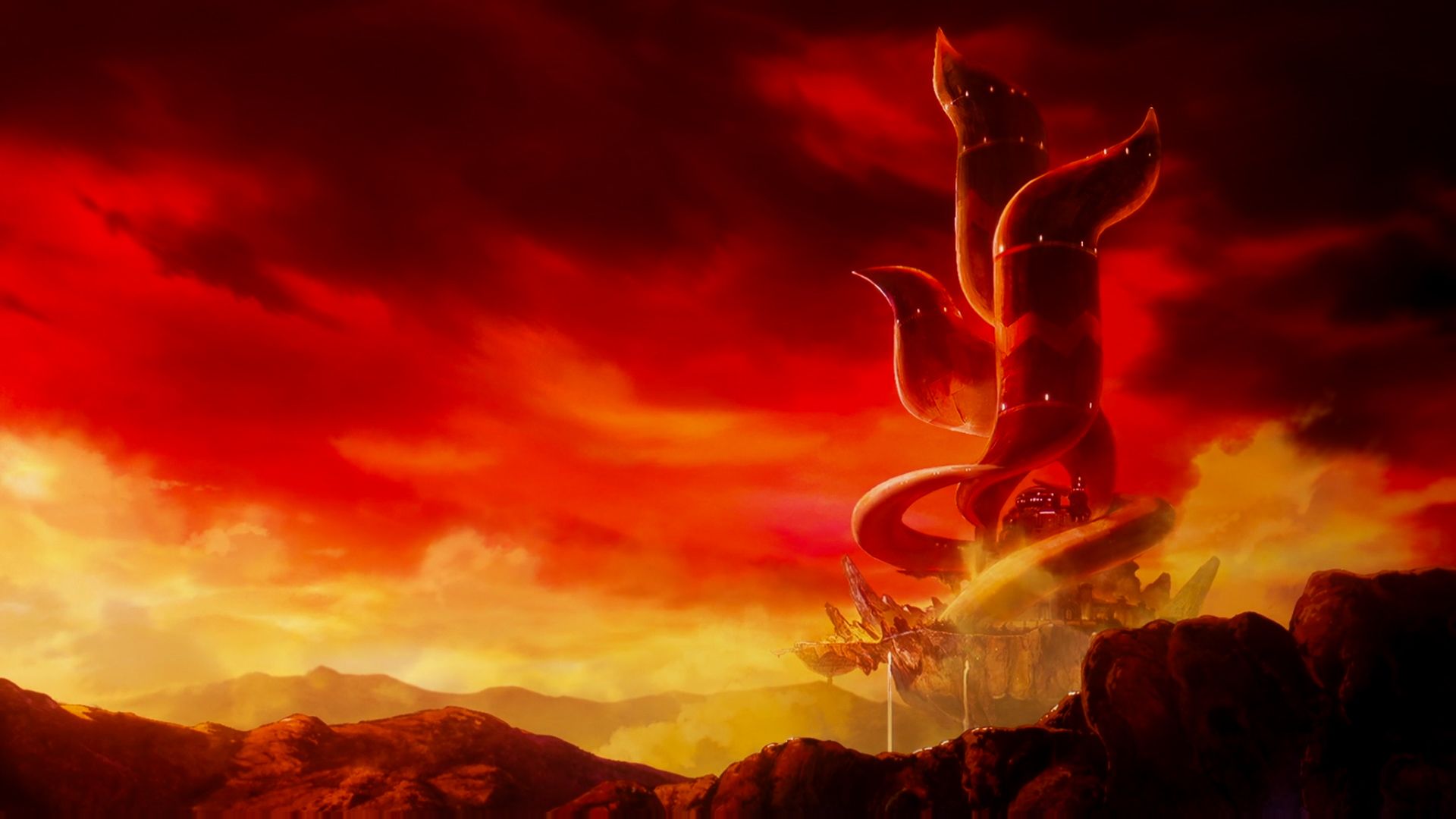
Toriyama’s narrative choices in this premiere do not merely add trivia to the wiki; they deliberately re-anchor the franchise in folklore. The Demon Realm does not look like a grim, industrial hellscape. Instead, it is an imaginative, vibrant wonderland characterized by gas-lit villages, fantastical ecology, and idiosyncratic technology. Gomah’s viewing of the Majin Buu conflict through archaic, CRT-style surveillance monitors is quintessential Toriyama—blending high-concept fantasy with an antiquated retro-futuristic aesthetic. It reinforces that the cosmos is vast, unpredictable, and entirely unconcerned with power levels.
The “Mini” Phenomenon: Why Daima is Not GT 2.0
When promotional materials first revealed Goku and his allies shrunk to child-sized proportions, skeptical corners of the fandom immediately cried out that Daima was nothing more than an upscale remake of 1996’s divisive Dragon Ball GT. The premiere obliterates this misconception in both premise and execution. Where GT isolated an aged Goku, Trunks, and Pan on an episodic galaxy tour, Daima embraces the full ensemble cast, transforming their regression into a thematic and comedic vehicle.
Gomah’s wish via Earth’s Dragon Balls to turn the Z-Fighters into children (“Mini”) stems from genuine terror rather than spiteful hubris. Having witnessed the terror of Super Saiyan 3, Gomah reasons that reducing the warriors to prepubescent forms will neutralize their combat efficacy. What he fails to understand—and what the premiere wonderfully articulates through character behavior—is the psychology of Son Goku.
Stripped of his towering frame, Goku does not despair or rage; his eyes light up with unvarnished delight. His decision to unearth the long-dormant Nyoibo (the Power Pole) is a symbolic reclamation of his roots. For years, critics of Dragon Ball Super pointed out that escalating divine transformations—Super Saiyan God, Blue, and Ultra Instinct—divorced the series from its kinetic, ground-level martial arts philosophy. By shrinking Goku and re-arming him with his classic red staff, Daima re-levels the playing field. The battle sequences are no longer governed by blinding planet-busting beam struggles; they are once again contests of leverage, balance, reach, and pure kinetic cunning.
Production Pedigree: Toei Animation’s Kinetic Love Letter
Visually, the premiere of Dragon Ball Daima stands shoulder-to-shoulder with the cinematic benchmark set by Dragon Ball Super: Broly. Directed by veteran visionary Yoshitaka Yashima alongside Aya Komaki (celebrated for her sublime, emotionally charged work on One Piece‘s Wano Country arc), the episode exhibits a degree of visual polish rarely seen in weekly television broadcasts.
The legendary Katsuyoshi Nakatsuru—whose connection to Toriyama’s aesthetic spans all the way back to the original 1986 anime run—serves as character designer and chief animation supervisor. Nakatsuru’s touch is evident in every frame: thick, expressive line art, nuanced anatomical weight, and an organic fluidity that shuns overly sterile digital compositing. The introductory recap of the Buu Saga battle renders classic scenes with modern, prestige-tier sakuga, delivering explosive hand-to-hand choreography that feels tactile, weighty, and refreshingly punchy.
Lighting choices throughout the premiere lean heavily into soft, storybook tones, mirroring Toriyama’s watercolor illustrations from the Daizenshuu art books. The animators understand that Daima is a fairy tale disguised as a shonen epic, treating character movement with expressive slapstick and sudden, terrifying bursts of speed.
Thematic Resonance: A Joyful Farewell from a Manga Titan
It is impossible to watch the premiere without acknowledging the immense emotional subtext woven into its production. Toriyama was deeply involved in Daima, contributing original concepts, detailed vehicle and character designs, and an unusually dense script outline. While later installments of modern franchise revivals frequently diluted his direct input through tiers of committee production, Daima smells, tastes, and breathes Toriyama’s unfiltered voice.
The episode’s humor carries that warm, subversive levity that made the early volumes of Dragon Ball and Dr. Slump global sensations. Characters argue over mundane formalities while world-ending deities sit awkwardly sipping tea. There is no cynicism here, no pandering to cynical “darker and edgier” modern tropes. It is an unapologetic testament to what Toriyama believed Dragon Ball fundamentally was: an unpredictable road trip driven by curiosity, good food, and the thrill of meeting strong people.
By framing the 40th anniversary around an adventurous descent into the unknown rather than a simple tournament of power, Toriyama’s final project invites audiences to stop obsessing over power scales and start marveling at worlds once more.
Final Verdict: A Triumphant, Bittersweet Legacy
The premiere of Dragon Ball Daima succeeds on every level it targets. It honors the vast historical tapestry of the franchise, introduces compelling, distinct antagonists whose motives stem directly from the canon’s most beloved arc, and revitalizes the visual language of the anime with peerless production values. More than anything, it serves as a triumphant monument to Akira Toriyama’s immortal artistic genius—a reminder that his storytelling was never just about screaming louder or transforming further, but about looking past the horizon with an open heart and a ready fist.
What were your favorite moments from the premiere of Dragon Ball Daima? How do you think Gomah’s conspiracy compares to previous villains, and are you excited to see Goku wield the Power Pole again? Sound off in the comments below, and keep it locked to Wibux.com for weekly episodic breakdowns and deep-dive lore analysis!