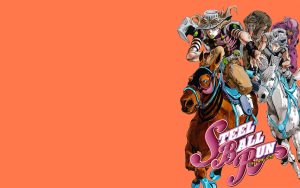
Ever since the melancholic, universe-resetting final chords of JoJo’s Bizarre Adventure: Stone Ocean faded into the ether in late 2022, a persistent, electric hum has reverberated through the anime ecosystem. It is not merely the usual post-season clamor for a sequel; it is an almost religious vigil. For over a decade, manga purists, casual viewers, and industry observers have looked toward the horizon with equal parts exhilaration and existential dread, waiting for three words that signify a monumental cultural undertaking: Steel Ball Run.
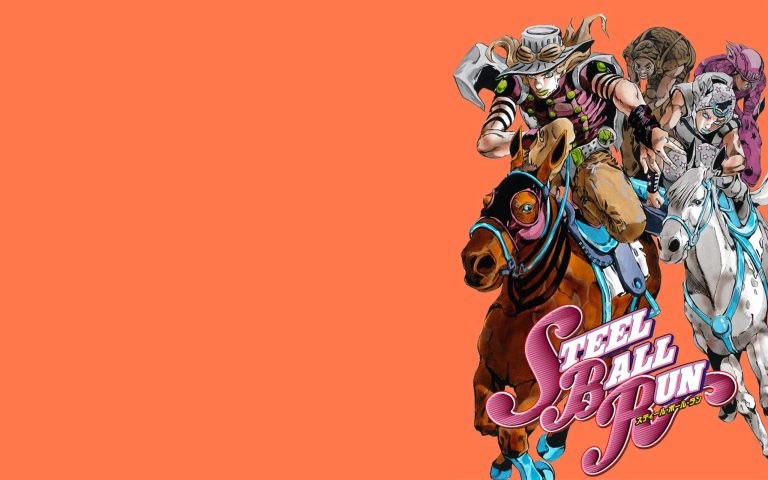
Currently standing firmly as one of the highest-rated manga of all time on MyAnimeList, Hirohiko Araki’s seventh installment isn’t just another sequential step in an iconic franchise. It is an inflection point—a staggering, 1890s cross-country trans-American equestrian race that re-engineered Araki’s creative identity and set an impossible benchmark for visual storytelling. But as anticipation reaches a fever pitch regarding David Production’s next move, the reality sets in: adapting Part 7 is the ultimate trial by fire for modern anime production.
A Seinen Rebirth: Leaving the Shonen Shackles Behind
To understand the immense buzz surrounding Steel Ball Run, one must understand its tumultuous, brilliant genesis. When serialized in 2004, the story began in Weekly Shonen Jump simply as Steel Ball Run, stripped of the classic JoJo moniker in early branding to allow Araki the creative leeway of an alternate-universe reboot. However, the true metamorphosis occurred in 2005 when the series migrated to Shueisha’s monthly Ultra Jump.
That editorial shift unshackled Araki from the punishing deadlines of weekly serialization, granting him the canvas required to evolve from an idiosyncratic pop artist into a master of psychological realism and intricate drafting. Freed from the editorial constraints of teenage shonen demographics, Araki steeped his Western odyssey in grit, historical verisimilitude, existential philosophy, and unapologetic visceral violence. The 6,000-kilometer equestrian race from the Pacific shores of San Diego to the concrete spires of New York became more than an athletic showcase—it became an allegory for human fallibility, divine providence, and personal redemption.
The Dynamic of Desperation: Johnny Joestar and Gyro Zeppeli
Subverting the Joestar Paradigm
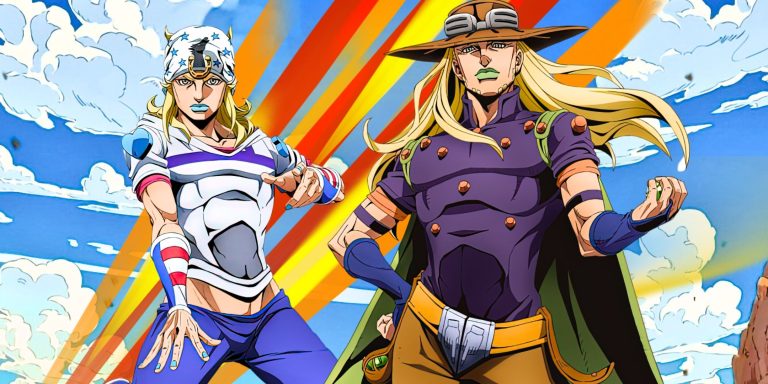
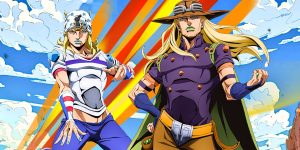
At the center of this dust-swept epic is an emotional architecture unlike anything Araki previously constructed. In Johnny Joestar, we do not get the stoic nobility of Jonathan, the trickster bravado of Joseph, or the cool invulnerability of Jotaro. Johnny is a disgraced, paraplegic former horse-racing prodigy whose arrogance cost him his mobility, his family, and his self-worth. Driven not by righteous justice, but by an obsessive, deeply human hunger to regain the sensation of his legs, Johnny operates with what Gyro Zeppeli calls “dark determination”—a cold, unflinching willingness to kill or sacrifice anything to cross his personal zero-point.
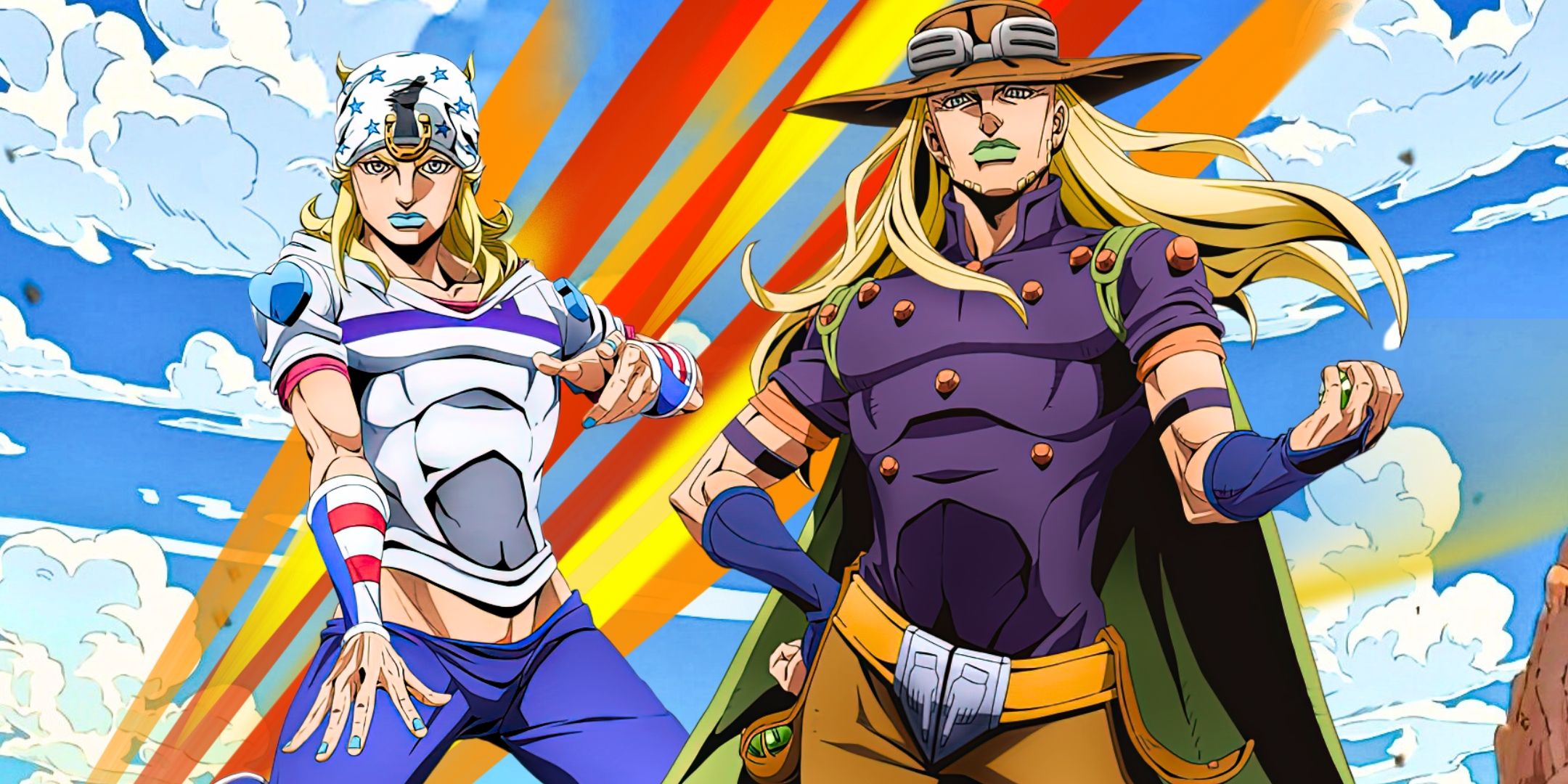
Juxtaposed against Johnny’s brooding desperation is Gyro Zeppeli, arguably the most charismatic deuteragonist ever inked into manga history. Ostensibly an eccentric, grill-toothed Neapolitan executioner who cracks absurd jokes about pizza mozzarella, Gyro harbors a devastating moral burden: competing in the brutal race to win royal amnesty for an innocent child condemned to die on the guillotine. Their chemistry transforms Steel Ball Run from a spectacle of superpowered encounters into a profound character study of brotherhood, mentor-student codependency, and trauma processing.
The Physics of the Golden Spin
Where previous parts relied on Sun-energy breathing (Hamon) or spiritual avatars (Stands), Steel Ball Run introduces the Spin—a mystical martial art based on the Fibonacci sequence and the mathematical perfection of the Golden Ratio. By imbuing steel spheres with rotational kinetic energy, Gyro manipulates anatomy, spatial geometry, and sound.
As Johnny learns to apply this art through his nail-firing Stand, Tusk, the power scaling takes on a grounded, almost scientific weight before transcending into dimensional warfare. For David Production, rendering the visual physics of the Spin—with its invisible gravitational fields, acoustic distortion, and morphing geometry—represents an intoxicating stylistic playground that could dwarf the psychedelic palettes of Diamond is Unbreakable and Golden Wind.
The Equestrian Nightmare: David Production’s Production Mountain
If the thematic depth of Steel Ball Run makes it a narrative triumph, its physical setting makes it an animator’s waking nightmare. Ask any veteran animator about the hardest subjects to render fluidly in 2D, and “quadrupeds running in perspective” sits uncomfortably near the top of the list. Now multiply that by dozens of horses charging through shifting terrain—arid deserts, torrential riverbeds, and dense blizzards—across twenty-four volumes of dense combat.
The 2D vs. 3D CG Compromise
David Production has built an untouchable pedigree over the last decade by respecting the textural integrity of Araki’s linework, famously utilizing kinetic typography and onomatopoeia to simulate the comic page. However, a purely hand-drawn 2D production of Steel Ball Run’s equestrian warfare would break nearly any studio in modern Tokyo. Rumors within the animation community constantly debate the studio’s technical strategy:
- Hybrid Integration: The most plausible route is utilizing highly stylized, cel-shaded 3D models for dynamic wide shots and background pack racing, smoothly transitioning to hand-drawn 2D for close-ups, physical skirmishes, and crucial Stand clashes.
- The Precedent: David Production demonstrated surprising proficiency with CGI modeling in Cells at Work! and historical battle sequences in other works, but horse locomotion demands a level of weight, muscle deformation, and biomechanical precision that leaves zero margin for uncanny-valley errors.
The protracted silence from Warner Bros. Japan and David Production is not a sign of indifference; it is evidence of pre-production engineering. Taming Araki’s wild horses requires an unprecedented pipeline investment, custom rigging, and perhaps collaboration with specialized CG studios to ensure the horses don’t pull viewers out of the period immersion.
Patriotism, Divinity, and the Corpse of Destiny
Beyond the logistical acrobatics and personal character arcs lies the overarching conflict that elevates Part 7 into political and metaphysical myth: the race for the Saint’s Corpse. The race itself is eventually unmasked as a smoke-and-mirrors campaign engineered by the 23rd President of the United States, Funny Valentine.
Valentine stands as one of the most intellectually compelling antagonists in contemporary fiction. He is not motivated by megalomania, crime, or sadism, but by a chilling, absolute patriotism. Armed with the interdimensional horrors of his Stand, Dirty Deeds Done Dirt Cheap (D4C), Valentine seeks the sacred relics to guarantee America’s eternal prosperity by shifting all misfortune onto the rest of the world. The clash between Johnny’s raw, selfish individualism and Valentine’s unyielding utilitarian collectivism forces viewers into a moral labyrinth where the line between “hero” and “villain” collapses under the weight of historical consequence.
The Verdict: An Inevitable Cultural Event
The hype surrounding the anime adaptation of Steel Ball Run is neither premature nor hyperbole. It is the natural culmination of a franchise that has continuously reinvented what serialized shonen and seinen can achieve. By shifting the paradigm from the claustrophobic corridors of Green Dolphin Street Prison to the vast, panoramic landscapes of a hyper-stylized American frontier, Hirohiko Araki created his absolute masterpiece.
When David Production finally drops that long-awaited teaser trailer—whether it begins with the deafening thunder of hooves across the sand or the clinking rotation of a single green steel ball—the anime sphere will witness a milestone event. Until then, fans must hold their breath, respect the gargantuan technical hurdle the animators face, and prepare their horses.
What do you think is the biggest hurdle for David Production in adapting Part 7: the horse animation, or faithfully translating the complex dimensional mechanics of D4C? Sound off in the comments below!