Ever since the bittersweet, universe-collapsing final chords of Stone Ocean faded in late 2022, the collective anime zeitgeist has been caught in a state of suspended animation. For over a decade, David Production accomplished what many once considered impossible: transforming Hirohiko Araki’s labyrinthine, high-fashion, hyper-stylized manga into a generational anime empire. Yet, every milestone—from Jonathan Joestar’s gentlemanly clash with Dio to Jolyne Cujoh’s defiant stand in Green Dolphin Street Prison—has felt like a prologue to a singular, undisputed holy grail. That grail is Steel Ball Run.
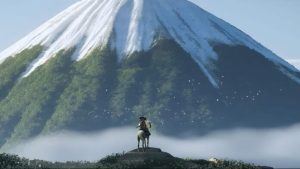
Widely regarded by critics and manga scholars as Araki’s magnum opus, Part 7 isn’t merely the next chapter in the JoJo lineage; it is an epochal reimagining. A complete structural reset set against the dust-choked expanse of late 19th-century America, Steel Ball Run bridges the kinetic bombast of supernatural battles with the introspective grit of a classical Western. But as the industry buzz surrounding a potential anime adaptation reaches a fever pitch, so too does an unavoidable tension: how does a studio adapt an equestrian epic that pushed the visual limits of the printed page without buckling under its own colossal ambition?
The Trans-American Odyssey: Araki’s Shift from Shonen to Seinen Mastery
To understand the near-mythic reverence surrounding Steel Ball Run, one must understand its publishing pedigree. When serialization began in Weekly Shonen Jump in 2004, it was initially framed simply as Steel Ball Run—a standalone period piece about a trans-continental horse race from San Diego to New York. However, when Araki migrated the series to the monthly seinen magazine Ultra Jump in 2005, the narrative shed the shackles of strict demographic censorship. The result was a dramatic metamorphosis.
Araki gained the narrative runway to dismantle the traditional hero archetypes he had spent two decades establishing. The race itself, masterminded by the eccentric promoter Steven Steel with a purse of 50 million dollars, serves as an unforgiving canvas where historical fiction collides head-on with supernatural horror. The American frontier isn’t romanticized; it is depicted as a sun-bleached, unforgiving graveyard where thirst, terrain, and rival cutthroats whittle down a massive roster of international competitors. The pacing pivoted from standard episodic Stand confrontations to an exhaustive, cross-country siege where every canyon and sand dune holds existential peril.
The Saint’s Corpse and the Subversion of Morality
What elevates Steel Ball Run far above typical sports-race narratives is the slow unveiling of its true, morbid MacGuffin: the fragmented, mummified relics of a divine figure known simply as the Saint. Across the American continent, these relics awaken latent Stands and bestow reality-warping miracles upon anyone who grafts them into their own flesh. By tying the pursuit of personal glory directly to the excavation of holy relics, Araki crafts a narrative where territorial conquest, religious fervor, and raw survival collide. The lines between piety, greed, and heroism are violently erased.
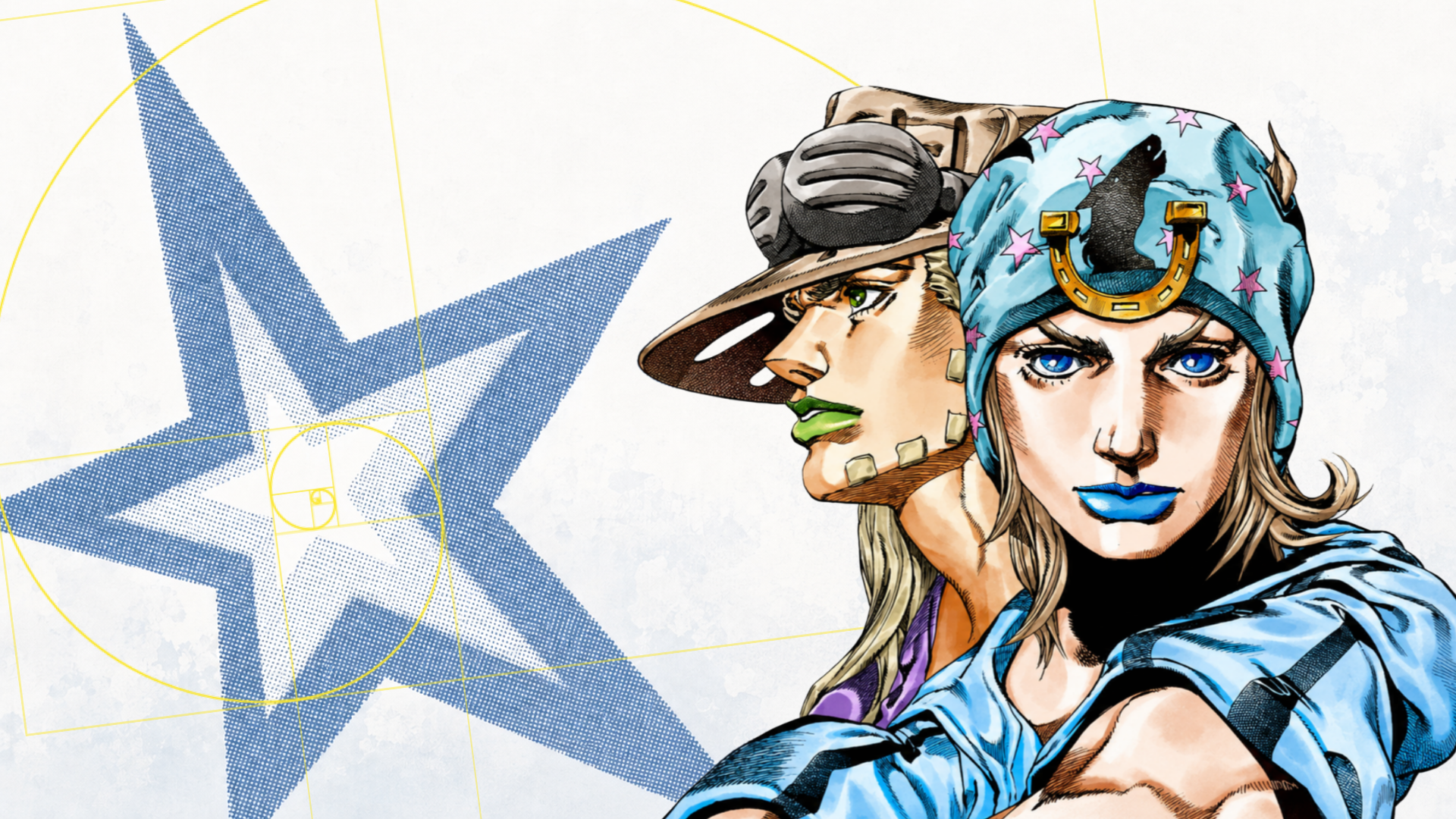
Paraplegia, Pride, and the Golden Ratio: Deconstructing Johnny and Gyro
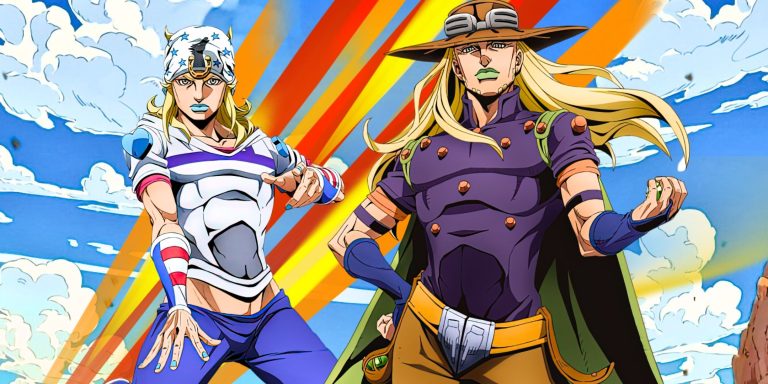
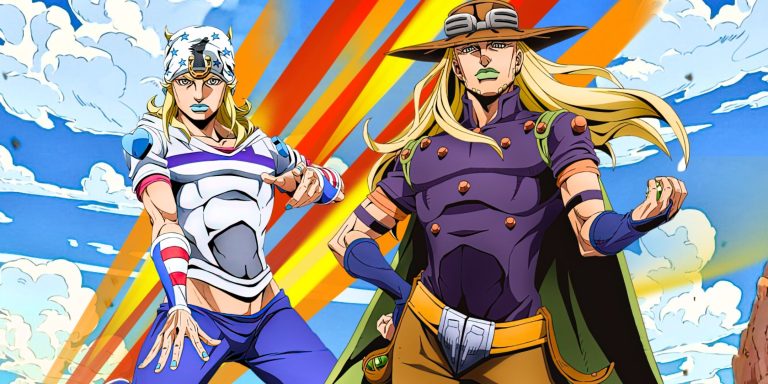
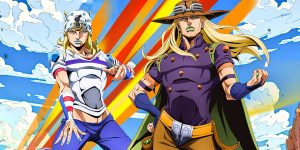
At the beating heart of this 6,000-kilometer odyssey lies the most complex, psychologically nuanced duo Araki has ever penned: Johnny Joestar and Gyro Zeppeli. Their partnership rejects the clean mentor-student and rival-turned-ally tropes that dominate the shonen landscape, opting instead for a co-dependent brotherhood forged in shared brokenness.
Johnny Joestar is explicitly not a virtuous hero. A former child-prodigy jockey whose life shattered after an act of reckless arrogance left him paralyzed from the waist down, Johnny begins his journey steeped in resentment, self-pity, and unadulterated depression. His motivation is stripped of all nobility: he doesn’t join the race to save the world or protect his family. He enters because catching a fleeting glimpse of Gyro Zeppeli’s mysterious weapon caused his legs to twitch for a fraction of a second. Johnny is defined by what Araki calls his “dark determination”—a terrifying, pitch-black resolve willing to sacrifice morality, allies, and his own soul to claw his way out of spiritual and physical rock bottom.
Balancing Johnny’s brooding desperation is Gyro Zeppeli, a disgraced executioner from the Kingdom of Naples whose boisterous humor, gold-plated grill, and operatic eccentricity belie a crushing moral crisis. Gyro enters the race to win royal amnesty for an innocent child condemned to death by the state’s archaic legal system. Yet Gyro is also bound by ancestral duty, carrying the ancient art of the Spin.
The Mechanics of the Spin: Beyond the Stand Paradigm
While Stands (such as Johnny’s evolving Tusk) remain present, Steel Ball Run completely revitalizes the franchise’s combat systems through the introduction of the Spin. Grounded in the mathematical purity of the Golden Ratio and the Fibonacci sequence, the Spin is a physics-based discipline that harnesses centrifugal force via specially weighted steel balls to manipulate flesh, track trajectories, and distort space itself. It represents a spiritual successor to the organic, breathing-based martial art of Hamon, yet it is far more cerebral. For an anime adaptation, visualizing the mathematical wireframes, invisible atmospheric distortions, and rotational velocity inherent to the Spin presents a dazzling choreographic frontier that could redefine how kinetic power is visualized in contemporary anime.
The Equestrian Hurdle: David Production’s Greatest Technical Crucible
If the thematic weight of Part 7 is enticing, its production logistics are genuinely terrifying. Within the Japanese animation industry, there is an infamous, long-whispered reality: horses are an animator’s nightmare. Quadrupedal locomotion requires an extraordinarily complex manipulation of skeletal anatomy, muscular tension, weight distribution, and flowing manes. Multiplying this challenge by dozens of galloping steeds traversing varied terrain across dynamic, low-angle tracking shots makes Steel Ball Run arguably the most labor-intensive project David Production could ever undertake.
Rumors and studio insider discussions have long circulated regarding how David Production will navigate this artistic minefield. Pure hand-drawn 2D animation for sustained cavalry warfare is practically unsustainable given modern seasonal production schedules. Conversely, heavy-handed 3D CGI risks alienating a fan base accustomed to the hyper-detailed, tactile linework that defined the studio’s runs on Diamond is Unbreakable and Golden Wind.
The solution likely rests in an ambitious hybrid pipeline. By pairing advanced 3D rigging—similar to the seamless equestrian models utilized in historical dramas like Vinland Saga or Wit Studio’s high-octane Attack on Titan maneuvers—with David Production’s proprietary 2D visual shading, the studio can maintain mechanical accuracy without sacrificing Araki’s signature heavy inks, pop-art color shifts, and visceral facial contortions. Whatever the methodology, adapting Part 7 demands unprecedented technical investment and an expanded production timeline.
Funny Valentine and the Politics of Manifest Destiny
An adaptation of Steel Ball Run cannot be discussed without addressing its monolithic antagonist: the 23rd President of the United States, Funny Valentine. Unfolding decades before the phrase “American Exceptionalism” was fully codified, Valentine embodies the terrifying apex of utilitarian nationalism. Sporting an athletic physique scarred by military service, Valentine operates under a chillingly simple philosophical decree: the ends justify the means so long as the United States possesses the ultimate mandate over the global balance of power.
His Stand, Dirty Deeds Done Dirt Cheap (D4C), allows him to traverse parallel dimensions, swapping mortal wounds with alternate versions of himself and summoning infinite reinforcements from adjacent timelines. The battle between Johnny and Valentine is not a clash of good versus evil; it is a confrontation between raw personal selfishness and tyrannical, self-righteous collectivism. Valentine’s charismatic monologues—most notably his chilling thesis on “The First Napkin”—demand a vocal performance of immense, magnetic gravitas. How an anime portrays Valentine’s shifting visual forms and unbending patriotic fervor will dictate whether the series achieves its full narrative resonance.
The Verdict: An Inevitable Cultural Juggernaut
The road to a JoJo’s Bizarre Adventure: Steel Ball Run anime has been prolonged, but that silence is arguably a symptom of reverence rather than neglect. This is not a property that can be rushed through a standard seasonal pipeline; it is an epic that demands world-class production scheduling, cutting-edge hybrid technology, and uncompromising creative ambition. David Production holds the keys to what could easily be the defining anime masterpiece of the mid-2020s.
The race has not officially started, but the mounting dust on the American frontier is impossible to ignore. When Johnny and Gyro finally mount their horses and ride onto television screens, the landscape of modern anime will once again be forced to yield to Hirohiko Araki’s golden, untamed vision.
Are you holding out for hand-drawn horses, or do you trust David Production to nail a hybrid 3D approach? Who is your dream voice casting for Gyro Zeppeli and Funny Valentine? Drop your theories in the comments below!