
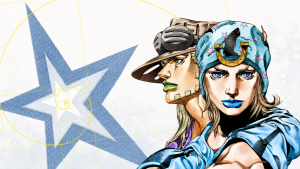


Ever since Emporio Alniño wept beneath a rain-slicked sky at the bittersweet conclusion of Stone Ocean, a collective, breathless vigil has gripped the global anime community. The reset of the original Joestar continuum didn’t merely close a thirty-year narrative arc; it unlocked the gates to Hirohiko Araki’s undisputed magnum opus: JoJo’s Bizarre Adventure: Steel Ball Run. Long regarded by manga connoisseurs as one of the finest serialized graphic narratives ever inked, Part 7 represents a transcendent leap in visual storytelling, philosophical depth, and sheer stylistic audacity. Yet, as whispers of David Production’s pre-production buzz grow louder across industry backchannels, the discourse has evolved from casual anticipation into an intense exploration of creative logistics, character psychology, and the technical boundaries of contemporary television animation.
The Reset Button: How Steel Ball Run Redefined Araki’s Mythos
To view Steel Ball Run merely as a sequel or a standard reboot is to misunderstand Araki’s artistic evolution. Serialized beginning in 2004, the series launched as an ambiguous period piece before shedding its structural camouflage to reveal its identity as the herald of an entirely reimagined universe. Transposed to 1890s America, the narrative tracks an apocalyptic, coast-to-coast equestrian race from San Diego to New York City, pitting eccentric outlaws, international savants, and covert agents against one another for a prize pool of fifty million dollars—and an occult secret woven into the very soil of the continent.
From Shonen Restrictions to Seinen Emancipation
The turning point for Part 7 occurred early in its run when the serialization transitioned from the frantic, youth-oriented pages of Weekly Sh&omacirc;nen Jump to the monthly pages of Ultra Jump. This structural pivot granted Araki larger canvas space, liberated release pacing, and unrestricted thematic freedom. Unburdened by traditional shonen editorial mandates, Araki embraced mature, unvarnished moral ambiguity. Bloodshed became visceral, backstories grew hauntingly intricate, and the romantic optimism of earlier JoJo generations gave way to a gritty, sun-baked American gothic atmosphere soaked in chiaroscuro lighting and spiritual decay.
Broken Prodigies and Golden Spirals: Johnny Joestar and Gyro Zeppeli
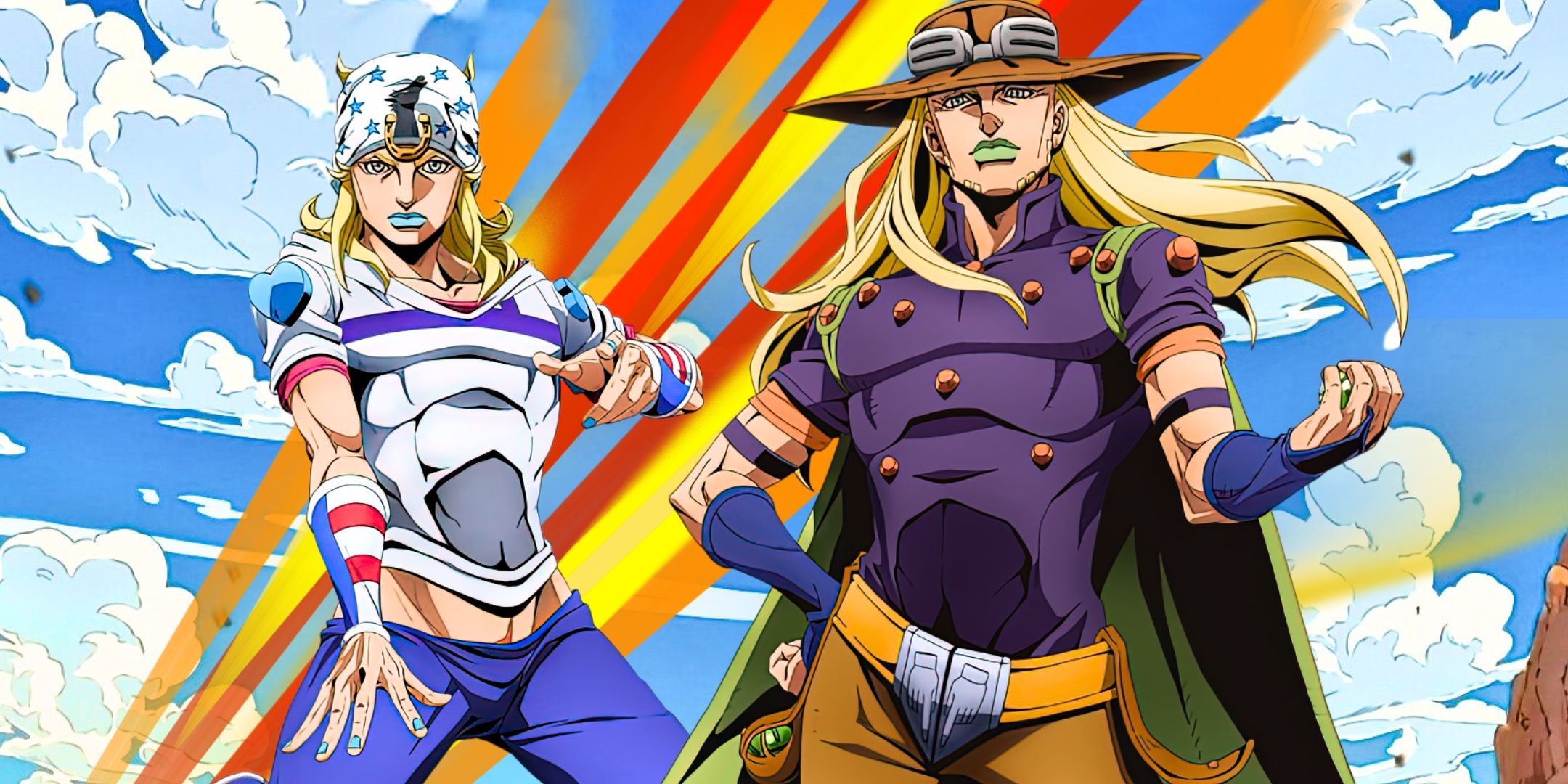
At the center of this sprawling, 6,000-kilometer odyssey lies anime’s most deeply realized dynamic duo: Johnny Joestar and Gyro Zeppeli. In subverting expectations, Araki bypassed the archetype of the virtuous, towering paladin. Johnny Joestar begins the journey not as an aspirational savior, but as a paralyzed, bitter former equestrian prodigy whose vanity cost him his family, his fame, and the use of his legs. Johnny is driven by what Araki explicitly characterizes as a “dark determination”—an unyielding, sometimes terrifying fixation on escaping his absolute bottom and transitioning from “negative back to zero.”
The Dynamic of Complicity: Gyro Zeppeli as Foil and Anchor
Balancing Johnny’s cold, desperate interiority is Gyro Zeppeli, a disgraced Neapolitan executioner adorned with etched gold teeth, an absurd sense of humor, and a heavy moral burden. Gyro is seeking to win the race not for personal aggrandizement, but to earn political amnesty for an innocent child condemned to die on his homeland’s gallows. Their relationship is neither effortless mentorship nor clean-cut fraternity; it is an agonizing, brotherly partnership forged through trauma, shared campfires, and bloody gunfights under the scorching sun of the Mojave Desert.
The Spin: Deconstructing Araki’s Most Elegant Magic System
While Stands naturally return with mind-bending complexity, Part 7 introduces The Spin (Kaiten)—a miraculous martial and physical art form rooted in the geometry of the Golden Ratio. Unlike the raw solar power of Hamon or the localized punch-ghost manifestations of Parts 3 through 6, The Spin is a metaphysical utilization of kinetic energy harnessed through steel spheres. The visual translation of this technique—manifesting in warped spatial dimensions, anatomical torsion, and the slow evolution of Johnny’s Stand, Tusk—demands an artistic fidelity that will push any production staff to its expressive limits.
The Horse in the Room: David Production’s Formidable Technical Hurdle
David Production has earned an infallible reputation for adapting the supposedly “unadaptable,” translating Araki’s garish color shifts, sound-effect kanji, and idiosyncratic fashion sensibilities with peerless panache. However, Steel Ball Run presents a logistical challenge that strikes terror into the hearts of digital and traditional animators alike: equestrian anatomy and persistent cavalry movement.
The 2D vs. 3DCG Dilemma
Horses are notoriously difficult to animate by hand. The complex biomechanics of a galloping steed, the undulating muscle structures, the shifting weight transfers, and the interaction of bridles, saddles, and shifting sand require hundreds of frames per sequence to avoid looking unnatural or wooden. Throughout anime history, production houses have notoriously stumbled over horse-heavy narratives, often retreating into uninspired, floaty 3DCG models that clash painfully against lush 2D backgrounds.
For David Production to preserve the breakneck kineticism of Araki’s line art across dozens of racers simultaneous in motion, the studio cannot rely solely on standard methods. The working theory circulating among animation directors suggests a high-end hybrid solution: deploying cell-shaded, heavily stylized 3D models with bespoke frame-rate limiting for complex wide-angle racing sequences, interspersed with intensely detailed, hand-drawn key frames for close-up skirmishes, Stand battles, and emotional character beats. To compromise on the cavalry sequences would be to compromise the very soul of the narrative.
The Looming Shadow of Funny Valentine and Manifest Destiny
Beyond the logistical hazards and character studies, an adaptation of Steel Ball Run must handle one of fiction’s most uniquely unsettling antagonists: President Funny Valentine. Armed with the multidimensional ability of his Stand, Dirty Deeds Done Dirt Cheap (D4C), Valentine is a masterclass in patriotic extremism. His quest to assemble the fragmented “Holy Corpse”—implied to be the physical remains of Jesus Christ scattered throughout the American continent—serves as a biting critique of American imperialism, exceptionalism, and utilitarian ethics.
Valentine does not act out of cartoonish sadism; he operates with absolute conviction that his actions will secure eternal prosperity for his nation at the direct expense of the rest of the world. This clash of worldviews elevates Part 7 from an eccentric Western into an epic socio-political deconstruction, giving any prospective voice cast and storyboard crew material of rare intellectual weight.
The Long Race Ahead: Why Part 7 is Worth the Wait
The anticipation surrounding the Steel Ball Run anime is not driven by fleeting internet hype; it is the culmination of more than thirty years of brand loyalty to an artistic vision that has consistently defied industry conventions. David Production knows the stakes. To rush Part 7 would be an act of cinematic vandalism; to conquer it would be to deliver a generational masterpiece that transcends anime subculture and redefines historical fantasy on screen.
The journey across Araki’s vast frontier promises to be exhausting, expensive, and technically perilous. Yet, as Johnny and Gyro demonstrate along every leg of their transcontinental pilgrimage, the pursuit of the impossible is the only path toward true revelation. The saddles are strapped, the golden spirals are spinning, and the starter’s pistol is waiting to fire.
What part of the Steel Ball Run manga are you most eager to see animated by David Production: the legendary ‘True Man’s World’ arc, or the terrifying reality-hopping mechanics of D4C? Sound off in the comments below, and stay tuned to Wibux.com for the latest anime breakdowns and production scoops.


One thought on “JoJo’s Bizarre Adventure: Steel Ball Run Anime Buzz: Johnny Joestar, Gyro Zeppeli, and David Production’s Next Frontier”