Ever since the cosmic reboot at the climax of Stone Ocean scattered the Joestar lineage into alternate timelines, a singular, deafening chant has echoed throughout every corner of the anime community: “Steel Ball Run when?” Hirohiko Araki’s seventh serialized entry in the generational saga of JoJo’s Bizarre Adventure is not merely another chapter in an eccentric lineage; it is widely hailed as Araki’s magnum opus—a hyper-literate, visually astounding reinvention of western lore, theological horror, and kinetic body-horror metaphysics. For years, rumors, fabricated teaser trailers, and cryptic social media breadcrumbs have whipped the fanbase into a borderline fever dream. But as David Production wraps other landmark projects and the timeline inexorably creeps toward an official announcement, the conversation shifts from mere anticipation to critical intrigue: How do you translate the crowning achievement of modern seinen into television history?
The Trans-Continental Rebirth: Araki’s Western Magnum Opus
To understand the unprecedented buzz surrounding Steel Ball Run, one must contextualize its dramatic arrival within Araki’s bibliography. When the manga debuted in 2004, initially shedding the “JoJo” moniker before pivoting to Shueisha’s monthly Ultra Jump, Araki liberated himself from the creative strictures of the weekly shonen grind. The resulting narrative—a brutal, 6,000-kilometer equestrian race traversing 1890s North America from San Diego to New York City—is an audacious synthesis of frontier mythology, historical conspiracy, and supernatural dread.
The race itself, orchestrated by the enigmatic promoter Steven Steel, serves as the sprawling stage for an existential treasure hunt. Beneath the veneer of a $50 million cash prize lies a clandestine race against time to assemble the mummified Corpse Parts of an unnamed biblical figure, covertly orchestrated by the charismatic, hyper-patriotic 23rd President of the United States, Funny Valentine. It is a work of breathtaking ambition, trading the claustrophobic urban sprawls of Morioh and the subterranean Italian underbellies of Golden Wind for sun-bleached badlands, frozen plains, and vast, suffocating horizons.
Johnny Joestar & Gyro Zeppeli: Anti-Heroes, Faith, and the Golden Ratio
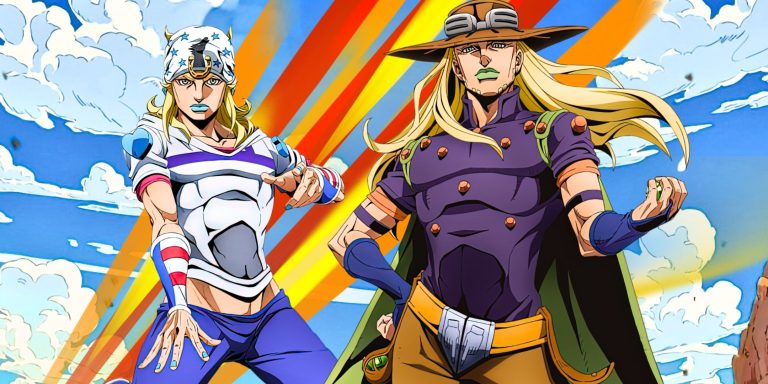
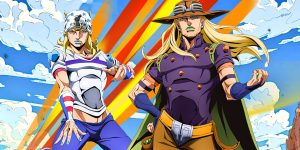
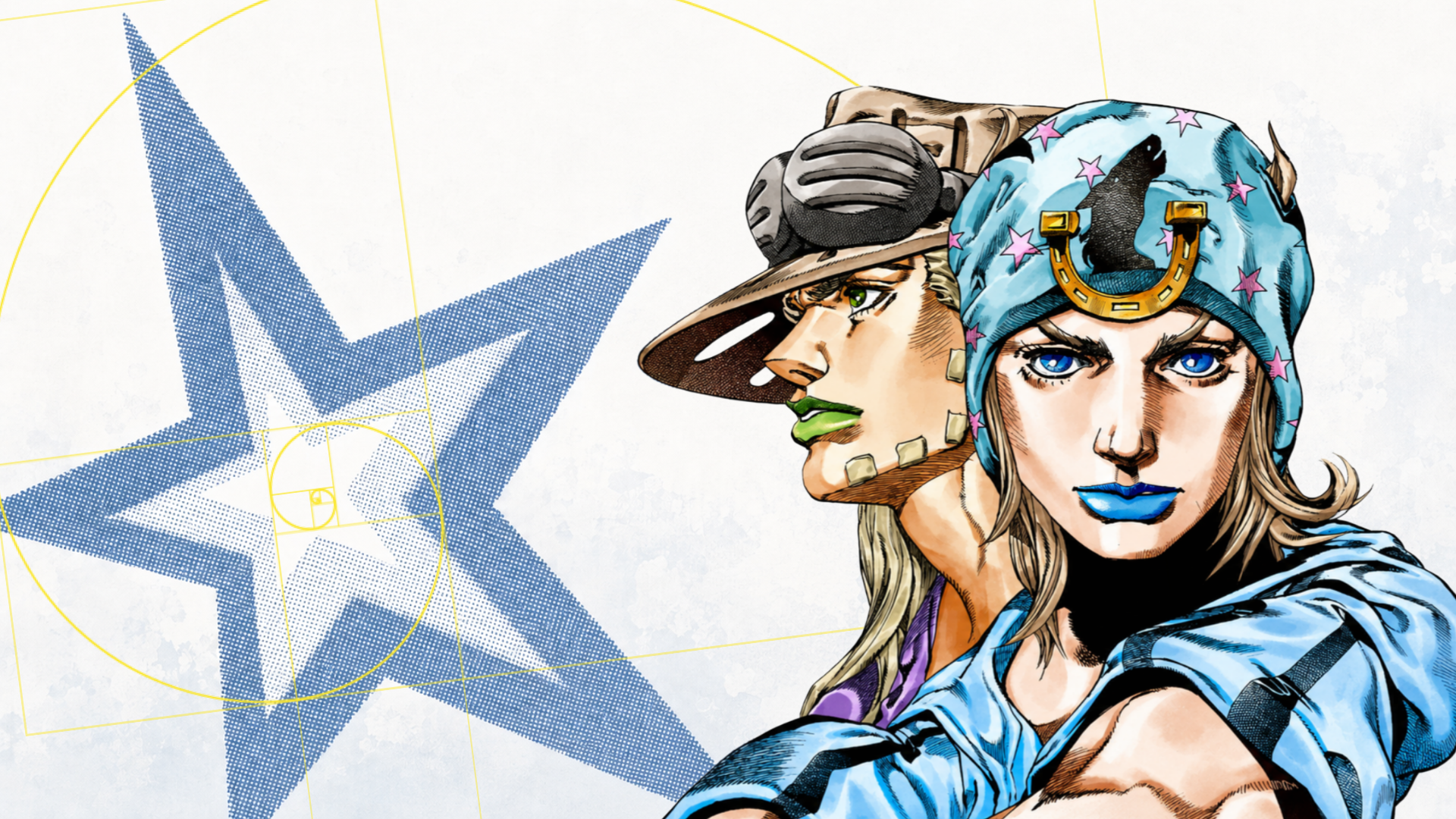
At the beating heart of this sprawling race is what may be the most emotionally resonant duo ever penned in manga: Johnny Joestar and Gyro Zeppeli. Departing radically from the virtuous chivalry of Jonathan Joestar or the juvenile delinquency of Jotaro Kujo, Johnny represents a deconstructed, intensely flawed anti-hero. Paralyzed from the waist down following an act of reckless vanity, Johnny is an embittered former equestrian prodigy trapped in physical and psychological stasis. He is selfish, plagued by trauma, and unashamedly driven by an obsession not with justice, but with reclaiming his ability to stand—a desperate hunger to move from “negative to zero.”
Enter Gyro Zeppeli, a disgraced Neapolitan royal executioner armed with mystical steel orbs and a vibrant, grill-toothed eccentricity. Gyro enters the race to win an executive pardon for an innocent child sentenced to death back home. Where Johnny is cold calculation, Gyro is bombastic bravado masking an agonizing moral conscience. Their evolving dynamic—punctuated by ridiculous improvised jokes about mozzarella cheese, existential camp-fire confessions, and unflinching codependence—anchors the hyper-stylized madness in authentic human grit.
From Hamon to The Spin: The Geometry of Combat
Steel Ball Run also marks Araki’s boldest mechanical evolution: the introduction of The Spin. Far more than a recycled variation of early JoJo Hamon, the Spin is a deadly, mathematically grounded discipline built around the Fibonacci Sequence and the Golden Ratio. By imbuing thrown projectiles with infinite rotational energy, Gyro manipulates cellular structures, bends trajectory paths, and creates spatial distortions.
When Johnny manages to tap into this kinetic marvel, his Stand, Tusk, evolves across four distinct morphological “Acts”—a narrative journey that mirrors Johnny’s psychological rehabilitation. By the time Johnny reaches the cataclysmic, reality-shredding properties of Tusk ACT 4, Araki transforms geometric concepts into visceral cosmic horror, leaving fans salivating at how David Production’s sound designers and animators will visualize such mind-bending phenomena.
The 3D Gallop Dilemma: David Production’s Formidable Canvas
If the thematic depth of Part 7 is enticing, its technical logistics are an absolute nightmare for any animation studio. The primary hurdle standing between Steel Ball Run and our screens can be summed up in a single word: horses.
Quadrupedal anatomy—specifically horses in full gallop—is universally acknowledged as the most labor-intensive, technically grueling subject in 2D hand-drawn animation. An entire series featuring dozens of detailed steeds navigating shifting terrains, dust storms, and close-quarters Stand battles poses a production logjam that could easily shatter an unseasoned team. Wit Studio struggled immensely with equine animation during the earlier seasons of Attack on Titan, and MAPPA leaned heavily on hybrid pipelines for Vinland Saga.
For David Production, who built their reputation on heavily stylized, ink-heavy key frames and dynamic, shifting color palettes, finding the sweet spot will be a test of their studio pedigree:
- The Hybrid 3D Pipeline: David Production demonstrated remarkable growth in utilizing cel-shaded 3D assets during Stone Ocean. A hybrid approach—employing high-fidelity CGI rigs for wide race-tracking shots while reserving hand-drawn 2D close-ups for jockey maneuvers and Stand deployments—is almost a certainty.
- Directorial Kineticism: The director must capture the relentless momentum of the race without sacrificing Araki’s signature fashion-forward poses. Camera angles will need to emulate sweeping, dynamic Panavision cinematography reminiscent of Sergio Leone’s classic spaghetti westerns.
- Soundscapes and Ambiance: The audiovisual identity of Part 7 must deviate sharply from the funk-techno of Part 5 or the electronic synths of Part 6. Fans expect Ennio Morricone-inspired brass, sweeping acoustic strings, and ambient western instrumentation to match the dusty brutality of the race.
Pop Culture Paranoia: The Meme Economy and Global Anticipation
Few unadapted works have achieved the cultural ubiquity of Steel Ball Run. Even without an official trailer, the internet has metabolized Part 7 into an autonomous meme ecosystem. Phrases like “Tell him to eat shit, Johnny”, Gyro’s nonsensical lullabies, and the geopolitical paradox of President Valentine’s dimensional-hopping Stand, Dirty Deeds Done Dirt Cheap (D4C), have permeated Twitter, TikTok, and Reddit for over a decade.
More importantly, the modern anime landscape has evolved into an era where seinen masterpieces are finally receiving prestige adaptations, as seen with Chainsaw Man and Vinland Saga. The botched “batch-release” model that Netflix inflicted on Stone Ocean fractured community discussion, sparking fierce debates among audiences who now fiercely demand that Warner Bros. Japan return to a traditional, weekly episodic rollout for Part 7. An epic of this caliber requires communal breathing room to allow theoretical debates, plot breakdowns, and collective awe to flourish from week to week.
Final Verdict: The Long Ride Toward Perfection
The journey to the Steel Ball Run anime is an endurance trial, much like the race across the American continent itself. While impatient voices clamor for an immediate release date, David Production would be wise to take all the pre-production runway they require. Rushing this adaptation would be an unforgivable disservice to an unmatched artistic achievement in sequential art. When the starting gun inevitably fires, JoJo’s Bizarre Adventure: Steel Ball Run won’t just dominate the seasonal rankings—it will fundamentally redefine what high-concept supernatural storytelling can achieve in animated form.
What are your biggest hopes and fears for the Steel Ball Run anime adaptation? Can David Production conquer the equestrian animation curse, or will they rely too heavily on CGI? Drop your theories, favorite Stand predictions, and dream voice casts in the comments below, and keep your browsers locked to Wibux.com for breaking JoJo updates.