
Ever since the cosmic, universe-resetting finale of JoJo’s Bizarre Adventure: Stone Ocean aired in late 2022, a deafening silence has settled over the anime landscape. For casual observers, the saga of the Joestar bloodline reached its definitive climax with Jolyne Cujoh. But for the initiated—the millions of devoted manga readers and franchise loyalists—that bittersweet conclusion was merely the prelude to something vastly more ambitious. The collective gaze of the anime community is now fixed squarely on a singular horizon: the long-awaited adaptation of Part 7: Steel Ball Run.
Widely revered as Hirohiko Araki’s undisputed magnum opus, Steel Ball Run is not just another installment in a legendary lineage. It represents a paradigm shift in Araki’s storytelling, a transition from kinetic shonen spectacle into the rich, morally ambiguous territory of high-stakes seinen fiction. The buzz surrounding its eventual adaptation by David Production isn’t mere sequel anticipation; it is a cultural reckoning. As rumors swirl and production speculative boards light up across the internet, the anime world is bracing for what could be one of the most mechanically demanding and artistically triumphant projects in modern television animation.
The Trans-American Odyssey: Why Steel Ball Run Stands Alone
To understand the sheer magnitude of the hype, one must understand the seismic shift Steel Ball Run brought to the source material. Serialized between 2004 and 2011, the story famously migrated from the pages of Weekly Shonen Jump to the monthly seinen magazine Ultra Jump. Unshackled from weekly deadlines and the demographic constraints of adolescent fiction, Araki was granted room to breathe, experiment, and bleed onto the page.
Set against the backdrop of an alternate 1890s America, the narrative revolves around the titular Steel Ball Run race—a grueling, 6,000-kilometer cross-country equestrian trek from San Diego to New York City boasting a $50 million grand prize. Yet behind this celebration of industrial-era grit lies a covert supernatural conspiracy: the search for the mummified relics of the Saint’s Corpse, holy artifacts that bestow reality-bending Stand powers and guarantee divine prosperity to the nation that controls them.
By blending historical revisionism, gritty Western tropes, and body-horror supernaturalism, Araki crafted a masterwork that completely revitalized the franchise. It re-anchored the concept of Stands in visceral, psychological reality while abandoning the clean moral binaries of previous arcs in favor of sun-bleached, ruthless pragmatism.
A Tale of Two Riders: Johnny, Gyro, and the Geometry of the Soul
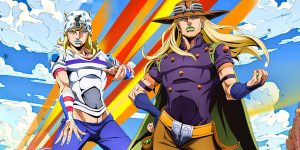
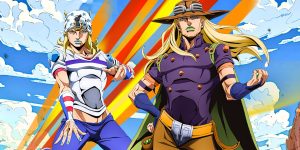
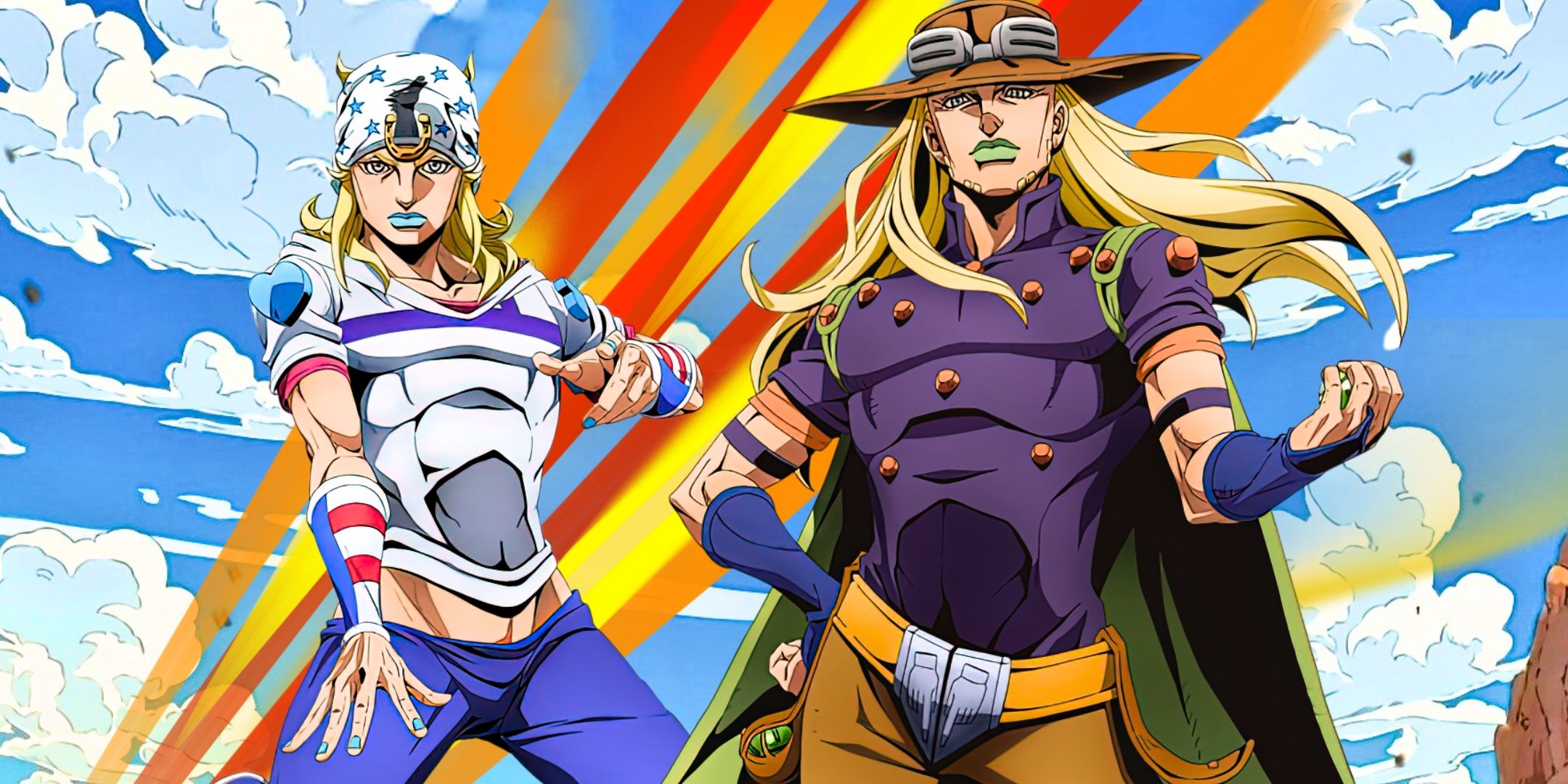
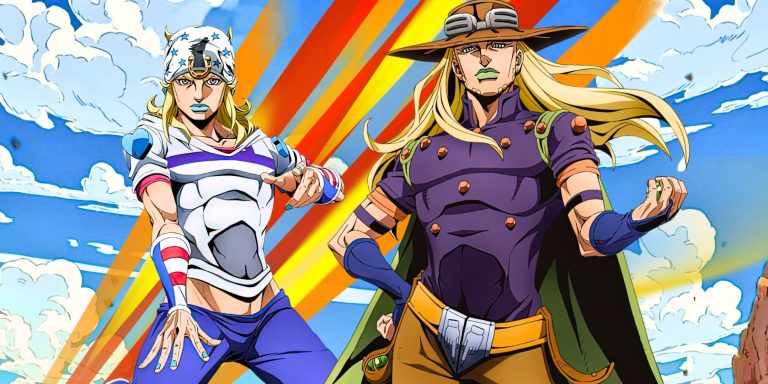
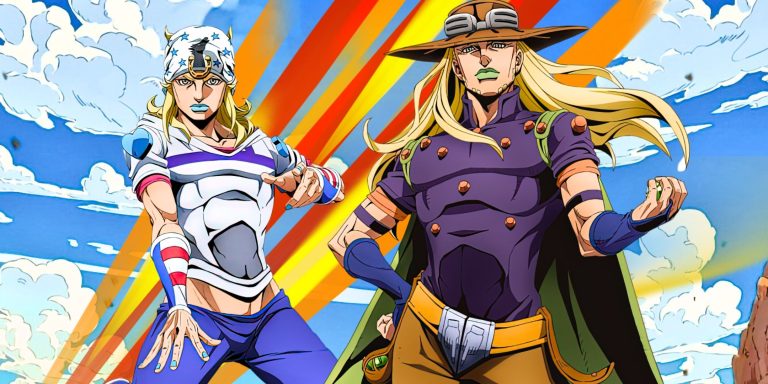
At the beating, bruised heart of Steel Ball Run is the finest duo Araki has ever penned: Johnny Joestar and Gyro Zeppeli. Their dynamic elevates the narrative from a grand adventure race into an intimate character study of trauma, redemption, and esoteric philosophy.
Johnny Joestar: The Subversion of the Shonen Hero
Johnny Joestar is unlike any protagonist who came before him. A former prodigy jockey paralyzed from the waist down following an act of sheer arrogance, Johnny enters the narrative stripped of his pride, his livelihood, and his will to live. He is not motivated by grand ideals of saving the world or protecting the innocent; he is driven by a desperate, borderline-feral desire to reclaim his autonomy. When he witnesses Gyro Zeppeli’s mystic rotating sphere momentarily cause his legs to twitch, Johnny clings to the race not for glory, but to bring his existence from “negative back to zero.” His character arc is defined by what the narrative calls “Dark Determination”—a cold, remorseless glint in his eye that signals a willingness to kill anyone who threatens his personal path to salvation.
Gyro Zeppeli: Charisma, Tragedy, and the Golden Spin
Balancing Johnny’s brooding, morally gray intensity is Gyro Zeppeli, a disgraced executioner’s son from the Kingdom of Naples. Armed with customized steel spheres and a gold-toothed smirk, Gyro joins the race to earn amnesty for an innocent child condemned to die on his father’s scaffold. Gyro introduces the concept of “The Spin”—a supernatural martial discipline rooted in the Golden Ratio, Fibonacci sequence mathematics, and perpetual rotational energy. Far more intricate than the original series’ Hamon, the Spin represents Araki’s fascination with natural symmetry and kinetic physics. The chemistry between Gyro’s eccentric bravado and Johnny’s melancholic resolve forms an unforgettable emotional core, transforming an unforgiving trans-continental dash into a deeply personal brotherhood.
The Technical Nightmare: David Production’s Equestrian Gauntlet
If Steel Ball Run is universally celebrated as a storytelling pinnacle, it is equally feared by animators as an logistical labyrinth. The fundamental question keeping animators and fans up at night is deceptively simple: How do you animate the horses?
In the animation industry, horses are notorious as one of the single most complex subjects to illustrate. Their four-legged gait, constant muscle deformation, intricate tack, and anatomical fluidity require an immense amount of hand-drawn frame volume. Steel Ball Run is not a show with a single horseback chase scene; it is a multi-dozen-episode epic where dozens of horses gallop side-by-side through sandstorms, rivers, snowscapes, and dense forests while their riders exchange gunfire and Stand attacks.
David Production has built a stellar reputation over the last decade by delivering faithful, stylish adaptations of Parts 1 through 6, leveraging bold sound effects typography, high-contrast palette shifts, and meticulously composed key frames. However, Part 7 demands an unprecedented production pipeline:
- The CGI-2D Hybrid Hurdle: David Production will almost certainly need to integrate sophisticated 3D CG models for the equine movements, similar to the hybrid pipelines used in modern action spectacles like Attack on Titan or Chainsaw Man. The creative challenge lies in rendering these models so seamlessly that they retain Araki’s hatched, fine-art seinen aesthetic without jarring the audience out of the experience.
- Visualizing the Infinite Spin: Animating the abstract, dimension-warping properties of the Golden Rectangle and the evolution of Johnny’s Stand, Tusk, requires cutting-edge visual effects compositing. Capturing Araki’s spiraling kinetic energy without turning the screen into visual noise will test the studio’s compositional limits.
Ideological Warfare: Funny Valentine and the Manifest Destiny
No discussion of Steel Ball Run is complete without its primary antagonist, the 23rd President of the United States, Funny Valentine. Boasting the dimensional-traversing Stand Dirty Deeds Done Dirt Cheap (D4C), Valentine is widely regarded as one of anime and manga’s most complex, charismatic villains.
Unlike previous antagonists whose motivations were driven by petty narcissism (Dio Brando) or neurotic self-preservation (Yoshikage Kira), Valentine is motivated by an unshakeable, deeply patriotic mission: to secure the Saint’s Corpse to make America an untouchable global superpower, effectively deflecting all global misfortune onto the rest of the world. His famous monologue regarding “the first napkin” dissects societal power structures with chilling persuasiveness. The impending clash between Valentine’s collectivist tyranny and Johnny’s unapologetically selfish drive makes the climax of Part 7 a profound philosophical interrogation of American exceptionalism and divine destiny.
The Fandom’s Vigil: When Will the Starting Gun Fire?
David Production has stayed notably silent, keeping their development slate close to the chest as they juggle other major franchises like Fire Force and the Urusei Yatsura revival. Yet the silence has only amplified the anticipation. The transition into the alternate universe of Steel Ball Run offers the studio a clean slate—a prestige reboot that could easily capture mainstream critical acclaim far beyond the existing JoJo fandom.
Adapting Part 7 is an Everest-level undertaking. It requires a massive budget, a multi-cour commitment, and a fearless technical approach to its sprawling American landscapes and kinetic cavalry battles. But if David Production can capture even a fraction of the raw, dusty, tragic beauty of Araki’s pages, Steel Ball Run will not just be the next chapter in an eccentric anime saga—it will be an undisputed masterpiece in television animation.
The starting gun hasn’t fired yet, but the horses are at the gate. What are your expectations for David Production’s adaptation of Part 7? Do you think the studio should lean into 3D CGI for the racing sequences, or hold the line for traditional 2D animation? Sound off in the comments below, and keep your eyes locked on Wibux.com for breaking updates on the Steel Ball Run anime adaptation!
One thought on “JoJo’s Bizarre Adventure: Steel Ball Run Anime Buzz: Johnny Joestar, Gyro Zeppeli, and David Production’s Next Frontier”