Ever since the bittersweet, reality-shattering finale of Stone Ocean aired its parting frames, the global anime sphere has lingered in a state of suspended, feverish anticipation. For over a decade, David Production pulled off what critics once deemed mathematically impossible: adapting Hirohiko Araki’s generational, stylized manga with uncompromising fidelity, vibrant color-palette shifts, and a musical reverence unmatched in modern television. Yet, all five preceding eras feel like a protracted prelude compared to the monolith lurking on the horizon. The whispers have escalated into a deafening roar across forums, social feeds, and animation circles alike. We have officially reached the event horizon of JoJo’s Bizarre Adventure: Steel Ball Run.
Universally lauded as Araki’s magnum opus—frequently challenging the highest-rated spots on MyAnimeList alongside Berserk—Part 7 is not merely the next chapter in an anthology. It is a total dimensional reboot, an aesthetic reinvention, and an agonizing technical challenge. Adapting this 1890 trans-American equestrian death race is both David Production’s greatest creative opportunity and an unprecedented production minefield.
Araki’s Seinen Metamorphosis: The Frontier as a Mythic Canvas
To understand the sheer weight of the Steel Ball Run discourse, one must understand its origin. Debuting in 2004 in Weekly Shonen Jump before swiftly transitioning to the monthly pages of Ultra Jump, the series unshackled Araki from the blistering constraints of weekly shonen deadlines. The result was transformative. Freed to delve into heavier themes, visceral violence, and sweeping panoramic spreads, Araki turned the late-19th-century American landscape into a sprawling, supernatural Western epic.
The premise is deceptively direct: an eccentric, cross-country horseback race with a staggering fifty-million-dollar purse, masterminded by the enigmatic promoter Steven Steel. Yet beneath the dust of the San Diego starting line lies a dense labyrinth of political subterfuge, religious mysticism, and cosmic horror. The race isn’t merely an endurance test; it is an archeological crusade for the scattered mummified relics of the Holy Corpse—an artifact that bestows unimaginable Stand power and geopolitical dominance to whoever controls it.
By transplanting the narrative to an alternate timeline, Araki stripped away the baggage of the previous six parts while retaining evocative thematic echoes. The series pivots from theatrical combat to raw survivalism, trading suburban Japanese alleys and claustrophobic prison walls for unforgiving plains, Monument Valley plateaus, and treacherous snowy peaks.
The Ballad of Johnny and Gyro: Subverting the Shonen Protagonist
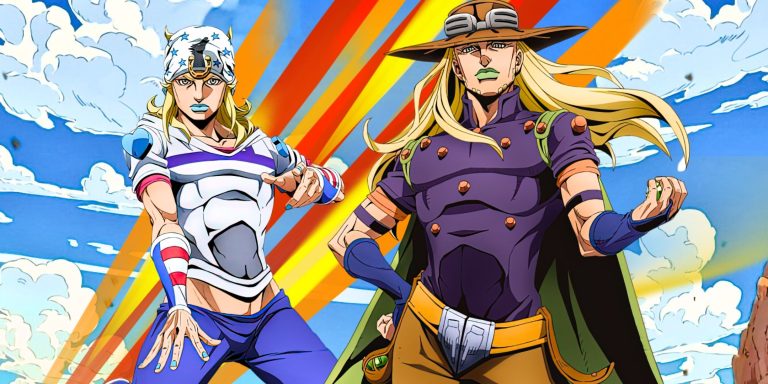
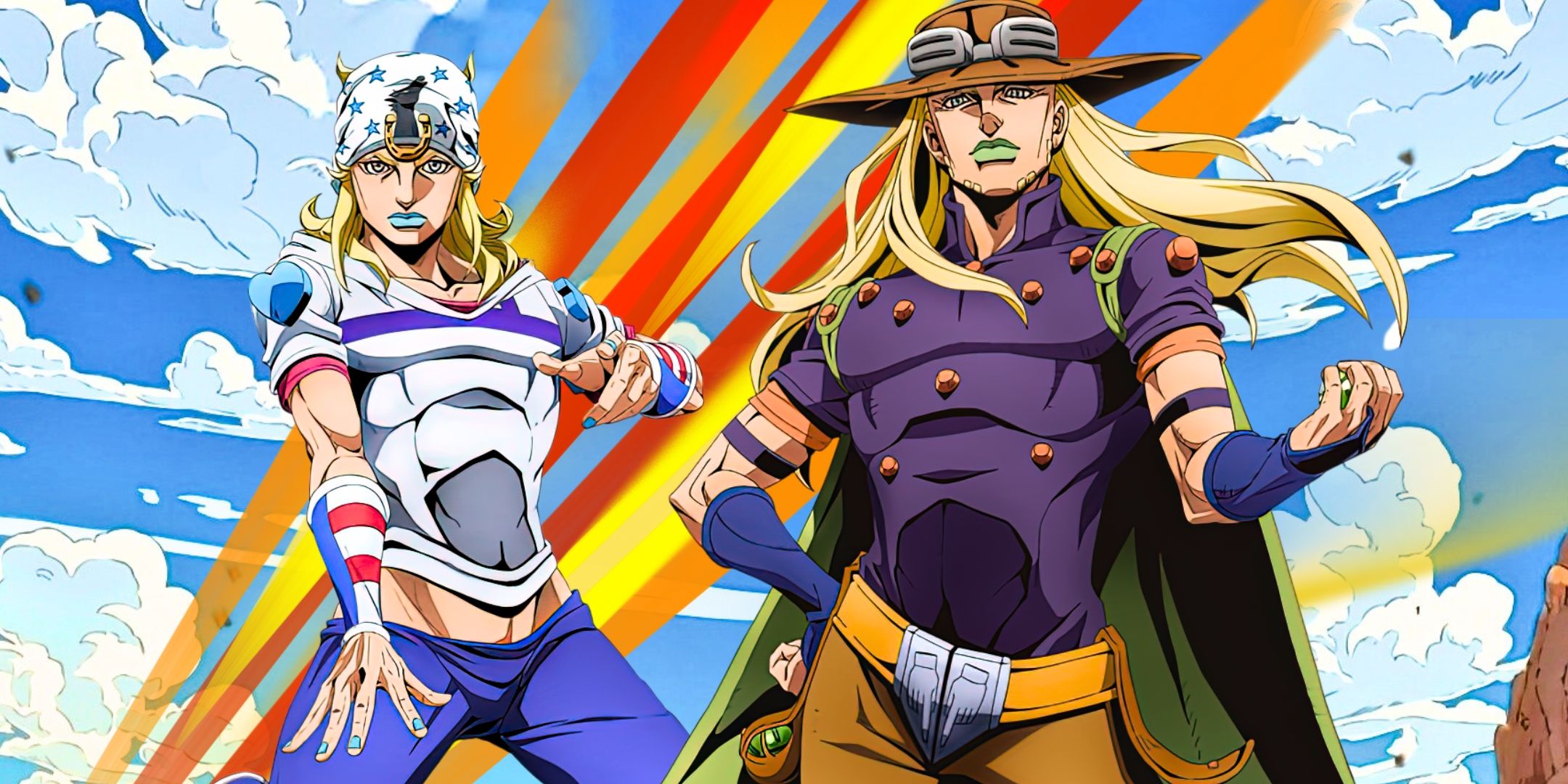
At the center of this sun-scorched odyssey stands what is arguably the most nuanced, emotionally rich dynamic Araki has ever penned: the complex bond between Johnny Joestar and Gyro Zeppeli.
From Negative to Zero: The Broken Prodigy
Unlike the stoic nobility of Jonathan Joestar or the triumphant charisma of Jotaro Kujo, Johnny Joestar begins his journey as an unlikable, fallen golden boy. A former horse-racing prodigy whose reckless arrogance resulted in a gunshot wound that paralyzed him from the waist down, Johnny is cynical, resentful, and hollowed out by depression. He does not enter the Steel Ball Run out of heroic altruism or patriotic pride. When he witnesses Gyro Zeppeli’s mysterious steel spheres briefly cause his paralyzed legs to twitch, Johnny’s drive becomes intensely selfish: he simply wants to stand again.
Araki famously described Johnny’s journey not as an ascent from zero to a positive number, but an agonizing crawl from “negative to zero.” His Stand, Tusk, visually tracks this psychological resurrection. Evolving across four distinct acts, Tusk morphs from a vulnerable, childlike companion that merely allows Johnny to shoot his spinning fingernails like bullets, into a devastating cosmic force capable of sundering the multiverse. It is character growth mirrored directly through supernatural kinetic physics.
The Golden Ratio: Gyro Zeppeli’s Buried Grace
Serving as Johnny’s reluctant mentor and spiritual anchor is Gyro Zeppeli—a disgraced executioner from the Kingdom of Naples racing to win clemency for an innocent child condemned to death. Flamboyant, deeply superstitious, and armed with gold-plated teeth and an idiosyncratic sense of humor, Gyro wields The Spin, an ancient physiological martial art harnessing the infinite energy of the Golden Ratio.
Where Johnny is cold steel and relentless fixation, Gyro is conscience, duty, and flawed levity. Their partnership avoids the standard anime buddy-comedy tropes, evolving organically through campfire banter, shared near-death trauma, and ideological debates over justice and legacy. Their chemistry is the beating heart that grounds the surrounding cosmic lunacy.
The Technical Everest: Why David Production Faces Its Toughest Test
If the thematic resonance of Steel Ball Run is undisputed, the practical question of how to adapt it has haunted animators for years. Bringing Part 7 to the screen is an endeavor that makes even veteran studios sweat, primarily due to one notorious element: horses.
The Equestrian Curse and the 3D/2D Hybrid Paradigm
It is an open industry secret in the world of Japanese animation that four-legged anatomy—particularly horses at full gallop—is an absolute nightmare to animate in traditional hand-drawn 2D. The complex musculature, the shifting weight, the rhythmic synchronization of hooves, and the interaction with environmental elements demand extraordinary labor. In Steel Ball Run, horses are not incidental background props; they are primary characters, engaged in intense tactical charges, high-speed maneuvers, and visceral Stand combat across every single episode.
David Production cannot simply apply the visual shorthand utilized in earlier JoJo adaptations. An excessive reliance on flat, low-framerate CGI models risks alienating fans and shattering the visual majesty that Araki’s heavy-inked manga panels command. The studio must forge a delicate, state-of-the-art hybrid pipeline: using sophisticated 3D models for the horses’ kinetic base motion, layered with meticulous, hand-drawn 2D line work and expressive hatching to preserve Araki’s mature seinen art style. Following mixed community responses to Netflix’s controversial batch-release model for Stone Ocean, David Production and Warner Bros. Japan face intense scrutiny. Fans are demanding a return to appointment weekly viewing, backed by a production schedule that allows the studio to breathe.
Dirty Deeds, Napkins, and Cosmic Manifest Destiny
No dissection of Steel Ball Run is complete without acknowledging its antagonist, the 23rd President of the United States, Funny Valentine. Armed with the dimensional-hopping Stand D4C (Dirty Deeds Done Dirt Cheap) and driven by an uncompromising, ultranationalist vision of American exceptionalism, Valentine is Araki’s most politically charged creation.
His famous “First Napkin” monologue—a masterclass in social philosophy asserting that power belongs to whoever dictates social momentum—serves as the dark mirror to Johnny’s personal struggle. The conflict in Steel Ball Run does not boil down to simple good versus evil. It is a catastrophic clash of convictions, pitting Valentine’s macroscopic, utilitarian tyranny against Johnny’s raw, individualist desperation. The thematic maturity of this confrontation will inevitably ignite mainstream anime discourse in an era where audiences actively seek morally complex narratives.
The Verdict: An Inevitable Cultural Reckoning
The road to a verified Steel Ball Run anime announcement may feel long, but it remains one of the most culturally loaded inevitabilities in the medium. When David Production finally fires the starter pistol for the transatlantic race, it will not simply be another season of television; it will be an industry benchmark—a monument to whether peak manga illustration can be successfully translated into modern prestige anime without sacrificing its soul.
Johnny Joestar’s quest to find his own redemption on the open prairie redefined what Hirohiko Araki could achieve as a storyteller. Now, the baton passes to the animators. The Golden Rectangle has been drawn; all that remains is for the world to watch it spin.
What do you think, JoJo fans? Should David Production take their time with a full hybrid-CGI pipeline to nail the horses, or are you holding out for pure 2D perfection? Let us know your thoughts and your dream voice cast for Gyro Zeppeli in the comments below!