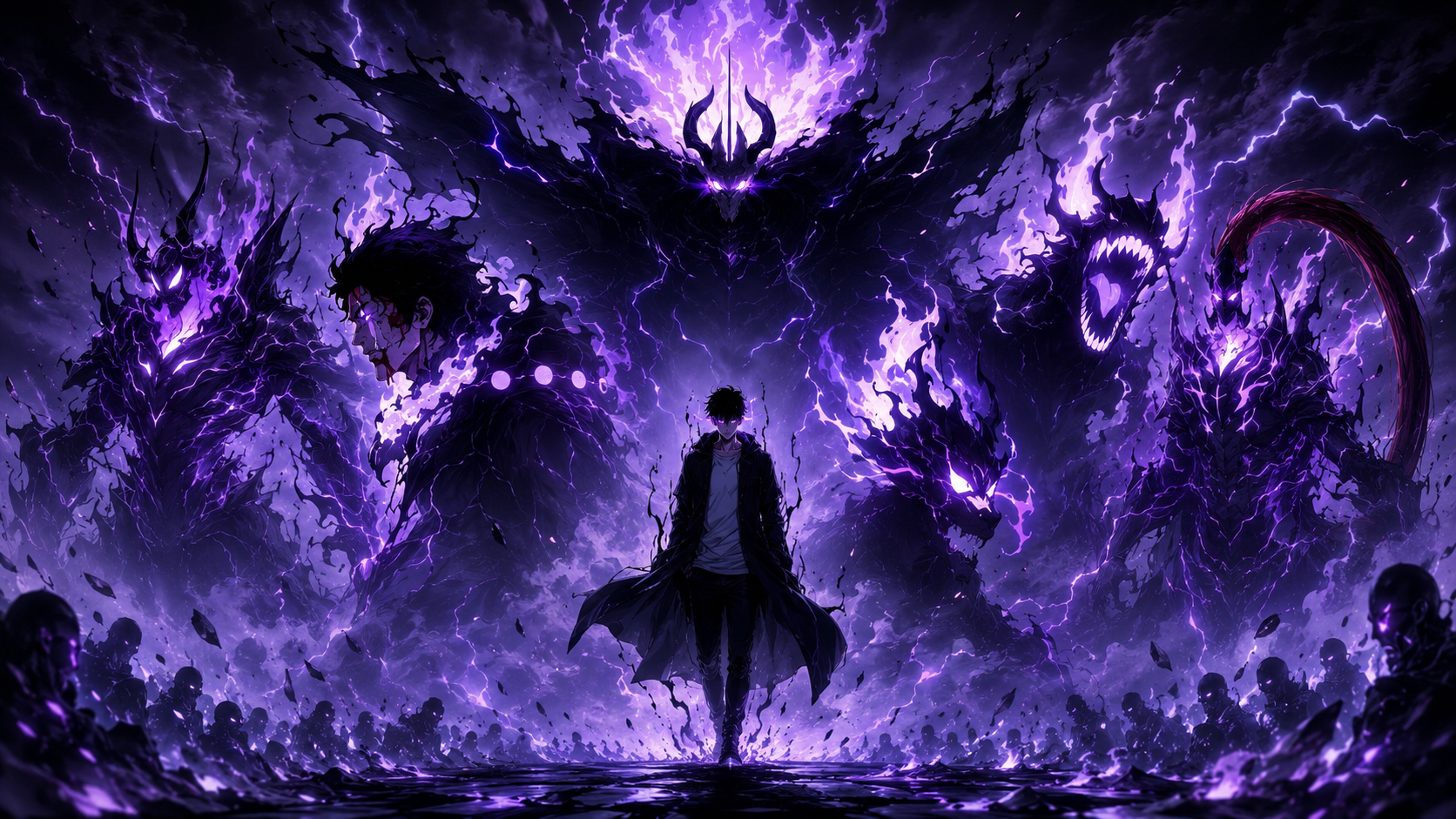
When Chugong’s landmark dark fantasy juggernaut Solo Leveling reached its universe-altering conclusion, the global anime and manhwa community braced for an inevitable vacuum. Sung Jinwoo had broken the paradigm of power-scaling, ascending from the pitiful “Weakest Hunter of All Mankind” to a primordial god of death who fundamentally rewrote reality. Yet, true power vacuums never stay empty for long. Enter Solo Leveling: Ragnarok—a sprawling, cosmic sequel that does not merely capitalize on its predecessor’s golden goose, but boldly subverts it. With REDICE Studio’s webtoon adaptation firing on all cylinders and industry whispers cementing A-1 Pictures’ long-term roadmap for the franchise, the narrative torch has officially passed to Sung Suho.
The stakes are no longer confined to Seoul’s shattered asphalt or the machinations of the Monarchs and Rulers. Instead, Ragnarok thrusts Earth into an interdimensional abattoir of cosmic horror. As fans track every breadcrumb leading toward the inevitable anime adaptation of this sequel saga, one truth becomes undeniable: Suho is not merely stepping into his father’s oversized combat boots—he is inheriting an apocalyptic mantle against entities that dwarf the very concept of death itself.
The Bloodline of Death: Sung Suho’s Awakening and the Re-Engineered System
The fundamental challenge of any sequel starring the protagonist’s scion—a narrative trope famously tested by franchises like Boruto and Dragon Ball—is manufacturing stakes without diluting the patriarch’s godhood. Ragnarok sidesteps this pitfall with surgical precision. During the epilogue of the original series, Jinwoo chose to seal away the terrifying innate darkness dormant inside young Suho, wanting his son to experience the warmth of an ordinary human upbringing alongside his mother, Cha Hae-In.
That pastoral illusion violently unravels when the dimensional barrier cracks. Suho’s inevitable awakening atop Gwanak Mountain is not a carbon copy of the double dungeon bloodbath; it is a clinical, desperate necessity. To prevent his son’s mortal vessel from disintegrating under the raw, unrefined aura of the Shadow Monarch, Jinwoo crafted a fail-safe: an entirely customized, gamified System calibrated explicitly for Suho. However, unlike Jinwoo’s grueling solo ascent, Suho begins his journey fully aware of what lies in the dark. He is an academic, a martial artist, and an intuitive tactician who does not wield necromancy as an assassin, but as an aggressive, front-line vanguard.
A Divergent Arsenal: Breaking Free from the Dagger Meta
While Jinwoo’s combat iconography was cemented by twin daggers, stealth dashes, and subterranean speed, Suho’s evolution reflects a broader combat spectrum. Inheriting not only his father’s necrotic dominion but also the peerless swordsmanship of Cha Hae-In, Suho seamlessly blends dual-blade precision with brute-force telekinesis and environmental manipulation. In the upcoming visual medium, this gives animators an entirely fresh choreography sandbox. Suho does not merely summon shadows to clean up the battlefield; he synchronizes with them, donning spirit armor and wielding beastly totems like the white tiger cub Gray, transforming the Shadow Monarch’s grim palette into a dynamic, elemental storm.
Beyond Monarchs and Rulers: The Eldritch Horrors of the Itarim
If the original series was a localized high-fantasy power struggle wrapped in dungeon-crawling tropes, Solo Leveling: Ragnarok catapults the franchise into the merciless realm of Lovecraftian cosmic horror. The central antagonists are no longer rogue Monarchs seeking territorial conquest; they are the Itarim—the Outer Gods. These primordial, malevolent creators originated from distant universes, driven by an insatiable hunger to consume the cosmic remnants left behind by Earth’s deceased Absolute Being.
This single lore expansion recontextualizes Jinwoo’s current absence. The Shadow Monarch has not abandoned his family; he is physically locked in a perpetual, reality-tearing war within the dimensional rift, serving as a solitary bulwark against an endless cosmic armada. Earth is merely an undefended flank, suddenly besieged by “Apostles”—grotesque heralds sent by the Itarim who introduce alien mana, mutate local wildlife, and establish aberrant dungeons that defy the established hunter ranking system entirely.
For an anime production, the Itarim present a staggering aesthetic elevation. Where the Monarchs were humanoid archetypes of destruction—beasts, ice elves, insect queens—the Itarim and their thralls are fluid, non-Euclidean monstrosities. Adapting this transition demands an auditory and visual shift from crisp, metal-on-metal dungeon raiding to psychedelic, existential dread that will test the creative thresholds of modern digital compositing.
The King’s Herald: Beru’s Evolution from Nightmare to Beloved Guardian
No discussion of Ragnarok’s potential screen dominance is complete without the fanatical, shrieking heart of the Shadow Army: Beru. The former Ant King of Jeju Island—who once gave an entire generation of anime watchers collective PTSD—undergoes one of the most brilliant tonal recalibrations in modern manhwa history. Despatched by Jinwoo from the cosmic frontlines to safeguard Earth and awaken the young prince, Beru exhausts virtually all his primordial mana just tearing through the dimensional fabric.
The result? A comedically miniaturized, chittering, yet fiercely lethal version of the former S-Rank nightmare. Beru acts as Suho’s cynical mentor, hype-man, and living encyclopedia of Monarch lore. The dynamic between the weary, pragmatic Suho and the over-the-top, melodramatic insect general who weeps openly at the slightest glimpse of Jinwoo’s greatness in the boy injects much-needed levity into an otherwise bleak apocalyptic narrative.
Yet, when the chips are down, the comedy evaporates. Even in a diminished state, Beru’s instincts are pure, unadulterated slaughter. The prospect of seeing this duality animated—shifting instantly from a pint-sized chibi mascot crying tears of pride to a chitinous, sonic-speed executioner—will unequivocally break the internet, solidifying Beru’s reign as the franchise’s ultimate mascot-turned-godfather.
The A-1 Pictures Blueprint: Building an Unstoppable Anime Engine
The explosive commercial metrics of A-1 Pictures’ inaugural seasons of Solo Leveling proved that the global market holds an insatiable appetite for top-tier Korean webtoon properties when treated with elite Japanese studio prestige. With director Shunsuke Nakashige establishing an uncompromising standard for kinetic pacing and Hiroyuki Sawano delivering an earth-shattering sonic identity, the corporate roadmap for an eventual Ragnarok television anime or theatrical launch is already crystallizing behind closed doors.
Industry insiders know that modern shonen and dark fantasy franchises thrive on continuous, multi-generational continuity. By the time the main anime reaches Jinwoo’s ultimate dimensional gambit, the foundational lore for Ragnarok will be prime for immediate serialization. With REDICE Studio consistently topping global digital platforms with the webtoon adaptation, the production pipeline between Seoul and Tokyo has never been more synchronized. A-1 Pictures won’t just be animating a sequel; they will be commanding a fully integrated multimedia universe capable of rivaling the contemporary giants of Shonen Jump.
The Verdict: Can the Prince Eclipse the Monarch?
Solo Leveling: Ragnarok is the rare sequel that honors its roots while systematically dismantling its safety nets. Sung Suho is not insulated by his father’s omnipotence; he is cursed by it, forced to climb a mountain of shattered dimensions while cosmic gods peer through the cracks in the sky. If the flagship series was about one man crawling out of the abyss to save his family, Ragnarok is about a son holding the line of reality itself so his father can finish a war among the stars.
When the screen fades to black and the iconic blue System text flickers to life for Suho, the anime landscape will realize what novel readers have known all along: the hunt didn’t end with Sung Jinwoo. It merely went cosmic.
How do you feel about Sung Suho taking the reins from Jinwoo, and what are your wildest animation expectations for the Itarim invasion? Drop your thoughts, theories, and hunter rankings in the comments below!