

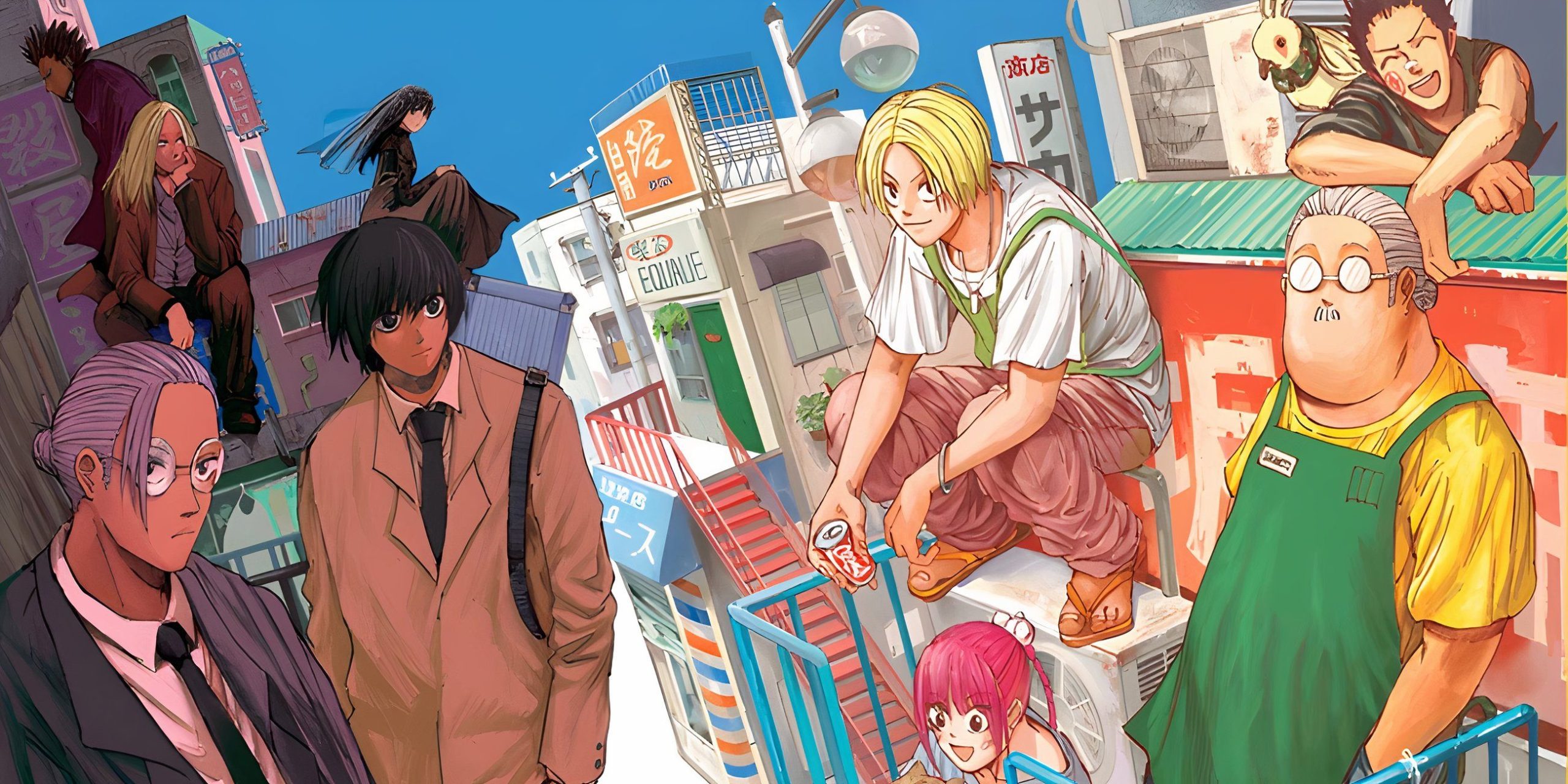
For four agonizing years, the manga community harbored a single, anxious question: Who is going to animate Sakamoto Days without ruining it? In an era where Weekly Shonen Jump is navigating the post-My Hero Academia and Jujutsu Kaisen landscape, Yuto Suzuki’s hyper-kinetic assassin comedy has served as the magazine’s crown jewel of raw spatial choreography. It didn’t rely on abstract cursed energy or esoteric power systems; it relied on momentum, mass, and the lethal application of ballpoint pens and cash registers. When TMS Entertainment finally pulled back the curtain—confirming the adaptation under director Masaki Watanabe and starring the legendary Tomokazu Sugita as Taro Sakamoto—the collective sigh of relief was instantly swallowed by intense, high-stakes anticipation. Translating Suzuki’s blistering, cinematic combat to the screen isn’t just an adaptation job; it is an animation tightrope walk.
The Kinetic Genius of Yuto Suzuki: Choreography Beyond the Page
To understand why the Sakamoto Days anime carries such tremendous cultural weight, one must unpack the kinetic grammar of the source material. Suzuki didn’t simply draw action scenes; he engineered them with the precision of Chad Stahelski and the slapstick physical genius of Buster Keaton. Modern shonen frequently relies on heavy impact frames, screen-shaking auras, and metaphysical monologues to sell tension. Suzuki, conversely, treats action as pure physics. Every punch carries identifiable inertia, every dodge creates a vacuum that ripples into the environment, and the visual geometry of a convenience store or a speeding commuter train is mapped down to the millimeter.
Environmental Weaponry and the John Wick DNA
The beating heart of Taro Sakamoto’s lethality is his complete mastery of ordinary objects. Much like Keanu Reeves’ John Wick weaponizing a library book or a horse, Sakamoto treats everyday mundane artifacts as instruments of blunt-force trauma. In Suzuki’s panels, a cough drop becomes a high-caliber projectile, an umbrella turns into an immovable ballistic shield, and price-tag scanners trace trajectories of lethal intent. The visual wit lies in the contrast: Sakamoto, a portly family man who runs a suburban grocery store, dispatches world-class hitmen without dropping his groceries. Adapting this requires an animation team that prioritizes spatial consistency over flashy particle effects—a rare discipline in today’s digital-first production landscape.
Inside TMS Entertainment’s Blueprint: Translating Stills into Sakuga Gold
TMS Entertainment occupies a fascinating space in anime history. While studios like MAPPA and ufotable dominate modern social media discourse with post-processing pyrotechnics and compositing magic, TMS represents an old-school lineage of rock-solid draftsmanship. Their pedigree stretches from Lupin the 3rd and Detective Conan to modern action heavyweights like Megalo Box and Dr. STONE. This heritage is precisely why TMS is an inspired choice for Sakamoto’s world: they understand automotive chases, gunplay, and kinetic crime capers better than nearly any other outfit in Tokyo.
The Creative Crew and Technical Demands
Helming the project is Masaki Watanabe (known for his steady narrative rhythm in Bartender and dynamic pacing in Battle Spirits), alongside character designer Yo Moriyama, whose background as a visual director on Attack on Titan and director on Megalo Box signals a gritty, grounded visual aesthetic. The central production challenge facing this team is not just rendering Sakamoto’s portly silhouette or his sudden transitions into his razor-sharp, slimmed-down state; it is preserving the clarity of motion.
In Suzuki’s manga, reader eyes are guided through panel gutters by deliberate lines of sight and debris flow. If the anime leans too heavily on choppy frame rates, extreme close-up cutaways, or excessive motion blur to mask production bottlenecks, the organic flow of the fight scenes will collapse. TMS must deliver long, continuous tracking shots that showcase full-body choreography. Early looks indicate that the studio is prioritizing high-density key animation over heavy digital filters, banking on weight and impact rather than superficial gloss.
The Lethal Sandbox: The Order, Slur, and the Cost of Taro’s Vow
Beneath the high-octane set-pieces lies a surprisingly nuanced psychological core that gives Sakamoto Days its enduring charm. The narrative engine is fueled by Taro’s quiet vow to his wife, Aoi: never kill again. In the hyper-violent underworld run by the Japanese Assassin Federation (JAF), this moral self-imposition acts as a narrative choke-chain. It forces Taro to neutralize world-ending threats non-lethally, elevating every skirmish from a routine slaughter into an intricate physical puzzle.
Taro’s Dual Identity: Domestic Patriarch vs. Sleeping Giant
Tomokazu Sugita’s casting as Taro is a stroke of genius. Known globally for bringing world-weary nonchalance to Gintoki Sakata and dry gravitas to Joseph Joestar, Sugita embodies Taro’s deadpan dual existence. Taro is a man who genuinely finds more joy in bagging discounted pork belly than surviving an ambush by cybernetic assassins. This domestic grounding elevates the stakes: every high-speed brawl isn’t merely about survival, but about defending the quiet domesticity he fought decades to earn alongside his psychic clerk Shin and former Triad member Lu Xiaotang.
The Shadow of The Order: Nagumo, Shishiba, and Takamura
The world opens up violently once the anime introduces The Order—the JAF’s elite, six-member execution squad. These are not cartoonish villains, but eccentric professionals operating at the apex of martial prowess.
- Nagumo: The smiling, enigmatic trickster whose weapon transformations require dazzling frame-by-frame animation shifts.
- Shishiba: The stoic hammer-wielding pragmatic who views the profession through the dry lens of corporate labor.
- Osaragi: The unhinged, bridal-clad phantom who wields a massive concrete saw like a ballerina.
- Takamura: The geriatric, muttering samurai who represents the closest thing the series has to a force of natural destruction. Takamura’s blade draws are so swift they blur reality, presenting TMS with the ultimate test of staging terror through pure editing and atmospheric audio design.
Opposing them is Uzuki (Slur), a revolutionary terrorist whose ideological war against the JAF introduces a complex web of split personalities, traumatic orphanages, and betrayal. The anime must successfully balance these tonal shifts—moving seamlessly from looney-tunes convenience store antics to chilling psychological horror.
The Weight of Expectation: Can TMS Satisfy the Sakuga Generation?
The modern anime fandom has evolved into a hyper-literate collective of animation critics. Viewers dissect individual key animator cuts on social media, analyzing layout, smears, and timing with academic scrutiny. Sakamoto Days lands directly in the crosshairs of this “sakuga generation.” The manga’s reputation as the gold standard of contemporary action illustration means that merely “good” animation will be deemed an underperformance by vocal community factions.
Furthermore, the global distribution footprint—backed by high-profile streaming arrangements—places the series in direct competition with global juggernauts like Chainsaw Man, Solo Leveling, and Bleach: Thousand-Year Blood War. TMS isn’t just adapting a comic; they are tasked with launching Jump’s next multi-million-dollar flagship franchise. The transition from slice-of-life neighborhood comedy in its opening episodes to the breathtaking, city-leveling amusement park and Tokyo museum raids later in the story will serve as the ultimate barometer of the production’s stamina.
The Verdict: The Return of Tactile Action
If TMS Entertainment stays true to its structural strengths—pairing fluid character mobility with unyielding spatial geography—Sakamoto Days could very well redefine Shonen action for the mid-2020s. In a market oversaturated with cosmic lasers and magic circles, Taro Sakamoto’s localized, tactile, and delightfully absurd violence is the breath of fresh air the industry desperately needs. It reminds us that nothing is deadlier than a retired master who simply wants to get home in time for dinner.
How do you feel about TMS Entertainment taking the reins of Suzuki’s modern masterpiece? Will the non-lethal family man dethrone the current kings of Shonen action? Sound off in the comments below!