


One Year Later: How KPop Demon Hunters Conquered Netflix, Hollywood, and the Entire World
Exactly one year ago today, on June 20, 2025, Netflix dropped an animated film that nobody saw coming — and by “nobody,” we mean literally the entire entertainment industry. KPop Demon Hunters, a quirky musical urban fantasy from Sony Pictures Animation, was supposed to be another cute streaming original. Instead, it became the most-watched film in Netflix history, with a staggering 600 million views and counting.
Fast forward to June 2026, and the film has spent an unbelievable 52 consecutive weeks on Netflix’s Global Top 10 Films chart. That is one full year. The movie hasn’t just broken records — it has demolished them. But what makes this story even more extraordinary is what happened next: an Oscar, a Grammy, and a confirmed sequel. Let’s break down the phenomenon that changed pop culture forever.
From Sony Animation Experiment to Netflix’s Crown Jewel
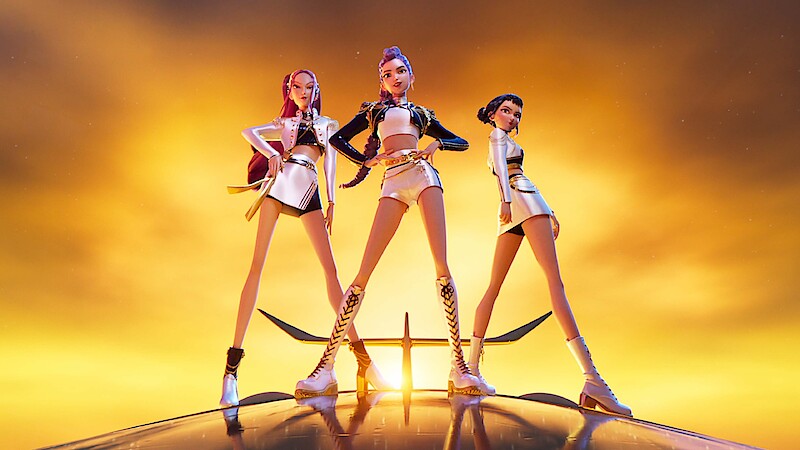
Co-written and directed by Maggie Kang and Chris Appelhans, KPop Demon Hunters was released directly on Netflix on June 20, 2025. The film follows a trio of K-pop idol demon hunters who balance world-saving supernatural battles with the pressures of pop stardom. The voice cast features Arden Cho, Ahn Hyo-seop, May Hong, Ji-young Yoo, Yunjin Kim, Daniel Dae Kim, Ken Jeong, and Lee Byung-hun — a roster that already signaled this project meant business.
What set it apart from every other animated musical was its authenticity. This wasn’t a Western studio’s approximation of Korean pop culture — it was a genuine love letter to the K-pop industry, crafted with care and respect. The animation blended stylized concert sequences with jaw-dropping supernatural action choreography, creating something that looked unlike anything audiences had seen before.
Within days of its release, KPop Demon Hunters was trending everywhere. TikTok was flooded with dance challenges recreating the film’s choreography. Twitter threads broke down every demon-hunting technique frame by frame. YouTube reaction channels couldn’t keep up with the demand. And Netflix’s numbers? They told a story no one predicted.
The Record-Breaking Numbers That Shocked Hollywood
Let’s talk about the milestones, because they deserve to be repeated:
- 600 million views — making it Netflix’s most-watched original film of all time, surpassing everything from Red Notice to Don’t Look Up
- 52 consecutive weeks in the Netflix Global Top 10 Films chart — an unprecedented full-year run
- Best Animated Feature at the 98th Academy Awards (2026) — beating stiff competition from Pixar, Studio Ghibli, and every other heavyweight
- Best Original Song at the Grammy Awards for “Golden” — marking the first time a K-pop song has ever won this category
The Oscar win was particularly significant. Directed by Maggie Kang, Chris Appelhans, and producer Michelle L.M. Wong, the film’s victory at the 98th Academy Awards cemented its place not just as a streaming hit, but as a legitimate piece of cinema. Netflix had been chasing Oscar validation for years, and KPop Demon Hunters delivered it in the most spectacular way possible.
The Grammy win for “Golden” was equally historic. As the first K-pop song to take home Best Original Song, it opened doors that had been closed for decades. This wasn’t just an award — it was a cultural shift.
How Did One Movie Dominate for an Entire Year?
The question on everyone’s mind: how does any film stay relevant on streaming for 52 straight weeks? The answer lies in a perfect storm of factors that entertainment analysts are still studying.
The K-pop engine is unstoppable. K-pop fandoms are famously dedicated, and KPop Demon Hunters tapped into that energy with unprecedented authenticity. The film didn’t just reference K-pop — it celebrated it, respected it, and gave fans something they’d been waiting for: a major Hollywood production that took the genre seriously.
The animation quality set a new benchmark. Sony Pictures Animation pushed boundaries with sequences that seamlessly blended concert choreography with supernatural combat. Every frame was designed to be shared, memed, and analyzed — which is exactly what happened.
Cross-cultural appeal. Unlike most animated films that target either Western or Asian audiences, KPop Demon Hunters resonated globally. It topped charts in South Korea, Japan, the United States, Southeast Asia, Latin America, and Europe simultaneously. The cultural bridge it built was as important as the entertainment it provided.
KPop Demon Hunters 2: Everything We Know About the Sequel
Perhaps the biggest news of all: a sequel is officially confirmed. Netflix and Sony Pictures Animation have locked in a deal for KPop Demon Hunters 2, with plans for a 2029 release. In a February 2026 interview with The Hollywood Reporter, the presidents of Sony Pictures Animation revealed that production is underway and the sequel may even push beyond 2029 to ensure the quality matches the original.
While plot details remain under wraps, the first film’s ending left plenty of threads to pull. The world-building established a universe where K-pop idols moonlight as demon hunters, and the lore barely scratched the surface. Fans are already theorizing about what the sequel could explore — new demon realms, rival idol groups, or perhaps a deeper dive into the mythology behind the hunters’ powers.
The fact that Sony is willing to wait until 2029 rather than rush production speaks volumes. They understand that the original’s success came from quality, not speed. A rushed sequel could tarnish the brand; a carefully crafted one could surpass it.
Why KPop Demon Hunters Matters Beyond the Numbers
What makes KPop Demon Hunters truly remarkable isn’t the view count or the awards. It’s what the film represents: a cultural moment where East and West didn’t just meet — they collaborated on equal footing, created something extraordinary, and proved that authentic storytelling transcends every boundary.
For years, Hollywood tried to “adapt” Asian pop culture with mixed results. KPop Demon Hunters flipped the script by making authenticity the foundation, not an afterthought. The result? The biggest animated film of the decade.
This success has already sparked a wave of similar projects across the industry. Major studios are now actively developing K-pop themed content, anime-inspired animation, and cross-cultural collaborations that would have been unthinkable five years ago. KPop Demon Hunters didn’t just break records — it broke open an entirely new lane in global entertainment.
What Comes Next for the Franchise?
Beyond the confirmed sequel, the KPop Demon Hunters universe is expanding. Official merchandise has been flying off shelves. The soundtrack continues to chart globally. Fan communities remain as active as ever, creating art, music, and theories that keep the franchise alive between now and the 2029 release.
Rumors are already swirling about potential spin-offs — perhaps focusing on individual hunters, exploring the demon realm in depth, or even a live-action adaptation. Sony and Netflix haven’t confirmed anything yet, but given the financial and cultural success of the franchise, expansion seems inevitable.
The Bottom Line
One year ago, KPop Demon Hunters was just another Netflix release. Today, it’s the most-watched film in the platform’s history, an Oscar and Grammy winner, and the blueprint for how cross-cultural entertainment should be made. It’s proof that when you respect a culture, invest in quality, and trust your audience, the results can be nothing short of extraordinary.
The countdown to 2029 has begun. And if the first year of KPop Demon Hunters is any indication, the sequel is going to be one of the most anticipated animated films ever made.
What do you think KPop Demon Hunters 2 should explore? Which character deserves their own spin-off? Drop your theories and predictions in the comments below!