Ever since the melancholic, bittersweet notes of Stone Ocean faded into the anime ether, leaving audiences emotionally wrecked across the reset timeline, a single, thunderous whisper has dominated the global anime landscape: Steel Ball Run. In the pantheon of sequential art, Hirohiko Araki’s seventh serialized installment of JoJo’s Bizarre Adventure is routinely hailed not just as a high point for the franchise, but as one of the greatest manga ever put to paper. Ranking alongside heavyweight juggernauts like Kentaro Miura’s Berserk and Takehiko Inoue’s Vagabond on critical consensus platforms, Part 7 is Araki’s undisputed magnum opus—an uncompromising, sprawling Western epic where visceral supernatural horror collides with the American frontier.
Yet, as the buzz surrounding David Production’s next move reaches a deafening fever pitch, so too does a palpable sense of trepidation. Adapting Steel Ball Run is not simply a matter of picking up where Jolyne Cujoh left off; it represents an unprecedented conceptual reset, an astronomical technical challenge, and a pivotal crossroads for how prestige anime is produced and distributed in the modern streaming era.
A Trans-Continental Crucible: The Seinen Rebirth of JoJo
To understand why the anticipation for a Steel Ball Run anime is so voracious, one must first appreciate the seismic structural shift the series underwent during its original run. Serialized initially in Weekly Shonen Jump before migrating to the monthly, older-skewing pages of Ultra Jump in 2005, Part 7 granted Araki something he had spent decades craving: creative oxygen. Unshackled from grueling weekly deadlines, Araki transformed what began as a stylish horse race across 1890s America into an intricate, slow-burn psychological epic drenched in dust, blood, and theological existentialism.
The premise is deceptively accessible: eccentric philanthropist Steven Steel organizes the “Steel Ball Run,” a cross-country equestrian race spanning from San Diego Beach to New York City, dangling a life-altering $50 million prize. Beneath the spectacle of steam-engine support vehicles and desert grit lies an insidious conspiracy orchestrated by the 23rd President of the United States, Funny Valentine. The true objective of the race is not fame or fortune, but the clandestine collection of the scattered, mummified relics of the Holy Corpse—an artifact endowed with miracles capable of guaranteeing absolute global dominion to whichever nation possesses it.
Broken Spirits and Golden Ratios: The Anatomy of Johnny and Gyro
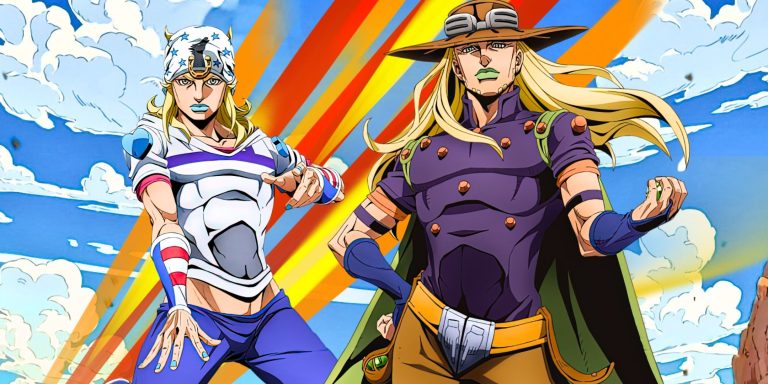
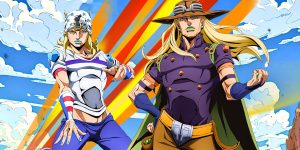
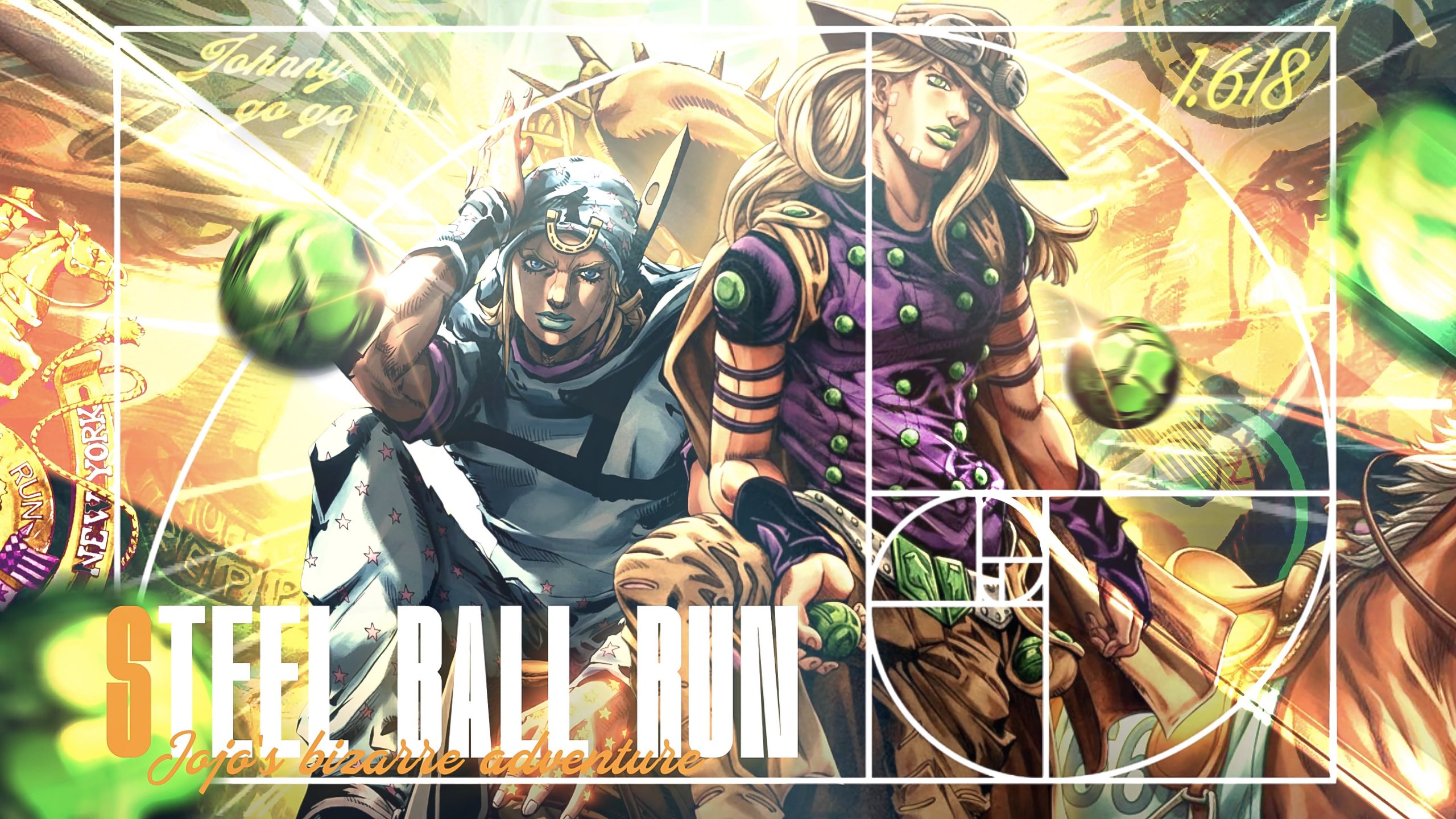
At the beating heart of Steel Ball Run is arguably the most exquisitely written duo in manga history: Johnny Joestar and Gyro Zeppeli. Their dynamic elevates the narrative far above a standard battle shonen, grounding cosmic Stand battles in profound human intimacy.
Johnny Joestar’s Dark Determination
Johnny is a complete subversion of the lineage of righteous Joestars. Paralyzed from the waist down following a tragedy born of his own youthful hubris, Johnny begins the story not as an aspiring hero, but as an embittered, cynical ghost of a disgraced horse prodigy. He is morally ambiguous, cold, and possessed by what Araki frequently terms a “dark determination”—an unyielding, sometimes terrifying willingness to sacrifice anything, including his own soul, to reclaim his ability to walk. His Stand, Tusk, evolves in tandem with his psychological maturation, transforming from a frail, nail-shooting familiar (Act 1) into an interdimensional, unstoppable force of rotational gravity (Act 4).
Gyro Zeppeli and the Majesty of the Spin
Serving as Johnny’s mentor, companion, and philosophical foil is Gyro Zeppeli, a disgraced executioner from the Kingdom of Naples entering the race to secure an amnesty for an innocent child condemned to death. Flamboyant, eccentric, and bearing gold grillz engraved with “GO! GO! ZEPPELI,” Gyro balances out Johnny’s simmering angst with absurdity and razor-sharp competence. More critically, Gyro redefines the franchise’s combat systems by introducing The Spin. A forgotten martial-mystic art rooted in the mathematics of the Fibonacci sequence and the Golden Rectangle, the Spin serves as an organic, biomechanical precursor to Stands. Visualizing the visual language of the Golden Ratio—harnessing rotational energy through high-density steel balls—is poised to be one of the most aesthetically intoxicating spectacles David Production has ever rendered.
The Equestrian Everest: David Production’s Greatest Technical Hurdle
If the thematic depth of Steel Ball Run is a dream for screenwriters, the visual demands are an outright nightmare for animators. There is an open secret within the Japanese animation industry: horses are production killers. Their complex quadrupedal skeletal mechanics, shifting muscular anatomy, and rhythmic gallops require an immense volume of hand-drawn frames that can buckle even premier animation studios.
Steel Ball Run is not an anime where characters occasionally ride horses; it is an anime where dozens of riders spend hundreds of miles jockeying for position at 40 miles per hour across dynamic, uneven terrains. David Production has built an ironclad legacy since 2012 by honoring Araki’s kinetic linework, dynamic color shifts, and distinctive sound-effect kanji. However, Part 7 forces a fundamental evolution of their pipeline:
Industry insiders widely speculate that David Production will need to lean into a sophisticated, cel-shaded 3D CGI hybrid system for the horses, reserving pristine, hand-drawn 2D animation for the characters, close-ups, and climactic Stand skirmishes. The existential question is whether modern digital compositing can seamlessly bridge the gap. If the CG horses break immersion, the visceral weight of the race evaporates. Conversely, if David Production executes a hybrid aesthetic comparable to Orange’s Trigun Stampede or Ufotable’s vehicle sequences, they could pioneer a brand-new standard for cinematic action in episodic anime.
Patriotism, Napkins, and Funny Valentine
Beyond the technical obstacles looms the thematic crown jewel of the series: President Funny Valentine. Armed with the multidimensional Stand Dirty Deeds Done Dirt Cheap (D4C), Valentine represents Araki’s most politically sophisticated antagonist. He is not driven by theatrical megalomania like Dio Brando or petty domestic psychopathy like Yoshikage Kira. Valentine is a zealous nationalist whose philosophical monologues—most famously his discourse on “taking the first napkin” to dictate societal conformity—paint him as a chillingly rational zealot who genuinely believes he is securing prosperity for his people, regardless of the global collateral damage.
The ideological clash between Johnny’s desperate, selfish pursuit of personal salvation and Valentine’s macrocosmic, utilitarian patriotism gives the narrative a crushing thematic weight. When this conflict inevitably graces television screens, it will ignite widespread discourse dissecting the moral architecture of its sprawling ensemble cast.
Reclaiming the Hype Cycle: Distribution Matters
Any candid assessment of the Steel Ball Run anime buzz must acknowledge the structural mistakes of the recent past. The handling of Stone Ocean on Netflix—specifically the disjointed “batch drop” release schedule—severely kneecapped the organic weekly cultural momentum that had historically made JoJo an internet-shattering event. The weekly meme generation, the agonizing anticipation of musical outro reveals, and the communal theory-crafting were prematurely stifled by corporate binge-model logistics.
For Steel Ball Run, the community’s demand is unanimous: this journey must be experienced as an endurance run, not a weekend sprint. A serialized, weekly broadcast schedule across multiple consecutive cours is vital. Part 7 requires space to breathe, allowing viewers to feel the grueling exhaustion of the race alongside Johnny and Gyro as they cross state lines, battle bizarre enemy Stand users, and unravel the cosmic tapestry of the Spin.
The Starting Line Awaits
The anticipation for JoJo’s Bizarre Adventure: Steel Ball Run is more than routine sequel thirst; it is the collective longing for the definitive adaptation of Hirohiko Araki’s creative zenith. The hurdles facing David Production are undeniably monumental—from the biomechanics of racing steeds to the tonal nuance of a crippled protagonist seeking the grace of a second chance. Yet, if the studio has proven anything over the past decade, it is that their reverence for Araki’s universe knows no bounds.
The race has not officially begun, but the riders are gathering at the starting line. When that starting pistol finally fires, the anime world will never be the same.
What are your biggest hopes and fears for David Production’s adaptation of Steel Ball Run? Do you trust a hybrid 3D/2D approach for the horses, and who is your dream voice cast for Gyro Zeppeli? Sound off in the comments below!