Ever since Jolyne Cujoh’s tragic yet transcendent showdown against Enrico Pucci brought the curtain down on the original Joestar bloodline in late 2022, a single, breathless question has echoed across every corner of the anime fandom: What about Part 7? Among manga purists and casual viewers alike, JoJo’s Bizarre Adventure: Steel Ball Run is not merely the next canonical installment—it is widely heralded as Hirohiko Araki’s undisputed magnum opus. Consistently locked near the summit of MyAnimeList’s highest-rated manga of all time, Steel Ball Run represents a seismic tonal, demographic, and artistic reinvention of the franchise. Yet, as the quiet murmur of David Production’s production pipeline transforms into a roaring cultural hum, the industry finds itself at a crossroads between monumental creative expectation and unprecedented technical hurdles.
A Clean Slate in 1890: Araki’s Masterclass in Reinvention
To understand the almost religious fervor surrounding the prospective Steel Ball Run anime, one must first appreciate its historical context within the manga industry. Serialized in 2004, the story initially launched without the explicit “JoJo” moniker before pivoting into the pages of Shueisha’s monthly Ultra Jump. Unshackled from the grueling weekly constraints of Weekly Shonen Jump, Araki abandoned the traditional battle-shonen framework in favor of an expansive, grit-soaked historical epic.
Set across the untamed expanse of late-nineteenth-century North America, the narrative follows the titular Steel Ball Run—a grueling, transcontinental horse race spanning from San Diego Beach to New York City. With a staggering fifty-million-dollar prize on the line, the event attracts an eccentric constellation of gunslingers, duelists, imperial assassins, and grifters. But what begins as an adrenaline-fueled sports marathon quickly mutates into a cosmic conspiracy centered on divine relics, metaphysical evolution, and interdimensional warfare. Araki didn’t just reboot his universe; he elevated his storytelling into the stratosphere of literary historical fiction.
From Punch-Outs to High-Stakes Tactical Realism
Unlike the close-quarters city brawls of Diamond is Unbreakable or the claustrophobic prison drama of Stone Ocean, Part 7 radically expands the physical canvas. Engagements take place across sun-bleached deserts, frozen lakes, and dense midwestern forests. Distance, stamina, terrain management, and weather conditions suddenly carry life-or-death consequences. Stands no longer simply manifest as ghostly, humanoid punching machines; instead, they operate as subtle, terrifying extensions of personal psychology, symbiotic parasites, or kinetic physics-defying anomalies.
Johnny Joestar and Gyro Zeppeli: The Broken Protagonist and the Flamboyant Mentor
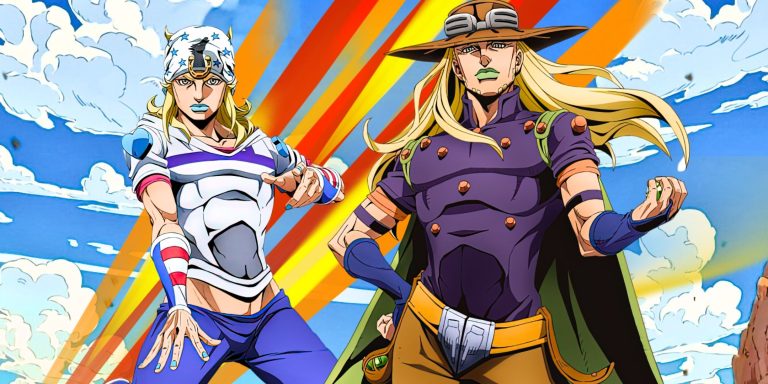
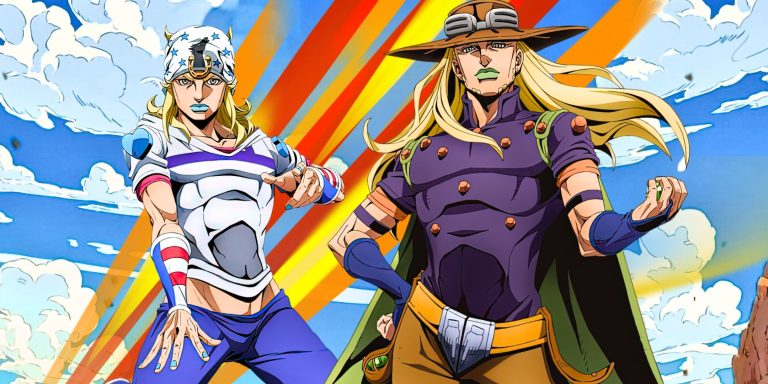
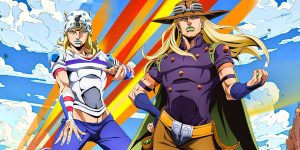
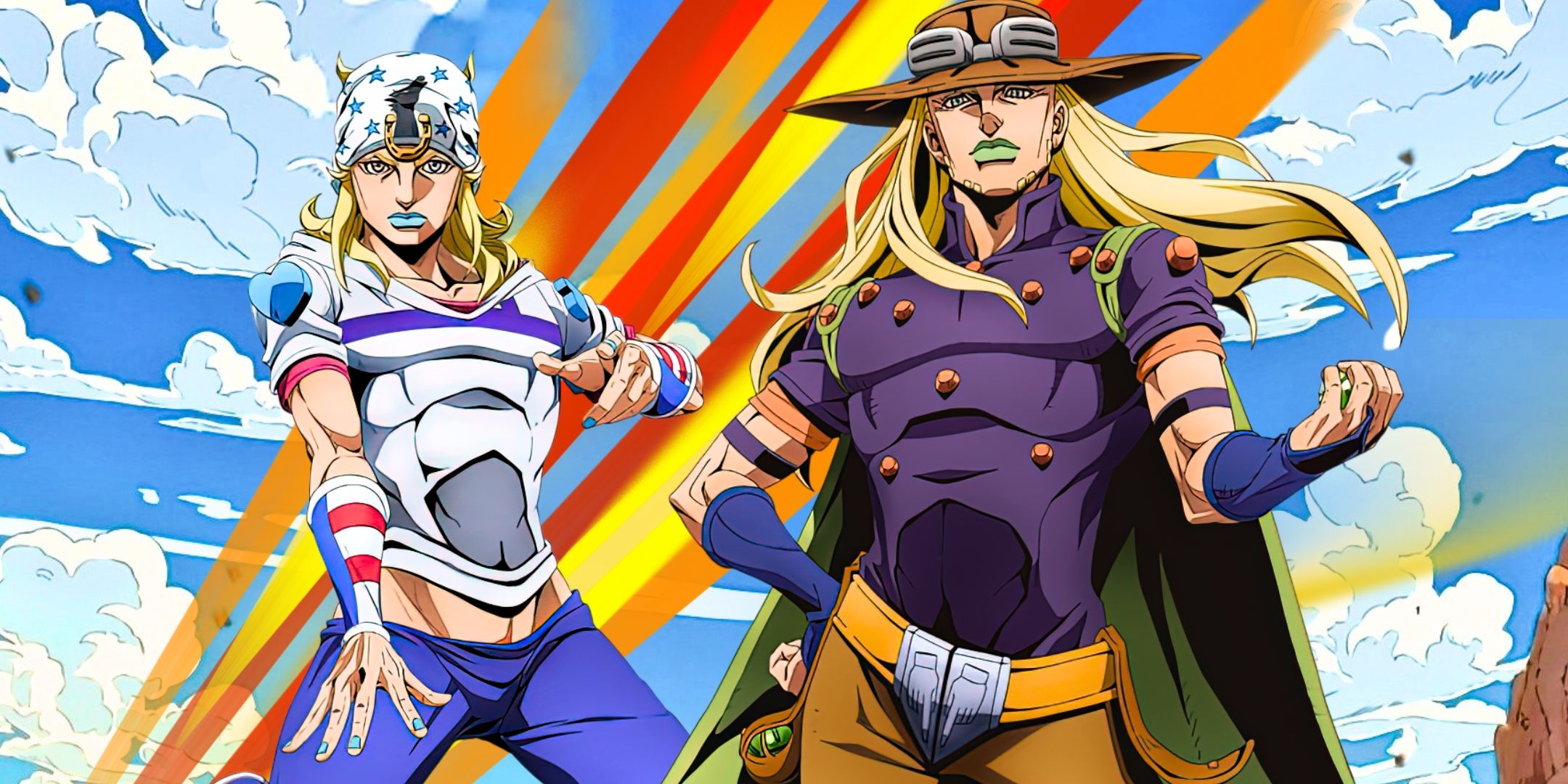
At the beating heart of this sprawling Western lies the most compelling, psychologically layered dynamic Araki has ever penned: Johnny Joestar and Gyro Zeppeli. On paper, they appear to be standard archetypes, but Araki subverts expectations at every turn.
Johnny Joestar is fundamentally distinct from previous lineage patriarchs like Jonathan or Jotaro. A former jockey prodigy who was paralyzed from the waist down due to his own youthful arrogance and vanity, Johnny begins his odyssey stripped of dignity, purpose, and hope. He is not driven by righteous altruism or noble justice. When Johnny looks at his enemies, his eyes possess what Araki famously describes as “the dark determination”—a ruthless, borderline terrifying willingness to kill to reclaim his mobility and self-worth. His Stand, Tusk, visually charts this agonizing internal evolution, mutating from a helpless, infantile entity into an apocalyptic colossus as Johnny confronts his deepest psychological traumas.
The Metaphysics of the Golden Spin
Contrasting Johnny’s brooding existentialism is Gyro Zeppeli, a disgraced Neapolitan executioner armed with steel spheroids and an indomitable, eccentric swagger. Gyro enters the race not for glory, but out of an agonizing sense of moral duty: to win the prize money and secure an amnesty pardon for an innocent child condemned to die on his homeland’s gallows.
Through Gyro, Araki introduces the franchise’s most intricate mechanical system: The Spin. Serving as an evolutionary spiritual successor to the original timeline’s Ripple (Hamon), the Spin is rooted in Renaissance mathematics and the Golden Ratio—a sacred geometric spiral found throughout the natural world. Watching Gyro mentor Johnny through the five progressive “Lessons” of the Spin provides the emotional bedrock of the entire series. Their campfire banter, absurd improvised songs, and hard-earned mutual respect forge a brotherhood that stands unmatched across contemporary shonen and seinen media.
The Elephant in the Room: David Production’s Equestrian Nightmare
If the narrative of Steel Ball Run is universally celebrated, its transition to television is universally dreaded by production coordinators. The root of this trepidation boils down to a fundamental reality of the medium: horses are an animator’s worst nightmare.
Equine anatomy features complex muscle contractions, shifting skeletal frameworks, and a mesmerizing four-beat gallop that pushes even master 2D key animators to the brink of exhaustion. In modern anime production—which routinely battles tight broadcast deadlines and talent crunches—hand-drawing dozens of galloping horses interacting dynamically across changing horizons is virtually suicidal. WIT Studio and MAPPA pushed their teams to the edge just handling cavalry skirmishes in Attack on Titan and Vinland Saga; Steel Ball Run, by contrast, demands relentless horseback traversal for dozens of consecutive episodes.
David Production, who have adapted parts 1 through 6 with unparalleled stylistic reverence, face an unprecedented technological Rubicon. Industry whispers and production analysts suggest a hybrid pipeline is inevitable:
- Advanced Cel-Shaded 3DCG: High-density 3D models for steeds (like Johnny’s mount, Slow Dancer, and Gyro’s Valkyrie) to maintain consistent perspective and rotational velocity during wide kinetic sequences.
- Hand-Drawn Close-Ups and Cross-Hatching: Hand-crafted 2D corrections overlaying digital armatures during key dramatic clashes, preserving Araki’s iconic high-contrast manga hatching.
- Unreal Engine Environment Work: The procedural generation of vast American frontiers to allow continuous, sweeping virtual camera movements without bankrupting the background art team.
The studio’s prolonged public silence post-Stone Ocean strongly suggests they are taking the necessary pre-production time to establish this ambitious infrastructure rather than rushing an unpolished product out the door.
Patriotism, Relics, and the Menace of Funny Valentine
No discussion of Steel Ball Run is complete without its central antagonist: the 23rd President of the United States, Funny Valentine. Armed with the reality-shifting Stand D4C (Dirty Deeds Done Dirt Cheap) and driven by a zealot’s desire to secure global dominance for America, Valentine represents one of anime’s most chillingly pragmatic villains.
Valentine’s quest to assemble the mummified pieces of the miraculous “Holy Corpse” scatters philosophical complexity across the entire narrative. He does not seek petty villainy; his famous “Napkin” monologue delivers a terrifyingly articulate thesis on power dynamics, historical destiny, and collective consensus. When the narrative reaches its crescendo, audiences are forced to ask an uncomfortable question: Is our selfish, broken protagonist Johnny actually in the right, or is he burning down a nation’s salvation purely for his personal redemption?
The Verdict: The Horizon Beckons
The adaptation of JoJo’s Bizarre Adventure: Steel Ball Run will not just be another anime premiere; it will be an industry watershed moment. If David Production can harness cutting-edge hybrid rendering to conquer the equestrian frontier, they will breathe life into Hirohiko Araki’s most emotionally profound, narratively airtight, and artistically daring saga. The road from San Diego to New York is unforgiving, brutal, and lined with blood—and anime fans will happily endure every grueling month of waiting if it means seeing Johnny and Gyro ride under the western sun done right.
What do you think is the biggest challenge David Production faces with Steel Ball Run? Can CGI horses truly capture the grit of Araki’s manga pages, or should the studio take a multi-year hiatus to animate it in hand-drawn glory? Sound off in the comments below!