Ever since the melancholic, celestial strings of Stone Ocean’s climax settled over the fandom, the global anime ecosystem has existed in a state of suspended animation. For over a decade, David Production has undertaken one of the most audacious, faithful adaptation marathons in modern media history, translating Hirohiko Araki’s multi-generational bloodline epic into a kaleidoscopic anime phenomenon. Yet, towering on the horizon is the undisputed summit of Araki’s creative evolution: Part 7: Steel Ball Run. Sitting permanently near the pinnacle of manga review aggregates worldwide, this trans-continental odyssey is not merely the next chapter in the pipeline; it represents David Production’s ultimate technical and narrative frontier.
The murmurs surrounding an eventual adaptation have evolved from speculative wishful thinking into a deafening roar. As rumors of pre-production and staff allocation churn through social feeds and industry forums, one truth remains self-evident: bringing Steel Ball Run to the small screen is a monumental gambit that will either redefine what serialized anime can achieve or expose the absolute limits of contemporary studio workflows.
A Seinen Rebirth: The Narrative Evolution of the Joestar Mythos
To understand the near-mythic reverence surrounding Steel Ball Run, one must appreciate the context of its birth. Originally serialized in Weekly Shonen Jump before migrating to the monthly, older-demographic haven of Ultra Jump in 2005, Part 7 signaled a radical paradigm shift for Hirohiko Araki. Freed from the pacing pressures and thematic constraints of typical shonen demographic mandates, Araki retooled his storytelling mechanics with literary prestige.
Set against the sprawling, mythic backdrop of late-19th-century America, Steel Ball Run decouples itself from the original continuity to establish an alternate timeline. This was no ordinary universe reset; it was an artistic palate cleanser. The narrative ditches urban turf wars and ancestral curses in favor of a grueling, trans-American horseback race stretching 6,000 kilometers from San Diego to New York City. The race itself—drenched in dust, steam, and greed—functions as an extraordinary canvas that weaves historical Americana with avant-garde supernatural horror.
Broken Idols and Spin Masters: The Psychology of Johnny and Gyro
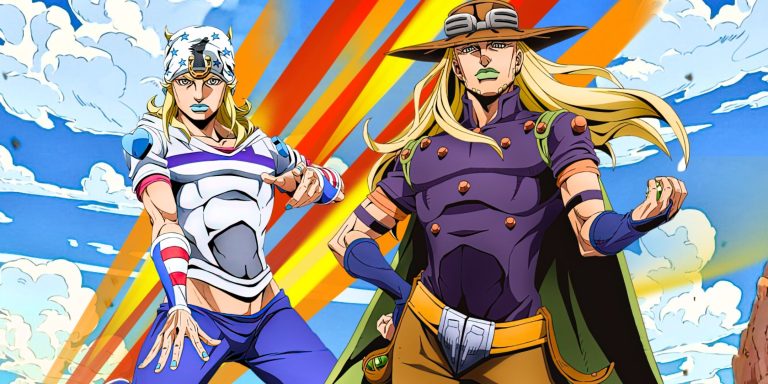
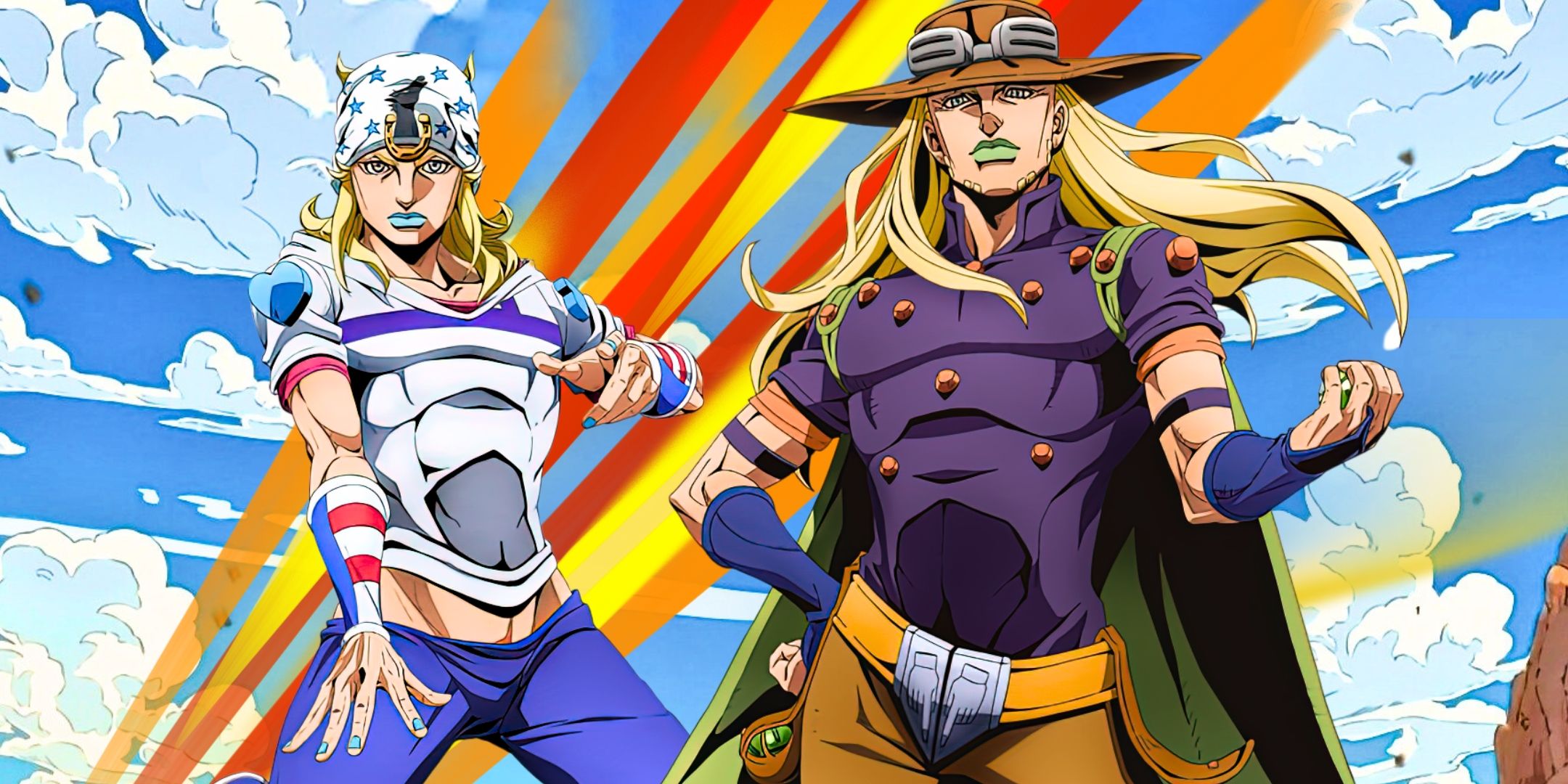
At the beating heart of Part 7’s critical acclaim is the dual-lead dynamic between Johnny Joestar and Gyro Zeppeli—easily the most intricate, psychologically layered character writing Araki has ever penned. Rather than presenting another archetype of unyielding chivalry akin to Jonathan Joestar, Johnny enters the narrative as a deeply flawed, paraplegic former jockey. Consumed by self-loathing, arrogance, and spiritual paralysis, Johnny is defined by an unnerving “dark determination”—a moral ambiguity rarely granted to titular protagonists.
Johnny’s quest is not fundamentally about saving the world or accumulating fame; it is an agonizing, intensely private pursuit of self-reclamation. His journey from complete physical and emotional brokenness toward spiritual renewal provides the story with profound thematic resonance.
The Golden Ratio and the Metaphysics of The Spin
Complementing Johnny’s introverted cynicism is Gyro Zeppeli, a flamboyant Neapolitan executioner’s son armed with steel spheres and razor-sharp charisma. Gyro’s introduction revolutionizes the combat mechanics of the series by introducing The Spin. While Stands remain integral to the combat taxonomy, the Spin is treated as a miraculous martial discipline grounded in the mathematical beauty of the Fibonacci sequence and the Golden Rectangle.
The Spin is not simply an offensive weapon; it is an existential philosophy. Through Gyro’s mentorship, the mastering of kinetic rotational energy acts as a tangible metaphor for Johnny’s physical rehabilitation and existential maturation. The thematic integration of sacred geometry into psychic Stand manifestations—such as Johnny’s evolving Stand, Tusk, and Gyro’s Ball Breaker—elevates combat from visceral brawling to high-concept conceptual chess.
The Great Equine Dilemma: David Production’s Formidable Technical Hurdle
If Steel Ball Run is so universally adored, why the agonizing hesitation? The answer lies in the harsh realities of commercial animation. In the anime industry, there is an infamous, universally recognized axiom: horses are an animator’s waking nightmare.
A galloping horse demands an intricate, four-beat anatomical cadence, constant shifting of muscular volume, and complex perspective shifts that push traditional 2D animators to their breaking points. Steel Ball Run is not a show with a single incidental carriage scene; it is a marathon featuring dozens of named characters engaged in high-velocity horseback combat across changing terrains for dozens of continuous episodes.
Industry observers widely speculate that David Production cannot tackle this colossal project through traditional 2D methods alone. For an adaptation of this scale to avoid disastrous production crunches, the studio will likely need to engineer a hybrid pipeline:
Integrating bespoke, cell-shaded 3DCG horse rigs that mirror the studio’s signature textural line art, while reserving expressive, hand-drawn 2D animation for character portraits, close-up interactions, and climatic Stand clashes. David Production has already proven its technological versatility through the dynamic environment assets in Fire Force and the stylish pop-art aesthetic of *Urusei Yatsura*, but Part 7 demands an unprecedented fusion of computational efficiency and organic hand-drawn prestige.
Patriotism, Relics, and the Philosophy of the ‘First Napkin’
An epic narrative requires a foil of matching gravity, and in President Funny Valentine, Araki crafted arguably the finest antagonist in the entire JoJo canon. Serving as the 23rd President of the United States, Valentine is driven by an unyielding, chauvinistic desire to secure the scattered, miraculous parts of the Saint’s Corpse to guarantee his nation’s eternal dominance.
Valentine’s multidimensional Stand, Dirty Deeds Done Dirt Cheap (D4C), introduces dizzying temporal and spatial complexities. Yet, it is his philosophical conviction—famously encapsulated in his rhetorical treatise on who determines society’s direction by being the one to pick up the “first napkin”—that gives the series its profound ideological friction. Unlike the sadism of Dio Brando or the psychopathic isolationism of Yoshikage Kira, Valentine represents the seductive, terrifying purity of absolute political utilitarianism. The moral clash between Johnny’s desperate, localized selfishness and Valentine’s grandiose, collectivist zeal creates a thrilling ideological showdown rarely rivaled in modern manga.
Verdict: The White Whale of Modern Anime Adaptations
The buzz surrounding David Production’s eventual announcement is more than the continuation of a beloved franchise; it is a referendum on the ambition of the modern anime landscape. Steel Ball Run stands as Hirohiko Araki’s peak creative synthesis—a masterstroke combining historical fiction, existential philosophy, grotesque body horror, and heart-wrenching camaraderie.
Whenever the first teaser visual finally drops—whether heralded by the clattering of iron horseshoes, the humming vibration of a spinning steel sphere, or the quiet twang of an acoustic guitar against an open western prairie—it will ignite the internet and mark the beginning of an era. The journey through the American wilderness is grueling, hazardous, and undeniably bizarre. If David Production can harness this untamable beast, they will not merely produce a great adaptation; they will deliver a generational classic.
What are your absolute non-negotiable expectations for the Steel Ball Run anime adaptation? Do you trust David Production to nail the complex horse animation with 3D/2D hybrid technology, and who is your dream voice cast for Gyro Zeppeli? Sound off in the comments below, and stay tuned to Wibux.com for breaking JoJo updates!