When the opening chords of “Jaka Jaan”—composed by Zedd alongside Yukinojo Mori—first echoed across television screens and streaming platforms worldwide, the global anime community collectively held its breath. October 2024 was always intended to be a victory lap: the monolithic 40th anniversary of Akira Toriyama’s Dragon Ball. Yet, following Toriyama’s tragic passing in March 2024, the premiere of Dragon Ball Daima transformed from an eagerly awaited seasonal launch into an emotionally charged cultural event. This isn’t merely another corporate brand extension; it is the master’s deliberate, deeply personal swansong. Rather than resting on the universe-shattering, god-tier power escalations of Dragon Ball Super, Daima takes a bold, introspective detour that plunges our heroes into uncharted canonical territory: the shadowy, long-whispered depths of the Demon Realm (Makai).
The Architecture of Makai: Decades of Lore Finally Realized
For decades, the Demon Realm was the ultimate blank canvas in Dragon Ball lore. Aside from brief glimpses of Dabura in the Majin Buu arc and non-canon expansions scattered across spin-off video games like Dragon Ball Heroes and Xenoverse, the cosmological underbelly of Toriyama’s universe remained shrouded in myth. Dragon Ball Daima immediately cures this systemic lore deficit within its premiere broadcast, investing substantial screen time into intricate, diegetic worldbuilding.
King Gomah, Degesu, and the Glaring Void of Majin Buu
The premiere recontextualizes the climactic battle against Kid Buu from an entirely fresh perspective: through the surveillance crystals of the Demon Realm’s throne room. With Dabura fallen on Earth, the throne passes to King Gomah, a diminutive, paranoid ruler who, alongside his smug advisor Degesu (the estranged brother of Shin, the Supreme Kai), watches the Z-Fighters dismantle Buu in utter disbelief. By tying Degesu directly to Universe 7’s sacred lineage, Toriyama elegantly mirrors the divine and demonic realms, confirming that the Core People (Shinjin) possess deep biological and cultural ties across dimensions.
Fearing that Goku and company will eventually set their sights on Makai, Gomah and Degesu orchestrate a preemptive strike using Earth’s Dragon Balls, re-energized by the ancient, withered Namekian sorcerer Neva. Rather than simply wishing for absolute destruction, Gomah makes the cunning decision to regress the Z-Fighters and their allies into children—an echo of classic Toriyama mischief that serves a dual purpose of disarming Earth’s protectors while fundamentally resetting the franchise’s power ceiling.
Beyond the GT Comparisons: Reclaiming the Spirit of Pure Adventure
When Toei Animation first revealed Goku’s diminutive stature in early teasers, cynical fandom chatter immediately branded Daima as “Dragon Ball GT 2.0.” The premiere aggressively dispels this superficial comparison within minutes of its runtime. Where GT turned Goku into an underpowered child primarily as an uncoordinated plot device, Daima utilizes the de-aging phenomenon to strip away decades of bloated power-scaling and return Goku to the kinetic, tactile roots of physical martial arts.
The Resurrected Power Pole and Kinetic Combat
Goku rediscovering his center of gravity as a child is played with exquisite comedic timing, but it also carries immense tactical consequence. The premiere highlights Goku training with his iconic Power Pole (Nyoibo), an artifact relegated to the background for nearly thirty years. Toriyama’s visual storytelling shines here: when arms and legs are shorter, hand-to-hand combat must become more resourceful, fluid, and rhythmic. By shifting the threat away from galaxy-erasing energy blasts and refocusing on leverage, spatial awareness, and staff techniques, Daima recaptures the whimsical kineticism that made the original 1984 run a timeless classic.
Visual Masterclass: Nakatsuru, Yashima, and Toei’s Modern A-Team
From an aesthetic and structural standpoint, Dragon Ball Daima is undeniably the most visually consistent, lavishly animated television premiere in the franchise’s history. Under the co-direction of seasoned storyboarder Yoshitaka Yashima and the visionary Aya Komaki (renowned for her transcendent direction on One Piece’s Wano Arc), the premiere effortlessly balances modern digital compositing with the hand-drawn ethos of the 1990s golden era.
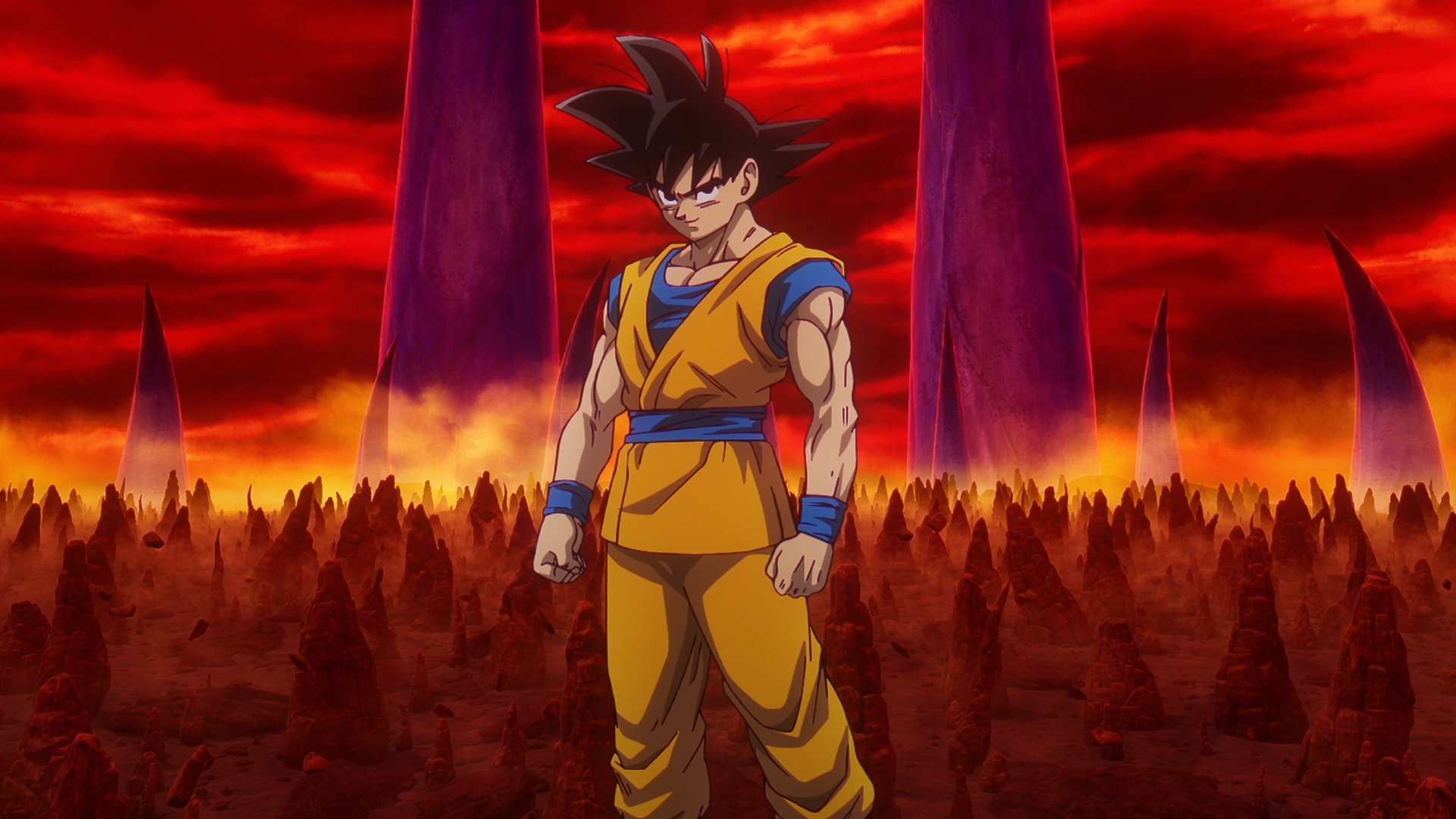
Legendary character designer Katsuyoshi Nakatsuru returns to translate Toriyama’s modern, rounded character sketches into motion, yielding an art style brimming with life. Shading is kept organic, linework remains expressive, and the environmental backdrops of both the Sacred World of the Kai and the crimson-tinged Demon Realm possess atmospheric painterly depth. Toriyama’s personal fascination with idiosyncratic vehicle designs and fantastical creatures is on full display; the premiere revels in quirky insectoid crafts and mechanical switches, grounding the adventure in the late auteur’s unmistakable industrial retro-futurism.
The Fandom’s Bittersweet Symphony: Reception and Emotional Resonance
The global reaction to Daima’s premiere has been overwhelmingly poignant. While social media platforms were flooded with frame-by-frame breakdowns of lore connections and praise for the fluid fight choreography, an underlying thread of bittersweet reverence defined the conversation. Fandom spaces that had previously argued bitterly over power-tier lists and canonical validity banded together to celebrate the creator’s artistic fingerprints, which are indelibly stamped across every single minute of the premiere.
Community sentiment has made one thing abundantly clear: Dragon Ball Daima feels uniquely authored. In a contemporary media landscape dominated by algorithmic story beats and soulless revivals, Daima boasts the spontaneous, unpredictable, and joyful nature of Akira Toriyama simply drawing whatever made him smile. The lighthearted banter between Goku and Vegeta, Piccolo’s deadpan acceptance of his pint-sized state, and the whimsical introduction of mysterious new companions like the rogue Glorio showcase a narrative that refuses to take itself too seriously, even as it dramatically expands the world’s canon.
Toriyama’s Parting Gift to Shonen Culture
The premiere of Dragon Ball Daima accomplishes what many modern legacy sequels fail to grasp: it honors the past without being held hostage by it. By deliberately descending into the mysterious Demon Realm, Goku is no longer merely fighting to defend the status quo of Earth; he is venturing out as an explorer into the unknown, driven by pure curiosity and the infectious thrill of a brand-new journey.
As the episode closes and Goku sets his sights beyond the planar veil of Universe 7, viewers are left with the comforting realization that Toriyama left us precisely where he started: wide-eyed, smiling, and ready for an unforgettable adventure. Dragon Ball Daima is a vibrant, lovingly crafted monument to the man who defined modern manga, reminding us that no matter how powerful Goku becomes, his greatest strength will always be his boundless sense of wonder.
What were your favorite callbacks and lore reveals in the premiere of Dragon Ball Daima? Are you ready to see Goku dive deeper into the mysteries of the Demon Realm? Sound off in the comments below, and keep your scouters locked to Wibux.com for weekly episode breakdowns and anime retrospectives!