


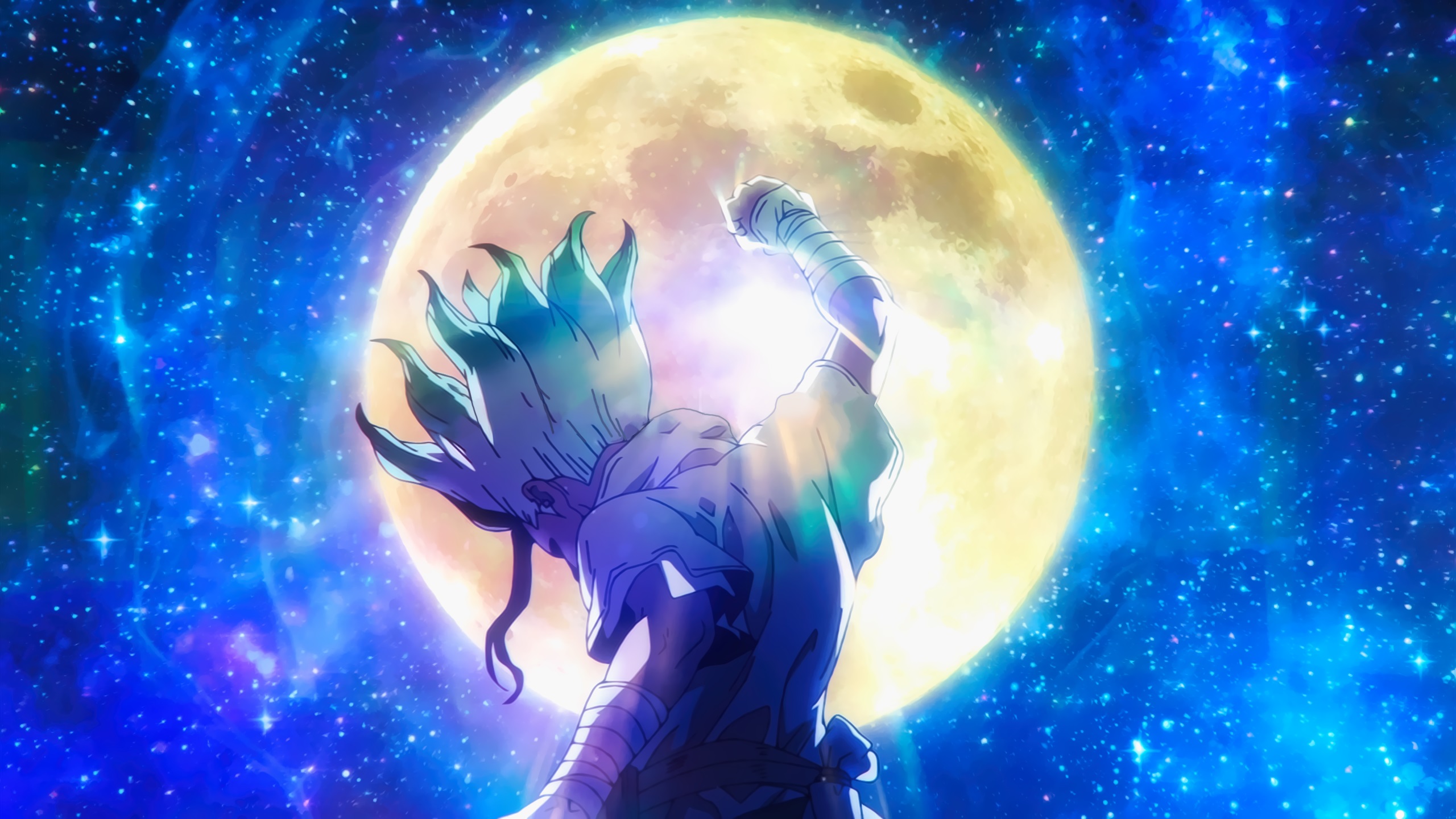
When Senku Ishigami first broke free from his limestone shell in the overgrown ruins of post-apocalyptic Tokyo, his armory consisted of wild mushrooms, caustic bat guano, and a stubborn refusal to let civilization die. Over four seasons, Riichiro Inagaki and Boichi’s celebrated masterpiece has defied the traditional battle-shonen doctrine. It replaced ki blasts and cursed energy with the thermodynamic laws of the universe, proving that human ingenuity is the ultimate superpower. Now, as TMS Entertainment gears up for Dr. STONE: Science Future—officially confirmed as the anime adaptation’s fourth and final season—the Kingdom of Science faces an ambition so colossal it dwarfs every waterwheel, cell phone, and steam engine crafted thus far: launching a manned expedition to the moon to confront the architect of humanity’s 3,700-year slumber.
This is not merely an escalation of scale; it is the culmination of an ideological battle. The upcoming finale will push the narrative across planetary boundaries, bringing the enigmatic radio frequency that haunted Senku from the heavens into direct, kinetic focus. For longtime followers of the franchise, Science Future represents a monumental victory lap for modern anime storytelling.
The Apollo Leap: Constructing Mankind’s Greatest Marvel from Scratch
The journey to the lunar surface is arguably the most audacious narrative pivot in modern shonen history. Where lesser series might rely on a sudden magical power-up or a hidden ancient relic to bridge an impossible gap, Dr. STONE doubles down on its foundational ethos: agonizing, step-by-step technological progression. Senku’s crew cannot simply wish themselves into orbit; they must rebuild the global industrial supply chain from the soil up.
Following the globe-trotting logistics established in New World, Science Future demands an unprecedented scale of manufacturing. Viewers will witness the Kingdom of Science transform into an international industrial syndicate. Constructing a spacecraft capable of breaking Earth’s gravitational pull requires materials that primitive forges cannot dream of handling—pure silicon, advanced telemetry circuits, liquid oxygen, precision rocketry, and lightweight alloys.
What makes this trajectory compelling from an anime journalist’s perspective is how it recalibrates the narrative tension. The antagonist of the early phases is not a roaring monster, but the cruel precision of orbital mechanics. Every weld on the rocket’s hull, every circuit soldered by Kaseki’s weathered hands, and every line of primitive assembly code engineered by the Kingdom carries the terrifying weight of life or death. The narrative transforms into an exhilarating procedural drama, honoring NASA’s Golden Age while retaining the electric, pop-art kineticism that defines Boichi’s visual heritage.
The Ghost in the Static: Unraveling the Mystery of Why-Man
The Morse Code Spectre
No discussion of Science Future can exist without addressing the chilling enigma that transformed the series from a survivalist comedy into a cosmic mystery: Why-Man. Ever since the Kingdom of Science cobbled together their first radio receiver and picked up the hypnotic, synthesized cadence of a single English question—“WHY”—the tone of the series irrevocably shifted. That haunting broadcast was not just a plot device; it was an existential shot across the bow.
Why-Man represents the ultimate subversion of Senku’s worldview. Where Senku views science as a universal tool for liberation and altruistic elevation, Why-Man deploys technology as a weapon of total, cold-blooded subjugation. The realization that the entity operates from the surface of the moon elevated the series from an Earthbound reconstruction project into a desperate interplanetary counter-offensive.
The Paradox of the Medusa Device
Central to this upcoming showdown is the nature of the Petrification Device itself—colloquially named the “Medusa.” Throughout the narrative, the device has behaved as both a tomb and an elixir, capable of halting biological decay indefinitely and even reversing fatal injuries upon de-petrification. Inagaki’s thematic framework shines brightest here: Is petrification an apocalyptic curse, or was it an agonizingly calculated act of preservation? The confrontation between Senku and Why-Man will peel back the philosophical layers of the Great Petrification, forcing audiences to wrestle with questions regarding mortality, human evolution, and the staggering arrogance of playing God among the stars.
TMS Entertainment’s Final Stand: Adapting Boichi’s Masterwork
From an animation production standpoint, TMS Entertainment shoulders a historic responsibility. Boichi’s manga illustrations reached an almost hallucinatory level of mechanical and anatomical detail during the lunar arc. His double-page spreads of launch vehicles, mission control telemetry, and the desolate lunar landscapes are masterclasses in ink-and-paper drafting. Translating that sheer visual density into motion without over-relying on soulless CGI is the central trial awaiting the production team.
Directed across previous iterations by the steady hands of Shingo Iino and Shuhei Matsushita, the anime has historically balanced stylized, exaggerated character comedy with cinematic, hyper-realistic renderings of scientific inventions. For Science Future, the studio must elevate its compositing and sound design to theatrical levels. The roar of rocket engines, the dead, terrifying vacuum of deep space, and the dizzying vastness of the Earth seen from low orbit demand an atmospheric palette far more mature than the sunlit forests of the Ishigami Village saga. Fans should expect an ambitious visual tour-de-force that pushes the studio’s hybrid 2D/3D workflows to their absolute limit.
The Psychology of the Launch: Generational Relay and Human Will
Beneath the formulas and circuitry, Dr. STONE has always been an emotional relay race run across thousands of years. The core tragedy—and triumph—of Senku’s character is that he is living out the dream his adoptive father, Byakuya Ishigami, could only watch slip away from the cupola of the International Space Station as humanity turned to stone.
The lunar mission represents the poetic closing of a generational loop. Byakuya left behind platinum, stories, and unconditional faith; Senku answers that legacy by returning humanity to the cosmos his father once gazed down from. This emotional undercurrent elevates the mission beyond a simple military strike against an alien antagonist. It is a declaration that human curiosity cannot be chained to the ground, no matter how many millennia of silence are forced upon it.
Furthermore, the three-person crew chosen to journey into the dark will force an extraordinary dynamic of trust, skill, and sheer psychological grit. Chrome’s evolutionary leap from an ignorant “sorcerer” to a legitimate aerospace thinker serves as the thematic soul of the final season: proof that the flame of scientific inquiry does not belong to Senku alone, but burns instinctively within all of humanity.
The Definitive Culmination of the Modern Shonen Era
In an industry currently dominated by grimdark fantasy, multiversal combat, and supernatural carnage, Dr. STONE: Science Future stands as a defiant, glorious anomaly. It remains an unapologetic love letter to human tenacity, peer review, and the unyielding beauty of the periodic table. It daringly argues that our greatest weapon against existential dread is not the sword, but the notebook.
As Senku Ishigami stands on the launchpad, pointing his index finger toward the heavens with his trademark grin, we are preparing to witness the end of one of the most uniquely inspirational franchises ever serialized in Weekly Shonen Jump. The countdown has begun, the propellant is pressurized, and the final frontier awaits.
Are you prepared for the final launch, Kingdom of Science? What are your theories on the true identity and origin of Why-Man? Drop your hypotheses in the comments below, and keep your transceivers locked to Wibux.com for exclusive breakdowns, episode reviews, and animation deep-dives.