

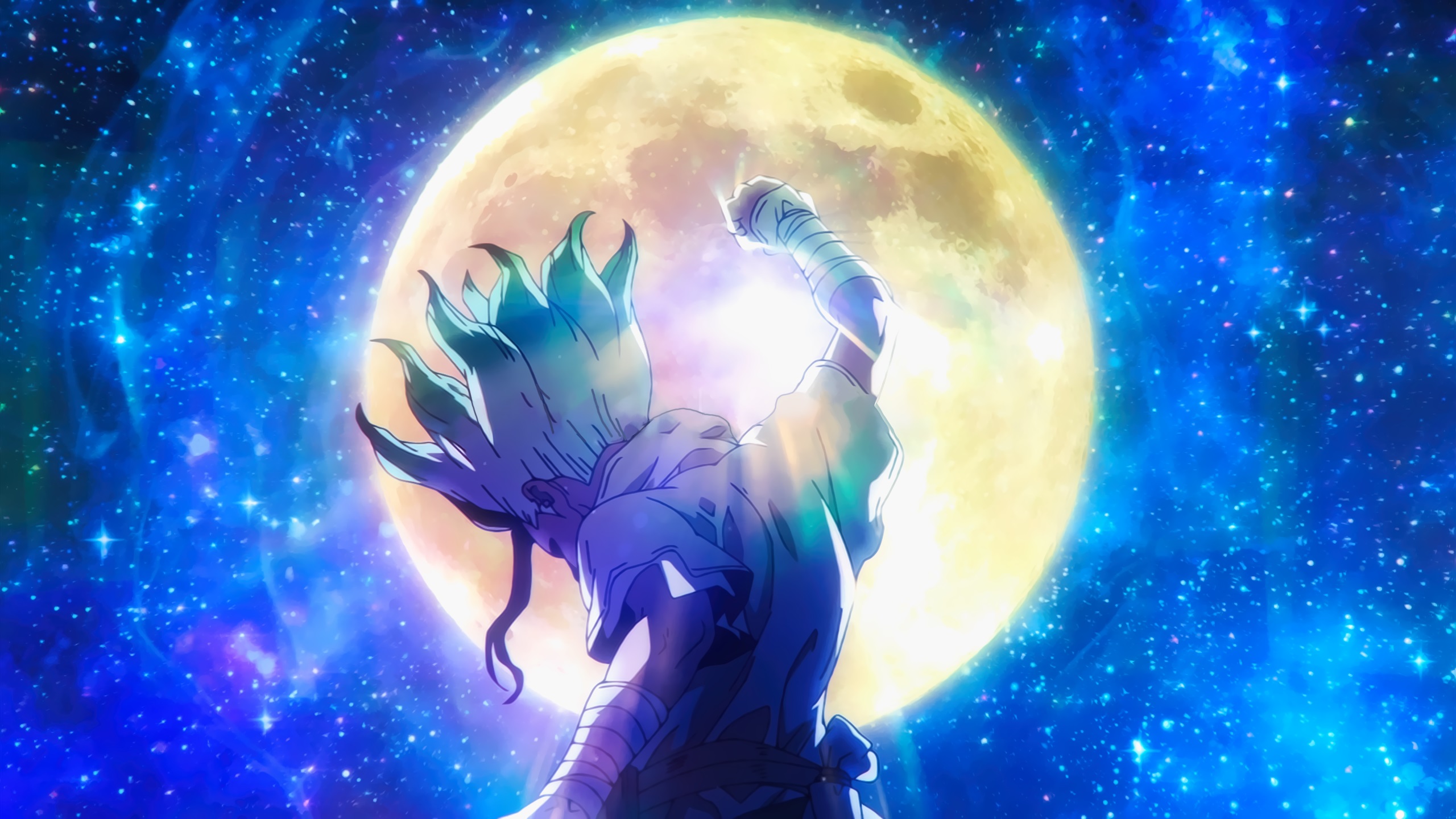
When Senku Ishigami awoke from 3,700 years of petrified isolation, armed with nothing more than an encyclopedic recall of periodic tables and sheer, unyielding stubbornness, few could have anticipated the breathtaking narrative trajectory that lay ahead. Shonen jump titles traditionally measure power scaling through escalating energy blasts, supernatural awakenings, or shattered mountain ranges. Dr. STONE, however, dared to wage its battles across the periodic table. From concocting crude calcium carbonate fertilizer to building cathode-ray tubes out of bamboo and copper wire, Riichiro Inagaki and Boichi’s magnum opus has consistently treated scientific enterprise as the ultimate superpower. Now, as TMS Entertainment gears up for the fourth and final season, Dr. STONE: Science Future, the Kingdom of Science stands on the precipice of its most audacious milestone yet: crossing the vacuum of space to touch the Moon and facing down the cosmic enigma known as Why-Man.
From Dirt-Floor Chemistry to the Sea of Tranquility
The progression of Dr. STONE has always been a masterclass in narrative compounding. Every kiln fired, every copper wire wound, and every drop of nitric acid distilled serves as an indispensable prerequisite for the next technological leap. In Science Future, this progression escalates from incremental community-building to a breathtaking global industrial logistics campaign. Crafting a single chemical compound is child’s play compared to constructing a multistage orbital launch vehicle in a world where modern supply chains have been dead for nearly four millennia.
The Industrial Symphony of Global Resource Gathering
Before Senku can even dream of igniting a rocket engine, the Kingdom of Science must construct a hyper-specialized global network. Viewers who marveled at the creation of the Perseus ship in New World are about to witness logistics on an unprecedented scale. Reaching orbit demands rare earth metals, liquid oxygen, precision electronics, and high-purity superalloys. This narrative sprint circles the planet, establishing outposts from the Americas to the South Pacific. It is a stunning thematic declaration: humanity’s survival is not a solitary endeavor, but a coordinated planetary effort. The sheer audacity of witnessing stone-age primitives master CNC machinery, microchips, and aerospace engineering provides an intoxicating rush that no conventional combat tournament arc could ever replicate.
Deconstructing Why-Man: The Existential Core of the Stone World
Ever since that chilling, automated radio transmission interrupted Senku’s communications with a synthesized voice repeating “WHY”, the shadow of Why-Man has loomed over the series like an eldritch specter. The antagonist of Dr. STONE has never been a mustache-twirling warlord; even previous adversaries like Tsukasa Shishio and Ibara were driven by desperate, albeit warped, philosophical rationales. Why-Man, operating from the silent desolation of the lunar surface, represents something vastly more disquieting: an unyielding technological paradox.
The Sterile Promise of Stagnation vs. The Pain of Progress
The impending confrontation on the Moon cuts directly to the thematic core of the franchise. The petrification beam—the Medusa—is not inherently an engine of destruction; it is a mechanism of stasis. By halting cellular decay, the green light effectively grants eternal preservation at the expense of consciousness, evolution, and agency. Why-Man views the petrification of humanity as an act of calculated mercy or cold utilitarian logic. In direct contrast stands Senku Ishigami, a champion of the messy, painful, beautiful reality of biological life. To Senku, mortality, suffering, and failure are the very crucibles that forge technological innovation. The lunar showdown is fundamentally a philosophical duel: Is it better to sleep peacefully forever in indestructible stone, or to bleed, burn, and build among the stars?
Character Psychology at Zero Gravity: The Weight of 3,700 Years
While the hard-science mechanics remain the show’s intellectual engine, its emotional resonance has always been driven by the ghosts of the past. The lunar landing is not just an engineering triumph; it is a profound familial reconciliation. Millennia ago, Byakuya Ishigami watched the Earth turn to stone from the cupola of the International Space Station, spending the remainder of his life leaving resources, audio recordings, and hope behind for his adoptive son. When Senku breaks through the Earth’s atmosphere, he is physically entering the domain where his father gazed down upon the world.
Furthermore, the dynamic within the Moon Mission vanguard highlights how far the ensemble cast has evolved. Chrome’s transformation from an insecure “primitive sorcerer” collecting shiny rocks to a genuine, peer-level aerospace contributor serves as an emotional anchor for the entire story. Alongside him, warriors like Kohaku and ideological wildcards like Tsukasa and Stanley Snyder demonstrate the holistic reconciliation of humanity. The weapons of war have been systematically repurposed into the tools of exploration—a poetic subversion of real-world aerospace history, which was famously born from the terrors of the Cold War ballistic missile race.
TMS Entertainment’s Production Gambit: Translating Boichi’s Hyper-Detailed Vision
Adapting the final stretch of the manga presents TMS Entertainment with its steepest visual challenge yet. Boichi’s illustration style is renowned for its hyper-kinetic linework, anatomical exaggeration, and obsessively researched technical diagrams. In Science Future, the animation studio must strike a delicate balance between hard-vacuum realism and the vibrant, Saturday-morning exuberance that defines the franchise’s visual identity.
Depicting space travel demands absolute mechanical authenticity: the deafening roar of stage separation, the silent physics of cold-gas thrusters, and the terrifying expanse of pitch-black zero gravity. Directorial restraint will be just as crucial as dynamic action sequences. The auditory shift from Tatsuya Kato and Hiroaki Tsutsumi’s triumphant folk-orchestral themes to the suffocating, ambient silence of the lunar surface has the potential to produce some of the most chilling, cinematic moments in modern shonen history.
The Legacy of Shonen’s Most Optimistic Masterpiece
In an anime landscape often dominated by grimdark deconstructions, psychological trauma, and nihilistic battlegrounds, Dr. STONE has remained a beacon of radical optimism. It dares to believe that human curiosity is fundamentally good, that civilization is worth fighting for, and that science—when driven by empathy—can overcome any obstacle. Dr. STONE: Science Future is not merely concluding a storyline; it is delivering a triumphant eulogy for the Stone Age and planting humanity’s flag firmly in tomorrow.
When the final countdown strikes zero and the engines roar to life, audiences won’t just be cheering for a shonen protagonist defeating an enemy. They will be cheering for the human spirit, echoing through billions of years of evolution, screaming into the cosmic void that we are alive, we are curious, and we will never stop exploring.
Are you ten billion percent ready for the Kingdom of Science’s final voyage? Which invention from Senku’s arsenal has been your absolute favorite throughout the journey? Drop your thoughts, theories, and launch predictions in the comments below!