
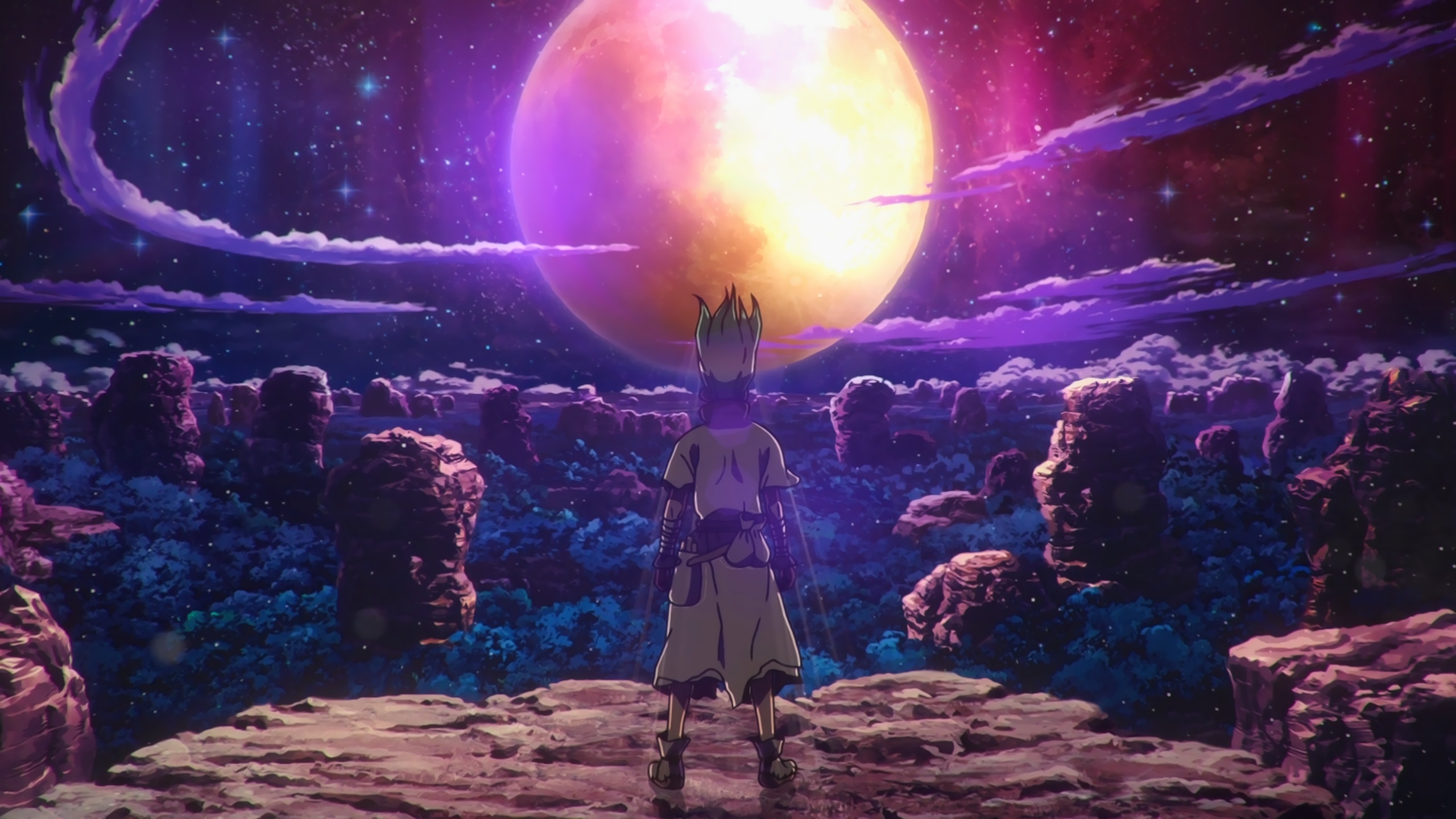
When Senku Ishigami broke free from his stone casing in the year 5738 AD, clad in nothing but ragged deer pelt and armed only with an encyclopedic memory of the periodic table, the idea of reaching the cosmos seemed laughably absurd. Modern anime history is littered with protagonists who inherit ancient bloodlines, unlock celestial powers, or summon world-shattering spells to alter their destinies. Dr. STONE took a radically counter-cultural path: it wagered that the grinding, failure-prone, peer-reviewed pursuit of human empirical science was thrilling enough to anchor a premier Weekly Shonen Jump franchise. Now, with the impending arrival of Dr. STONE: Science Future—the multi-cour fourth and final season helmed by TMS Entertainment—that singular gamble enters its definitive orbit.
The stakes have ceased to be purely logistical or territorial. The upcoming finale will see the Kingdom of Science break gravity’s bonds, launching a crew to the Moon to confront the petrification’s enigmatic instigator: the radio voice known simply as Why-Man. What began as a battle for basic primitive survival has evolved into an interplanetary techno-thriller, pitting Senku’s indefatigable optimism against an existential riddle that has paralyzed humanity for nearly four millennia.
Building the Apollo Program from Scratch: The Logistical Miracle
The trajectory toward Science Future represents one of the most mechanically satisfying escalation curves in contemporary storytelling. Most shonen narratives escalate by inflating power scales—destroying cities, then planets, then dimensions. Riichiro Inagaki’s writing, bolstered by the scientific consulting of Kurare, took the opposite approach: scaling infrastructure. To build a rocket capable of a lunar rendezvous, the Kingdom of Science could not merely discover a mystical relic; they had to rebuild global supply chains from the bedrock up.
Across previous seasons, fans watched Senku conquer metallurgy, chemistry, communications, and oceanic navigation. Science Future contextualizes the global tour undertaken across the Americas, South America, and beyond—procuring aluminum, petroleum, rubber, and rare earth minerals. The narrative turns the planetary landscape into a grand strategy matrix where every resource collected is an essential node in an intricate technological tree.
This grounding in material reality gives the upcoming Moon mission a visceral, earned weight. When the engines finally ignite, viewers aren’t just observing a space launch; they are witnessing the culmination of thousands of hours of blacksmithing, microscopic manual labor, circuit weaving, and mathematical calculations performed on slide rules and rudimentary computers. It is human ingenuity stripped of plot armor, elevated by blood, sweat, and raw calculus.
The Shadow on the Moon: Unraveling the Mystery of Why-Man
While the mechanical engineering of a lunar rocket provides the kinetic thrust of the season, the ideological core revolves around Why-Man. Ever since that chilling Morse code broadcast—a synthetic, hollow repetition of the word “WHY”—hijacked Senku’s crude radio towers, the series adopted the cadence of existential cosmic horror. The entity residing on the lunar surface represents a total inversion of everything Senku values.
The Philosophical Divergence of Immortality
Without diving recklessly into structural spoilers for anime-only viewers, the nature of Why-Man and the Medusa devices (the petrification mechanisms) shifts Dr. STONE from a lighthearted edutainment adventure into high-concept speculative science fiction. The Medusa beam isn’t merely a weapon; it is an ontological paradox. It freezes biological life in suspended animation, granting functional immortality at the cost of agency, thought, and self-determination.
Why-Man’s perspective fundamentally questions the human drive: Why struggle? Why suffer the entropic decay of biological aging, war, and disease when you can sleep in eternal, crystalline perfection? Senku’s rebuttal is the philosophical heartbeat of the entire franchise. To Senku, life without curiosity, progression, and the capacity to fail is not survival—it is merely inert matter. The lunar showdown is fundamentally a dialectic between stagnation masquerading as peace and the messy, dangerous, beautiful engine of scientific advancement.
Character Trajectories: The Weight of 3,700 Years
The emotional payload of Science Future rests heavily on the generational baton pass between Senku and his adoptive father, Byakuya Ishigami. Byakuya’s presence has loomed over the narrative like a guardian star. His decision to leave behind the Soyuz record, the Platinum capsules, and stories of endurance on Treasure Island laid the precise groundwork for Senku’s arrival. The Moon mission serves as the symbolic rendezvous between Byakuya’s legacy—stranded in orbit aboard the International Space Station watching Earth turn to stone—and his son’s arrival decades of centuries later to reclaim it.
Furthermore, the three-person crew designated for the mission crystallized the series’ core archetypes. The narrative demands not just raw intellect, but psychological grit and physical supremacy:
Chrome’s Evolution: Chrome’s trajectory from a backwoods “sorcerer” collecting curious rocks to a genuine aerospace innovator represents the natural democratization of science. He is living proof that scientific inquiry is an innate human instinct rather than an elite privilege.
The Moral Synthesis: Former ideological adversaries like Tsukasa Shishio and Ryusui Nanami illustrate the series’ thematic maturity. Tsukasa’s initial vision of an uncorrupted, agrarian utopia has softened through an understanding of necessity; Ryusui’s insatiable greed has been completely recontextualized as an engine for collective ambition. When these forces harmonize inside a single spacecraft, the narrative achieves a profound thematic synthesis.
TMS Entertainment’s Celestial Challenge: Animation and Pacing
For TMS Entertainment and the production committee, adapting the climax of Boichi’s breathtaking manga illustrations is a monumentally steep hill to climb. Boichi’s hyper-detailed, dynamic rendering of space hardware, zero-gravity physics, and cosmic environments pushed the boundaries of static art. The transition to fluid animation under director Shuhei Matsushita demands an uncompromised artistic budget.
Dividing Science Future into multiple cours is the single most encouraging production choice announced for the finale. Compressing the final arcs into a standard 12 or 24-episode order would have severely compromised the pacing, gutting the meticulous trial-and-error sequences that make the eventual triumphs so exhilarating. By pacing the adaptation deliberately, TMS Entertainment can allow the atmospheric claustrophobia of the lunar voyage and the metaphysical confrontation with Why-Man room to breathe, backed by Tatsuya Kato, Hiroaki Tsutsumi, and Yuki Kanesaka’s soaring, synth-meets-orchestral score.
The Enduring Legacy of Ten Billion Percent Optimism
In an anime landscape currently saturated with cynical anti-heroes, grimdark fantasies, and escapist power fantasies, Dr. STONE stands as a rare beacon of secular optimism. It is a show that unashamedly champions collective human effort, international cooperation, and rational skepticism. It reminds audiences that our real-world modern infrastructure—the electricity humming in our walls, the glass screens beneath our fingertips, the medical vaccines in our veins—is every bit as magical as a sorcerer’s incantation.
As Dr. STONE: Science Future prepares to launch its final sequence, it carries the expectations of a massive global fandom eager to see human civilization fully restored. Whether Senku’s gambit against Why-Man ends in unconditional triumph or hard-won compromise, one truth remains unshakeable: humanity’s reach will always extend outward, driven by an unyielding desire to understand the mechanics of the universe.
How do you feel about the Kingdom of Science finally going extraterrestrial? Do you believe the anime can stick the landing with Why-Man’s controversial identity? Sound off in the comments below, and stay locked to Wibux.com for all your episodic breakdowns and production analyses as the final season approaches.