

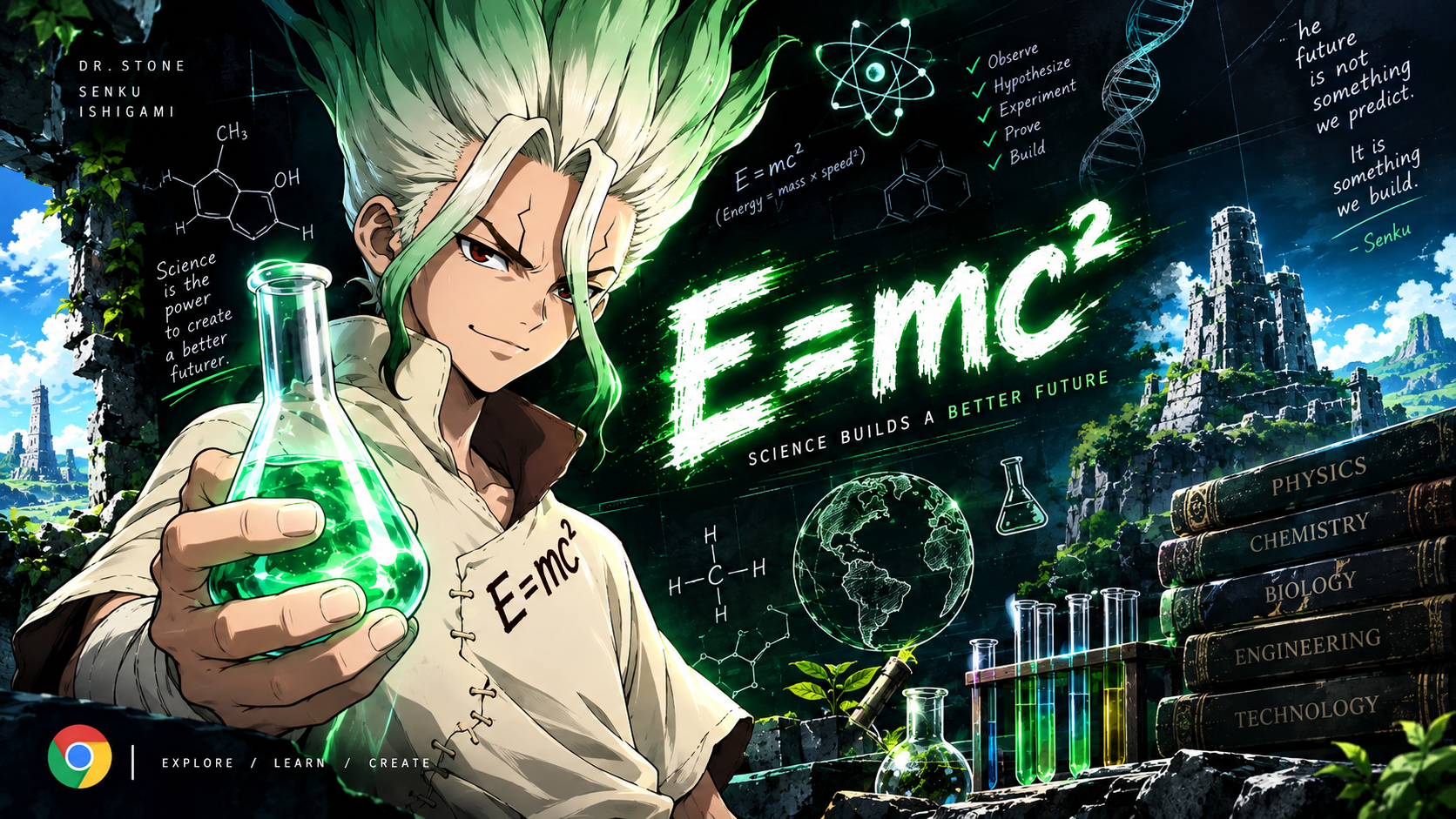
When Riichiro Inagaki and Boichi first serialized Dr. STONE in the pages of Weekly Shonen Jump back in 2017, the premise felt almost absurdly optimistic. While contemporary modern shonen leaned heavily into supernatural curses, demonic pantheons, and existential dark-fantasy brutality, Senku Ishigami wielded calcium carbonate and unyielding rationality. Fast-forward through three critically acclaimed seasons, an explosive TV special, and an entire stone-age industrial revolution: the Kingdom of Science stands on the precipice of its magnum opus. With the greenlight of Dr. STONE: Science Future, the fourth and final season, the series prepares to launch its most narratively daring and technically colossal undertaking yet—a one-way ticket to the Moon to confront humanity’s petrifying specter, Why-Man.
For longtime fans, this climactic adaptation by TMS Entertainment is not merely the close of another high-profile production; it is the poetic culmination of a modern anime classic. The series is bridging the gap between primitive survivalism and the aerospace frontier, taking an anime that began with hand-carved stone axes and escalating it to liquid-fueled propulsion systems and celestial exploration.
The Ultimate Technological Leap: From Primitive Kilns to Apollo-Grade Engineering
The upcoming narrative arc of Science Future demands an unprecedented scale. Where previous seasons focused on regional infrastructure—developing sulfa drugs in Ishigami Village or navigating the treacherous waters toward Treasure Island—the final stretch requires a truly planetary mobilization. Senku’s ambition is no longer bounded by geography; it is bound by the laws of gravitational escape velocity.
Constructing a Global Supply Chain
To build a rocket capable of reaching lunar orbit, the Kingdom of Science must transition into a geopolitical entity. Viewers will witness a hyper-accelerated recapitulation of modern human logistics. The story spans the globe to secure raw rubber, petroleum, rare-earth metals, and astronomical quantities of aluminum. What makes Inagaki’s writing continually exceptional is its refusal to hand-wave the grueling trial-and-error inherent to engineering. The lunar mission is not presented as an overnight miracle, but as an agonizing series of failed launches, metallurgical bottlenecks, and iterative computer programming. This commitment transforms theoretical physics into high-octane narrative suspense.
The Resonating Echo of Byakuya’s Legacy
Looming over this technological sprint is the profound emotional specter of Byakuya Ishigami. Dr. STONE has always grounded its analytical chill in cross-generational human warmth. Humanity was petrified while looking down from the International Space Station, where Byakuya and his fellow astronauts survived to plant the seeds of civilization’s rebirth. Senku’s ascent into the stratosphere represents a thematic homecoming—a son physically ascending to the heavens to finish the mission his father preserved across 3,700 years of dormancy. It lends the impending space race a rare, tear-jerking emotional weight that sets it leagues apart from standard sci-fi showdowns.
Confronting the Void: Deconstructing Why-Man and the Petrification Paradox
No mystery in modern anime has brewed with as much quiet dread as the phantom voice broadcasting on 12.8 kilohertz. First intercepting the Kingdom of Science’s wireless communications with a relentless, mechanical repetition of the English word “WHY,” Why-Man has evolved from an unsettling broadcast glitch into an existential adversary perched upon the lunar surface.
The confrontation awaiting viewers in Science Future moves beyond physical combat; it is an ideological duel over the fundamental nature of existence. Why-Man represents cosmic indifference—or perhaps an alien, synthetic logic that perceives the Medusa petrification beam not as a weapon of mass extinction, but as a twisted gift of eternal life. The biological fragility of humanity, characterized by mortality, disease, and emotional volatility, stands in direct contrast to the immutable, petrified stasis forced upon the planet. Senku’s entire ethos argues that life is only precious because of its struggle and finite nature, setting the stage for an explosive thematic resolution when astronaut boots finally kick up lunar dust.
Character Psychology at Terminal Velocity: The Tripod Crew Dynamic
The logistics of a lunar landing introduce strict resource and payload limitations, crystallizing one of the manga’s tensest narrative debates: who actually gets on the rocket? The psychological interplay among the chosen crew encapsulates the thematic triumvirate of Dr. STONE’s worldview:
Senku provides the sheer, uncompromising computational genius—the intellectual vanguard who refuses to rely on intuition when empirical data is available. Counterbalancing him is Ryusui Nanami, the embodiment of human greed repurposed as an engine for progress. Ryusui’s navigation skills and insatiable desire to conquer the unknown supply the psychological audacity required to launch oneself into a pitch-black abyss. Rounding out the necessary dynamics are physical brawn and ground-level intuition, demanding that former mortal enemies, such as Tsukasa Shishio, and primitive savants like Chrome, confront their limitations against the endless vacuum of space.
Watching these distinct worldviews coalesce under zero gravity provides the narrative rocket fuel. Inagaki constructs an ensemble that is intensely specialized, demonstrating that scientific achievement is never the victory of a lone genius, but the radical synchronization of disparate human talents.
TMS Entertainment’s Production Pedigree: Animating the Infinite
Adapting the final arcs of Boichi’s manga is an intimidating artistic challenge. Boichi’s visual language during the space-race chapters is defined by staggering micro-detail—cross-sections of combustion chambers, macro-lensed circuit boards, and vast, terrifying vistas of Earth curving away into the ink-black expanse of the cosmos. TMS Entertainment, alongside director Shuhei Matsushita, has consistently respected this technical density while maintaining kinetic action choreography.
The auditory landscape will equally dictate the season’s resonance. Composers Tatsuya Kato, Hiroaki Tsutsumi, and Yuki Kanesaka face the challenge of evolving the show’s musical identity. Transitioning from the rustic Celtic folk, stone whistles, and tribal rhythms of the early seasons toward expansive synth-orchestral motifs mirrors humanity’s own sonic transition from campfire songs to the silence of the vacuum. Early production murmurs suggest that Science Future will feature a multi-cour rollout, affording the production team the structural runway necessary to avoid the dreaded pacing compression that has plagued other high-profile shonen finales in recent memory.
The Scientific Humanism of Dr. STONE: A Defining Modern Legacy
In an anime landscape dominated by chosen-one prophecies, bloodline awakenings, and sudden power scaling, Dr. STONE has carved out a singular legacy. Its core thesis has always been profoundly humanist: human progress is not magic; it is an agonizing, step-by-step accumulation of knowledge passed down through sweat, failure, and collaborative survival. Senku does not win because he possesses supernatural luck; he wins because humanity spent two million years figuring out how to build levers, smelt iron, and calculate orbital trajectories.
Dr. STONE: Science Future promises to be a thrilling, intellectually validating conclusion to one of the most creatively daring anime of the last decade. As Senku Ishigami gears up to fire his thrusters toward the lunar horizon, the series is primed to prove that the human spirit—when fortified by science—is genuinely capable of conquering the infinite.
Are you ten billion percent ready for the final frontier? How do you think the anime will handle the truth behind Why-Man and the Medusa devices? Sound off in the comments below, and stay tuned to Wibux.com for all your weekly Dr. STONE breakdowns!