


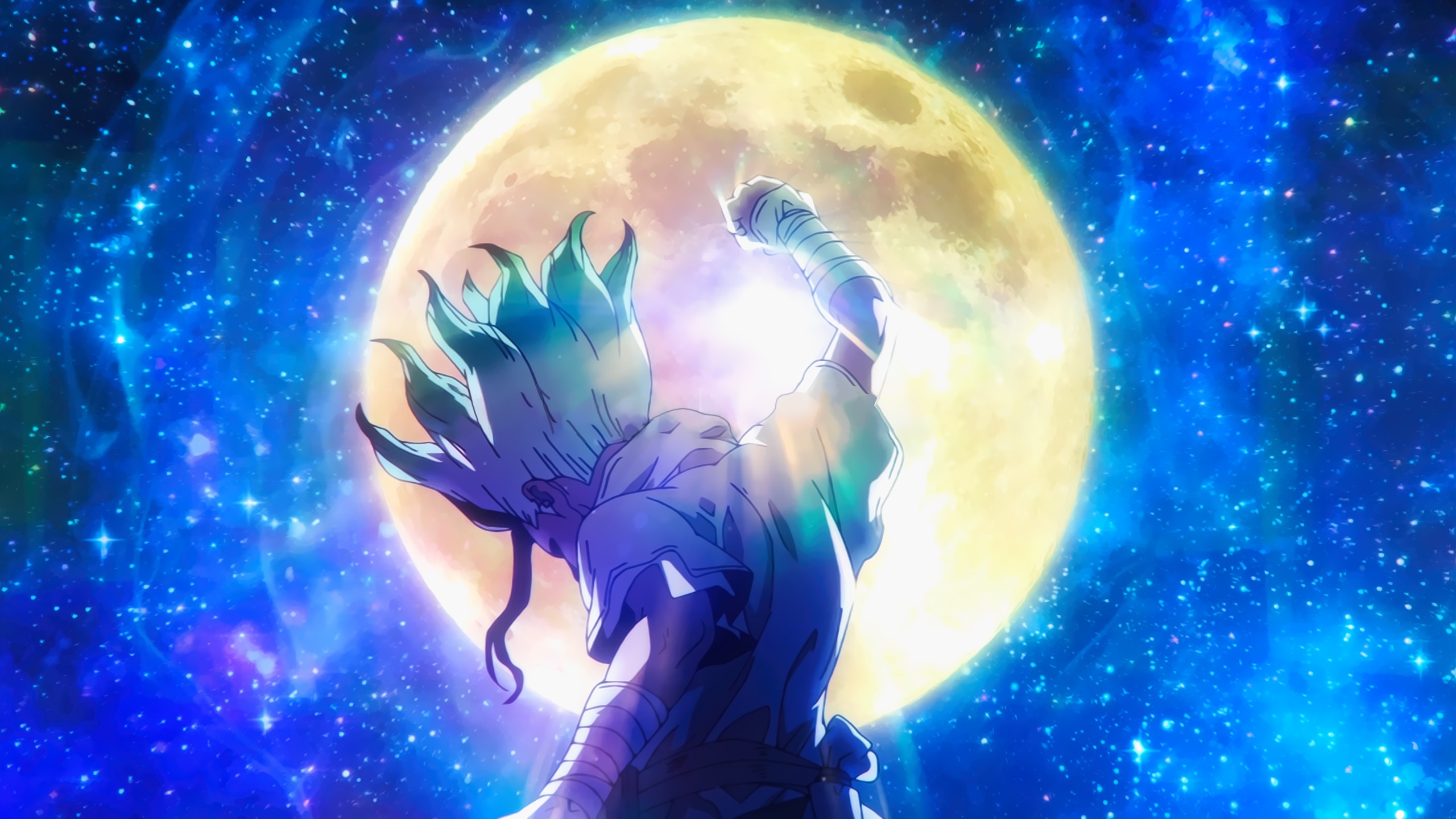
When Riichiro Inagaki and Boichi first introduced audiences to Senku Ishigami waking up in 5738 CE—clad in crude deer hide and armed with little more than an encyclopedic recall of the periodic table—few mainstream anime fans anticipated the sheer velocity of the technological acceleration that would follow. From mixing calcium carbonate into rudimentary mortar to distilling nitric acid and weaving copper wire for primitive dynamos, the Kingdom of Science has treated two million years of human civilization as a frantic, high-stakes speedrun. Now, with the arrival of Dr. STONE: Science Future, the fourth and final season handled by TMS Entertainment, the narrative pivots from terrestrial survival to the infinite abyss of space. Senku’s final frontier is not merely a logistical marvel; it represents a cultural turning point for modern shonen storytelling, transforming an educational adventure into an existential confrontation on the surface of the Moon.
The Apollo Trajectory: Scaling From Primitive Dirt to Cosmic Orbit
The progression of Dr. STONE has always relied on a compounding curve of technological development, but Science Future demands an unprecedented qualitative leap. In previous seasons, the Kingdom of Science solved immediate survival crises: penicillin to defeat illness, cellphones to win an information war, and ocean-faring galleons to cross the Pacific. However, escaping the Earth’s gravitational pull requires the synthesis of disciplines that cannot be improvised through sheer willpower. Rocketry demands precise petrochemical refinement, high-tolerance metallurgy, telemetry networks, and, most crucially, advanced computing.
The Computational Leap and the Global Supply Chain
To launch a payload capable of carrying human beings to lunar orbit, Senku and his brain trust must manufacture microchips, magnetic core memory, and programmable logic from scratch. This transition marks a profound tonal shift in the narrative. The story departs from cozy communal crafting and morphs into a globe-trotting logistics thriller. Raw materials like tungsten, aluminum, and crude oil must be sourced across continents, forcing characters like Ryusui Nanami and Chelsea Childe to coordinate global extraction routes. Science Future effectively captures the staggering truth of humanity’s real-world Space Race: reaching the stars is never the achievement of a lone eccentric genius, but the aggregated labor of millions of interconnected hands.
Unmasking Why-Man: Deconstructing the Great Lunar Paradox
Looming over every blueprint, blast furnace, and launch calculation is the chilling shadow of Why-Man. First introduced as an anomalous, automated Morse code transmission repeating the English word “WHY” across global radio frequencies, this antagonist represents one of the most uniquely terrifying entities in contemporary anime. Why-Man is not a standard battle-shonen warlord boasting destructive martial arts; he is an omnipresent, unblinking question mark sitting on the lunar surface, radiating an existential chill over the entire rebuilt civilization.
Mechanical Threat or Biological Philosophy?
The central thematic clash of this final arc centers on the petrification mechanism itself: the Medusa devices. Why-Man’s weapon of choice granted humanity a bizarre form of immortality by turning biological tissue to stone, preserving consciousness across millennia at the cost of total physical paralysis. As Senku designs the spacecraft intended to confront this lunar entity, the show sets up a clash between two fundamentally irreconcilable philosophies. Is eternal stasis preferable to the chaotic, self-destructive freedom of human progress? Why-Man’s motives challenge the very premise of civilization, transforming what began as an engineering procedural into an inquiry into whether humanity actually deserves the technological power it wields.
Production Pedigree: How TMS Entertainment Faces the Zero-G Hurdle
Behind the scenes, the weight of bringing this monumental conclusion to life falls squarely on TMS Entertainment. Under the steady directorial vision of Shuhei Matsushita, the studio has consistently delivered vibrant, kinetically satisfying adaptations of Boichi’s famously hyper-detailed manga artwork. However, Science Future introduces a visual aesthetic entirely alien to the lush, verdant landscapes of post-petrification Earth. The animators must now contend with sterile cleanrooms, fiery atmospheric launch sequences, orbital mechanics, and the eerie, desaturated desolation of the lunar regolith.
Translating Boichi’s Hyper-Detailed Mechanical Draftsmanship
One of the manga’s greatest strengths during this climax was Boichi’s almost obsessive rendering of complex machinery—every valve, rocket nozzle, wiring harness, and circuit trace was drawn with reverent, industrial accuracy. TMS Entertainment faces the delicate balance of integrating complex 3D CGI models for spacecraft and launch vehicles alongside the hyper-expressive, often comedic hand-drawn character animation that grounds the franchise. If the visual spectacle of the Saturn-style rocketry fails to communicate the awe-inspiring, terrifying power of thousands of pounds of combustible thrust, the emotional resonance of the mission collapses. Early production signals, however, suggest that the studio is treating the multi-cour finale with the prestige and cinematic grandeur usually reserved for feature films.
The Anti-“Chosen One”: Senku’s Humanist Philosophy
What elevates Dr. STONE above the crowded landscape of supernatural power systems and chosen-one archetypes is Senku Ishigami’s unshakable character psychology. Senku does not possess superhuman strength, divine ancestry, or plot armor driven by emotional fury. His superpower is pragmatic patience. In an industry dominated by instantaneous power-ups and spiritual awakening, Senku’s ethos remains delightfully grounded: science is simply the steady, step-by-step rules of the universe applied through relentless trial and error.
This dynamic shines brightest through his interactions with the ensemble cast. The mission to the Moon does not rely solely on Senku’s mind; it demands Chrome’s unfiltered, primitive intuition, Ryusui’s insatiable desire that transmutes greed into exploratory ambition, and Gen Asagiri’s psychological manipulation to maintain morale across an exhausted populace. By positioning science as a shared, democratic inheritance rather than an elitist secret, the journey to Why-Man becomes a celebration of collective human agency. Every character, regardless of physical prowess or historical origin, holds a critical wrench in the machine that will take them into the cosmos.
The Final Frontier for Shonen Jump’s Smartest Titan
As Dr. STONE: Science Future prepares to close the book on Riichiro Inagaki’s modern masterpiece, it stands as an anomalous triumph within Weekly Shonen Jump. It proved that an intellectual premise, rooted in verifiable physics, chemistry, and history, could rival the sheer adrenaline of demon slayers and pirate captains without compromising its core message. The impending showdown with Why-Man is more than a standard boss battle; it is the ultimate affirmation of humanity’s refusal to surrender to oblivion.
When Senku finally straps into the cockpit and sets his sights on that blinding white sphere in the night sky, viewers will not just be watching an astronaut blast off—they will be witnessing the culmination of millions of years of human persistence defying the silence of the universe. Ten billion percent, this is a finale that anime history will not soon forget.
Are you prepared for the emotional launch of Dr. STONE: Science Future? What are your theories on Why-Man’s ultimate origins, and can the anime adaptation stick the landing of Boichi’s intricate manga finale? Drop your thoughts, theories, and launch-day expectations in the comments below!