


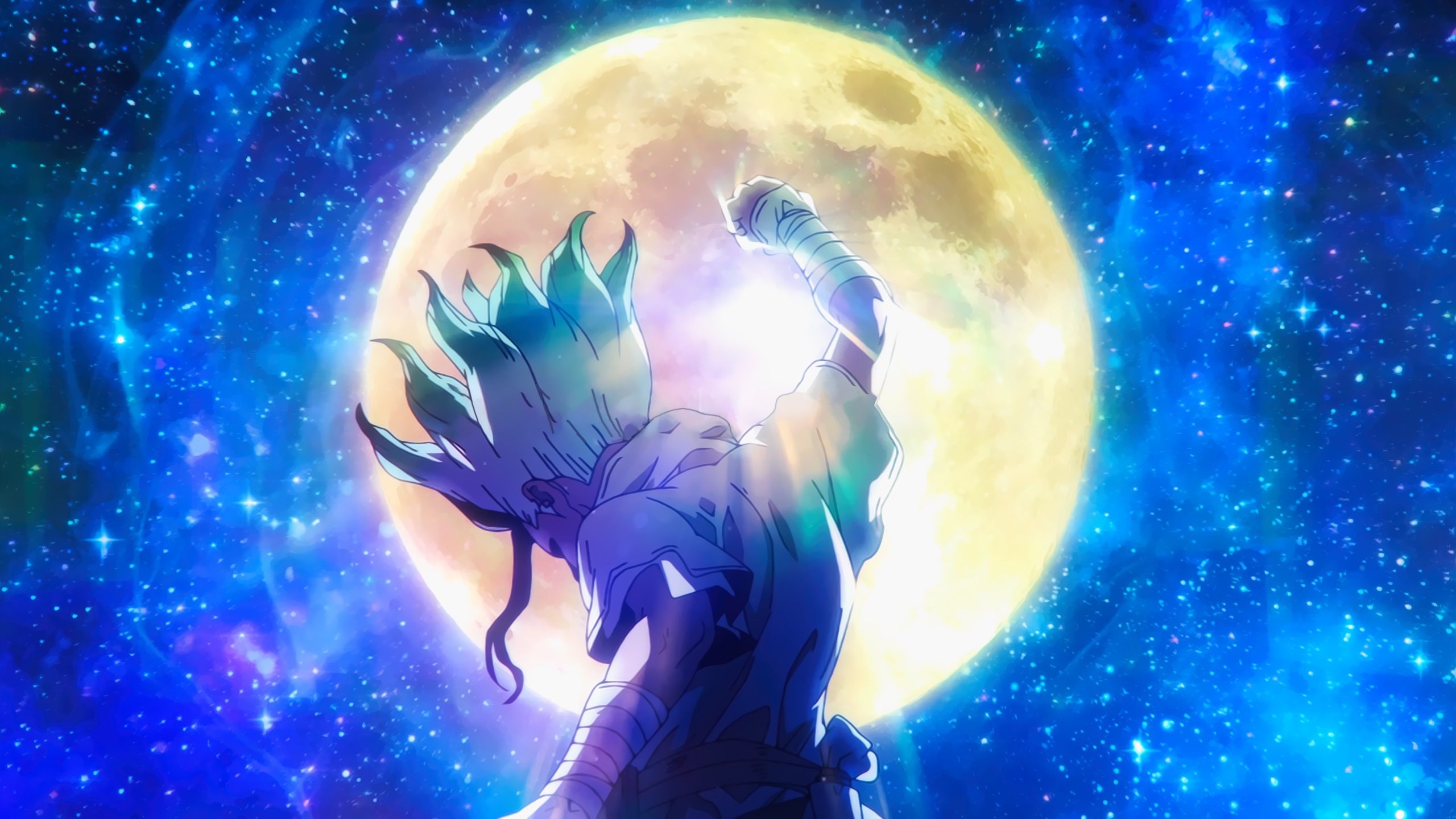
When Riichiro Inagaki and Boichi first introduced manga readers to Senku Ishigami in 2017, the premise felt equal parts brilliant and absurd: a green-haired savant conscious for 3,700 years within a limestone shell, set out to rebuild two million years of human civilization from mud, sweat, and basic chemistry. Fast forward through primitive pottery, steam engines, and regional naval expeditions, and the Kingdom of Science stands at the precipice of its grandest, most audacious undertaking. With Dr. STONE: Science Future—the fourth and final season of the acclaimed anime adaptation—the narrative is trading terrestrial dirt for the vacuum of deep space. The destination? The Moon. The objective? Confronting the author of humanity’s extinction: the enigmatic entity known only as Why-Man.
For a medium often dominated by mystical power escalations, cursed energy, and divine bloodlines, Dr. STONE has quietly redefined the shonen formula by turning the periodic table into the ultimate magic system. Now, as TMS Entertainment gears up to animate the final stretch of Inagaki’s masterwork across a multi-cour rollout, the stakes have escalated beyond mere survival. This is an ideological, scientific, and generational sprint toward the stars, marking a rare moment in modern anime where an adaptation reaches its conclusive finish line with its creative soul entirely intact.
From Stone Tools to the Saturn V: The Audacious Scale of Science Future
The progression of Dr. STONE has always operated on an exponential curve, but Science Future shatters the localized boundaries of previous arcs. To breach Earth’s atmosphere, Senku and his coalition cannot rely simply on scrap iron and sulfur collected in a nearby valley. The Moon mission demands an unprecedented global mobilization, transforming the narrative from a localized survival saga into a high-stakes logistical epic.
Viewers will witness the Kingdom of Science constructing a sprawling international supply chain. To build a modern rocketry program capable of reaching lunar orbit, Senku must establish specialized satellite hubs across the planet: raw materials from North America, computational infrastructure, precision manufacturing, and superalloys extracted from the earth’s richest deposits. The pacing shifts into high gear as the story demystifies the sheer collaborative miracle of human industry. It is not just about forging a single rocket; it is about resurrecting the interconnected infrastructure that makes space exploration possible.
The Geopolitical Symphony of Rebuilding
What makes this logistical marathon compelling is the delicate human calculus underlying it. Senku and his inner circle are no longer just reviving friends; they are deliberately awakening hundreds of specialized professionals across continents. The tension between Senku’s pure scientific pragmatism and the lingering ideological friction among the revived populace provides a gripping political undercurrent. The narrative poses an uncomfortable question: can humanity, given a complete slate wipe, bypass its historical cycles of conflict to achieve a single, unifying cosmic objective?
The Existential Terror of Why-Man: Deconstructing the Ultimate Antagonist
Every great shonen demands a foil, but Why-Man is unlike any villain in modern Japanese animation. First introduced as a disembodied voice hijacking radio frequencies with the chilling, synthesized question—“WHY? DO YOU WANNA DIE?”—Why-Man represents cosmic horror filtered through hard sci-fi. Stationed silently on the lunar surface, this entity has served as an omnipresent shadow over Senku’s journey since the construction of the Kingdom’s first rudimentary vacuum tube.
In Science Future, the narrative shifts from defensive adaptation to offensive confrontation. The mystery of the Medusa devices—the small, sleek petrification apparatuses that rain down like apocalyptic jewelry—finally unravels. Why-Man is not a standard warlord seeking conquest; the entity represents a terrifying convergence of logic, artificiality, and alien ecology that fundamentally misunderstands the essence of the human spirit.
A Clash of Philosophies: Rationality vs. Mortality
The confrontation on the Moon elevates the series beyond mechanical diagrams into profound philosophical territory. Petrification was framed throughout the early seasons as a catastrophic curse, yet as Senku closes in on the lunar anomaly, the dialogue challenges that assumption. Why-Man views the petrification beam as an act of cosmic salvation—an offer of unconditional immortality and crystalline preservation. Senku, representing humanity’s messy, fragile, yet ceaselessly ambitious nature, champions the exact opposite: the beauty of finite lifespans, the agony of labor, and the triumph of earned progress. The battle on the lunar dust is not fought with energy blasts, but with the undeniable weight of human volition.
Character Psychology: The Weight of 3,700 Years and Chosen Astronauts
At the center of this astronomical gamble lies the emotional resonance of Senku Ishigami. For three seasons, Senku has masked his profound emotional burdens behind a shield of cocky catchphrases and scientific detachment. Yet, the Moon mission is intimately tied to his deepest personal trauma: the legacy of his adoptive father, Byakuya Ishigami.
Decades before Senku woke up, Byakuya looked down from the International Space Station at a green flash that silenced his species, dedicating the remainder of his life to leaving behind resources, stories, and raw platinum for a son he knew would one day awaken. For Senku, reaching the Moon is not merely a tactical imperative to eliminate a threat; it is a spiritual dialogue across millennia. It is the fulfillment of Byakuya’s unyielding faith in human persistence.
Furthermore, the selection of the lunar crew highlights the psychological diversity of the Kingdom of Science:
• Senku Ishigami: The calculating brain, carrying the collective knowledge of human history without succumbing to cynicism.
• Kohaku: The kinetic heart and physical vanguard, a native of the Stone World whose instinctive survival skills bridge the gap between ancient wilderness and cosmic frontier.
• Ryusui Nanami: The embodiment of human greed repurposed as boundless ambition, whose navigational instincts provide the crew with unyielding forward momentum.
• Stanley Snyder & Dr. Xeno: The lingering wildcards, whose cold military proficiency and dark scientific ingenuity illustrate the moral compromises required to conquer the impossible.
TMS Entertainment’s Visual Crucible: Rocketry Meets Sakuga
From an animation standpoint, adapting the final arcs of Boichi’s manga is an intimidating prospect. Boichi’s illustrative style is renowned for its hyper-detailed mechanical schematics, hyper-muscular kinetic anatomy, and breathtaking wide-angle cosmic vistas. TMS Entertainment, alongside directors who have carefully guided the adaptation through Stone Wars and New World, faces the monumental task of animating orbital mechanics, launch sequences, and deep-space vacuum encounters.
Early teases and structural reports indicate that the production team is treating Science Future as their visual magnum opus. Rather than rushing the manga’s dense, multi-chapter moon-landing preparations, the split-cour production schedule allows the animators room to breathe. Expect visceral, documentary-adjacent launch sequences underscored by composers Tatsuya Kato and Hiroaki Tsutsumi, whose hybrid orchestral-electronic scores have consistently lent Dr. STONE its unique sense of triumphant technological awe. Translating the silence of the Moon against the kinetic urgency of Boichi’s layouts will be the visual hallmark that defines the series’ enduring aesthetic legacy.
The Legacy of a Shonen Landmark
As Dr. STONE: Science Future prepares to launch its final mission, the cultural footprint of the franchise comes into sharp focus. In an era where apocalyptic media frequently wallows in nihilism and societal collapse, Senku Ishigami’s adventure has consistently offered something radically different: unrepentant, infectious optimism. It is a series that looks at the darkest moments of humanity and declares, with complete mathematical certainty, that our ability to think, collaborate, and build will always outshine our instinct to destroy.
The upcoming lunar landing is more than a season finale—it is the triumphant exclamation point on one of the most uniquely uplifting shonen journeys of the 21st century. When Senku finally plants his boots into the gray lunar soil to look Why-Man in the eye, he won’t be standing alone. He will be carrying two million years of human civilization with him.
Are you ready for the Kingdom of Science’s final voyage? How do you think the anime will handle the truth behind Why-Man’s origins compared to the manga? Share your theories in the comments below, and stay tuned to Wibux.com for episode breakdowns and exclusive deep dives throughout the season!