For more than a decade, the international anime community has observed an unspoken covenant: no matter your stance on Hirohiko Araki’s sprawling multi-generational epic, everything transforms the moment the dust settles over the American frontier in 1890. Ever since the dimension-shattering climax of Stone Ocean aired on Netflix, the perennial whisper network among anime enthusiasts has erupted into a deafening roar. JoJo’s Bizarre Adventure Part 7: Steel Ball Run is not merely another cour waiting for production clearance; it is Araki’s undisputed magnum opus, an aesthetic revolution that redefined supernatural action, and quite possibly the most daunting adaptation David Production will ever touch.
Sitting consistently near the apex of critical rankings across modern manga literature, Steel Ball Run represents a monumental leap in ambition, philosophical maturity, and visual intricacy. As speculation reaches a fever pitch regarding when—and how—the studio will mount this titan, it is time to unpack why this particular story holds such an iron grip on the medium, and what hurdles stand between the page and the screen.
A Clean Slate on Dust and Iron: The Genius of Araki’s Alternate Timeline
To understand the hunger for a Steel Ball Run anime, one must appreciate the sheer narrative audacity that birthed it. After concluding the original Joestar bloodline’s six-part tragedy in Florida’s Green Dolphin Street Prison, Araki found himself unburdened by twenty years of established continuity. Rather than dragging out the increasingly convoluted genealogy of the original universe, he orchestrated a soft reboot, shifting the series from the youth-oriented confines of Weekly Shonen Jump to the monthly pages of Ultra Jump.
This demographic transition radically altered the story’s structural DNA. The premise—a grueling, trans-American horseback race stretching six thousand kilometers from San Diego Beach to New York City—subverted the traditional “monster-of-the-week” gauntlet. Instead, Araki fused the American Western with cosmic horror, political conspiracy, and survival fiction. The race is brutal, unforgiving, and muddy. Characters die not just from flamboyant Stand abilities, but from dehydration, infection, hypothermia, and stray bullets. By casting aside the bright primary colors of Morioh and the high-fashion grandeur of Part 5’s Naples, Steel Ball Run established a world soaked in grit, grease, and existential dread.
Paraplegia, Steel Balls, and the Golden Ratio: The Broken Duo
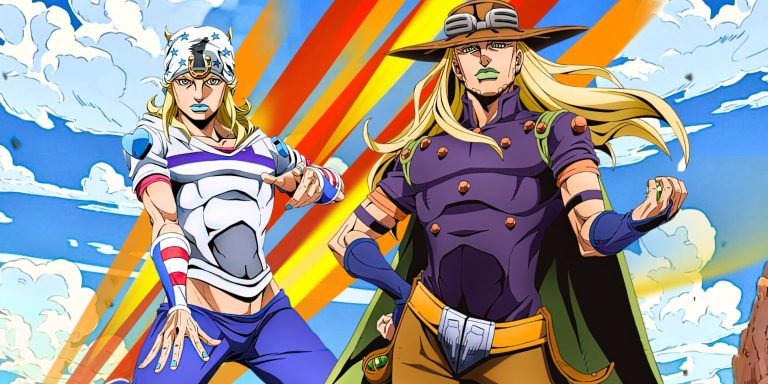
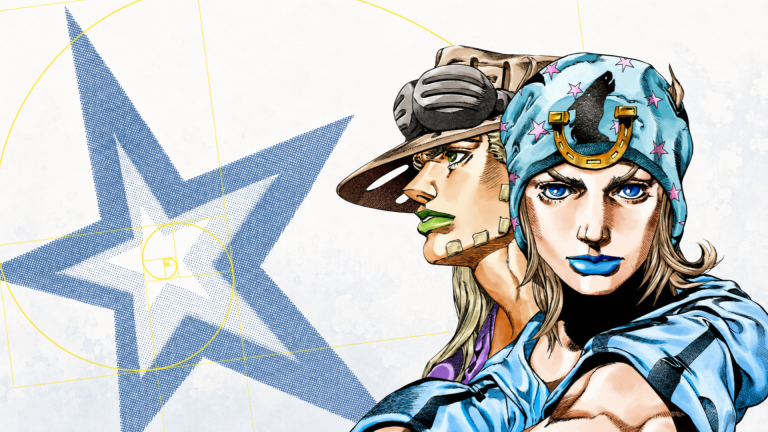
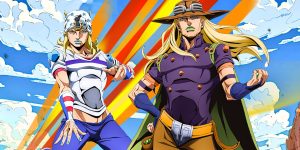
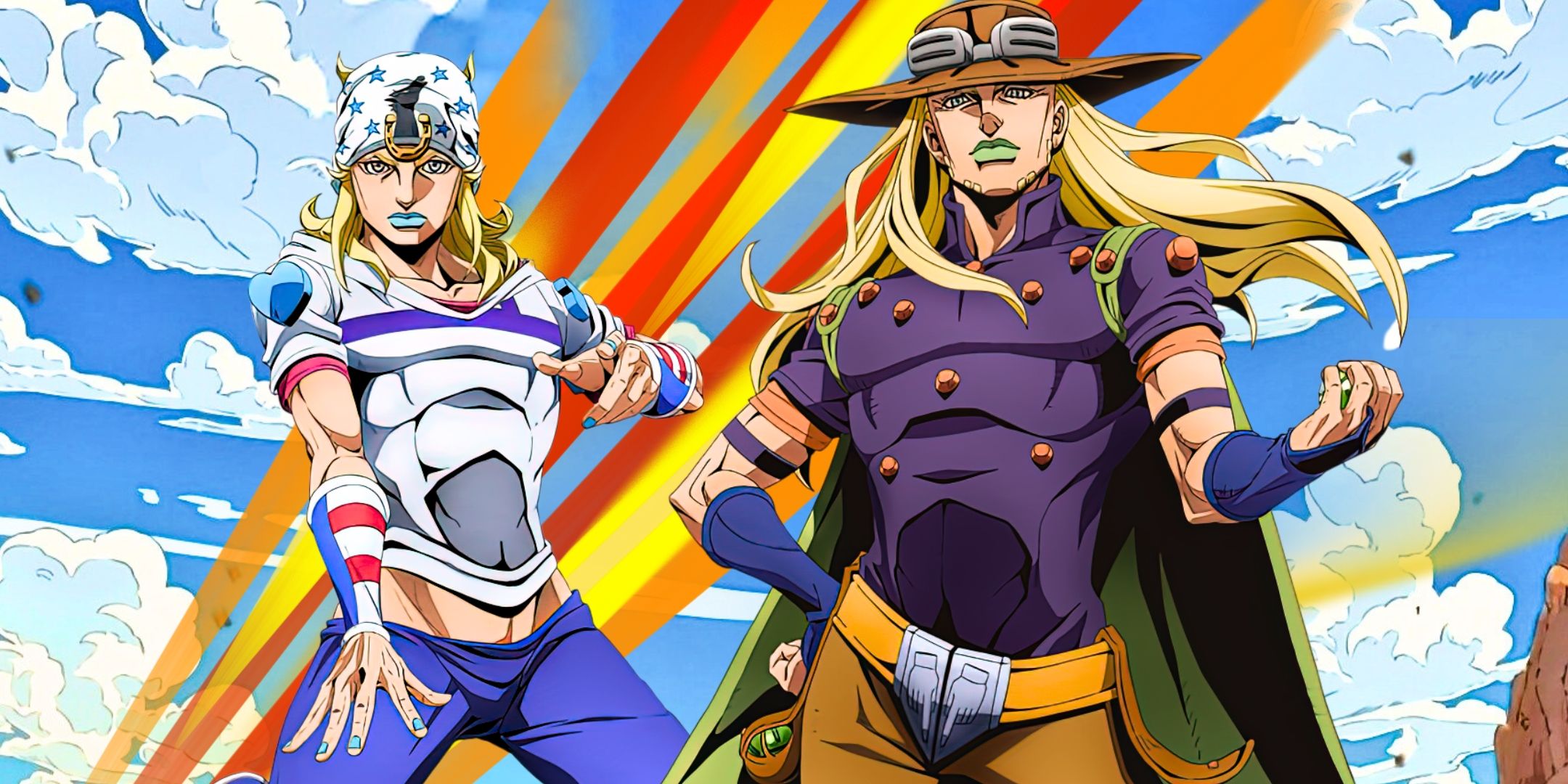
At the beating heart of Part 7 is a dual-protagonist dynamic that outshines nearly every partnership in modern sequential art. Johnny Joestar is fundamentally un-heroic at the onset: a disgraced, paraplegic former jockey whose hubris cost him his legs, his family, and his self-worth. Unlike Jonathan’s unyielding chivalry or Jotaro’s stoic righteousness, Johnny operates from a place of desperate, almost feral survivalism. His primary motivation isn’t saving the world—it is learning how to stand on his own two feet again, both literally and spiritually.
Enter Gyro Zeppeli, a disgraced Neapolitan executioner armed with mystical spinning steel orbs, grill-clad teeth spelling out his eccentric persona, and a hidden burden of conscience. Gyro is not Johnny’s superior; he is his reluctant mirror. Their campfire conversations about bad jokes, Italian opera, and phantom limbs ground the supernatural chaos in raw human tenderness. Over their shared journey, Araki explores themes of atonement, disability, and brotherhood with unprecedented emotional nuance.
The Evolution from Stands to “The Spin”
Narratively, Steel Ball Run elevates the power system of the franchise. While Stands still play a pivotal role, Araki introduces The Spin—a rotational martial philosophy derived from the Golden Ratio (Fibonacci sequence). Unlike the purely conceptual Stand battles of Stardust Crusaders, the Spin relies on anatomical precision, dynamic physics, and environmental mathematics. Johnny’s evolution through his Stand, Tusk (spanning ACT 1 through ACT 4), tracks his psychological growth: from firing fingernails like petty bullets to manipulating localized gravity and tearing through dimensional boundaries. Translating these intricate, geometry-driven abilities into kinetic, readable anime combat represents an exhilarating creative frontier for animators.
The Elephant—and the Stallion—in the Room: David Production’s Technical Crucible
If the excitement around Steel Ball Run is immense, the industry anxiety surrounding its realization is equally acute. There is an infamous running joke among industry insiders and animators: Part 7 will bankrupt whatever studio dares to draw its horses.
It is an open secret in the anime production pipeline that four-legged mammalian locomotion is among the most demanding, labor-intensive sequences a traditional 2D animator can undertake. A single running horse requires nuanced shifting of weight, skeletal flexing, and continuous muscle deformation. Steel Ball Run does not merely feature occasional horses; it features hundreds of them, caught in high-speed cavalry charges across shifting terrains, battling sandstorms, and navigating supernatural spatial anomalies.
Navigating the Hybrid 3D Pipeline
David Production has built its sterling reputation by respecting Araki’s ink: heavy hatching, dynamic pop-art color palette swaps, and stylized sound effect kanji hovering in mid-air. However, relying purely on hand-drawn 2D cuts for an ongoing, 40-plus-episode cross-country race is economically and physically unfeasible in the current anime industry. The critical challenge will be how the studio deploys 3D CGI.
Audiences have become notoriously wary of jarring, poorly shaded CGI horses dropped into hand-drawn environments. For Steel Ball Run to succeed on the visual pedestal its predecessors constructed, David Production will likely need to pioneer a sophisticated cel-shaded hybrid pipeline—perhaps taking cues from Orange’s work on Trigun Stampede or MAPPA’s dynamic camera tracking—blending 3D equestrian rigs with heavily supervised hand-drawn key frames for close-up impacts, Stand manifestations, and dramatic character poses.
Manifest Destiny and Moral Decay: The Shadow of Funny Valentine
No discussion of Part 7’s inevitable adaptation is complete without addressing its central antagonist: the 23rd President of the United States, Funny Valentine. Armed with the reality-shifting Stand Dirty Deeds Done Dirt Cheap (D4C), Valentine represents a radical evolution in Araki’s philosophical rogue’s gallery. Unlike the vampiric narcissism of DIO or the hedonistic self-preservation of Yoshikage Kira, Valentine is motivated by absolute, blinding patriotism.
His quest to assemble the scattered, mummified relics of the “Saint’s Corpse” (strongly implied to be Jesus Christ) across the American landscape is framed through his infamous “First Napkin” doctrine—a chilling disquisition on geopolitical dominance, prestige, and power dynamics. Valentine genuinely believes his horrific actions are for the eternal prosperity of his nation. Placing this fiercely ideological villain opposite an emotionally shattered Johnny Joestar turns the climax of Steel Ball Run into an intense clash of worldviews rather than a simple fistfight, offering thematic depth that rivals high-end prestige television.
The Horizon Calls: Waiting for the Starting Gun
As David Production navigates its current production slate, the question is no longer if JoJo’s Bizarre Adventure: Steel Ball Run will be adapted, but when the creative ecosystem is ready to carry its weight. The stakes could not be higher. Done poorly, the adaptation risks succumbing to uncanny-valley CGI shortcuts that dull Araki’s most painterly, sublime era of illustration. Done right, it has every ingredient necessary to stand alongside Vinland Saga, Attack on Titan, and Berserk as a benchmark of mature, monumental dark-fantasy fiction.
The course is mapped, the stakes are cosmic, and the golden ratio awaits. When that starting pistol finally fires, the world of anime will never be the same.
What are your biggest hopes and fears for David Production’s adaptation of Steel Ball Run? Do you think a hybrid 2D/3D approach can do justice to Johnny and Gyro’s journey, or should the studio take all the time it needs for hand-drawn perfection? Drop your theories and dream voice-cast picks in the comments below!