In the pantheon of sequential art, few transitions are as mythologized as Hirohiko Araki’s pivot from the claustrophobic, fate-bound tragedy of Stone Ocean to the sprawling, dust-choked vistas of JoJo’s Bizarre Adventure: Steel Ball Run. What began in 2004 as an ambiguous, seemingly detached Western serial in Weekly Shonen Jump swiftly evolved into something unprecedented: a seismic reinvention of Araki’s creative identity. When the series relocated to the monthly pages of Ultra Jump, the shackles of standard shonen constraints shattered, allowing Araki to deliver what is now universally heralded by critics and readers alike as his undisputed magnum opus.
Ever since the animated conclusion of Jolyne Cujoh’s saga drifted into the bittersweet strains of Duffy’s “Distant Dreamer,” the global anime community has held a collective, nervous breath. The internet routinely catches fire at the mere whisper of a trademark update, a stray animator tweet, or a cryptic promotional visual from David Production. But adapting Steel Ball Run is not merely checking off the next item on an episodic roadmap; it is the ultimate gauntlet. Bringing Part 7 to life requires tackling an Olympic-level production nightmare while faithfully translating the most philosophically layered, character-driven epic Araki has ever penned.
The Trans-American Odyssey: Araki’s Seinen Renaissance
To grasp the fervency surrounding Steel Ball Run, one must understand how radically it dismantled its predecessors. Set against the sun-bleached expanse of 1890s North America, the narrative revolves around an epic, 6,000-kilometer cross-country horse race with a life-altering $50 million purse. Yet, the race is merely a dynamic stage for an esoteric, supernatural geopolitical struggle. Araki uses this historical canvas to deconstruct manifest destiny, cosmic fatalism, and the raw mechanics of ambition.
The shift to a monthly publication cadence gave Araki the breathing room to craft expansive, hyper-detailed backgrounds and allow scenes to breathe. Rather than the punch-ghost slugfests of earlier eras, stands in Steel Ball Run evolved into conceptual, highly strategic puzzles. Abilities interact directly with terrain, kinetic energy, atmospheric pressure, and even physical biology. From the terrifying, raptor-shifting vectors of Scary Monsters to the dimensional foldings of Dirty Deeds Done Dirt Cheap (D4C), Part 7 elevated Araki’s signature combat into high-stakes, cerebral theatre.
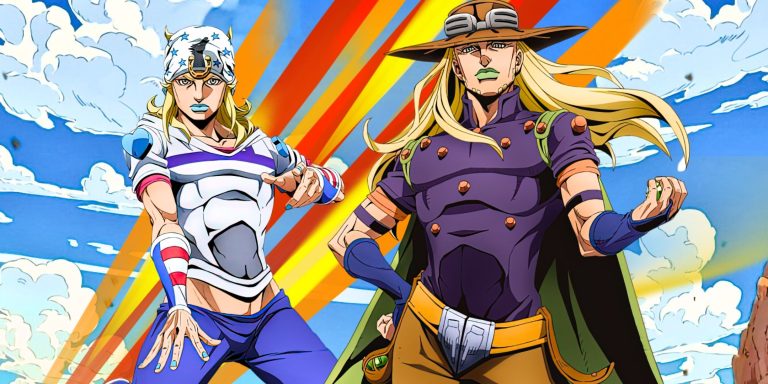
Johnny Joestar and Gyro Zeppeli: A Dynamic Carved in Imperfection
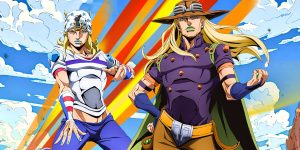
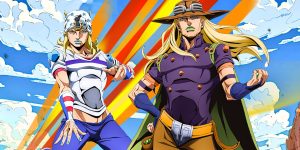
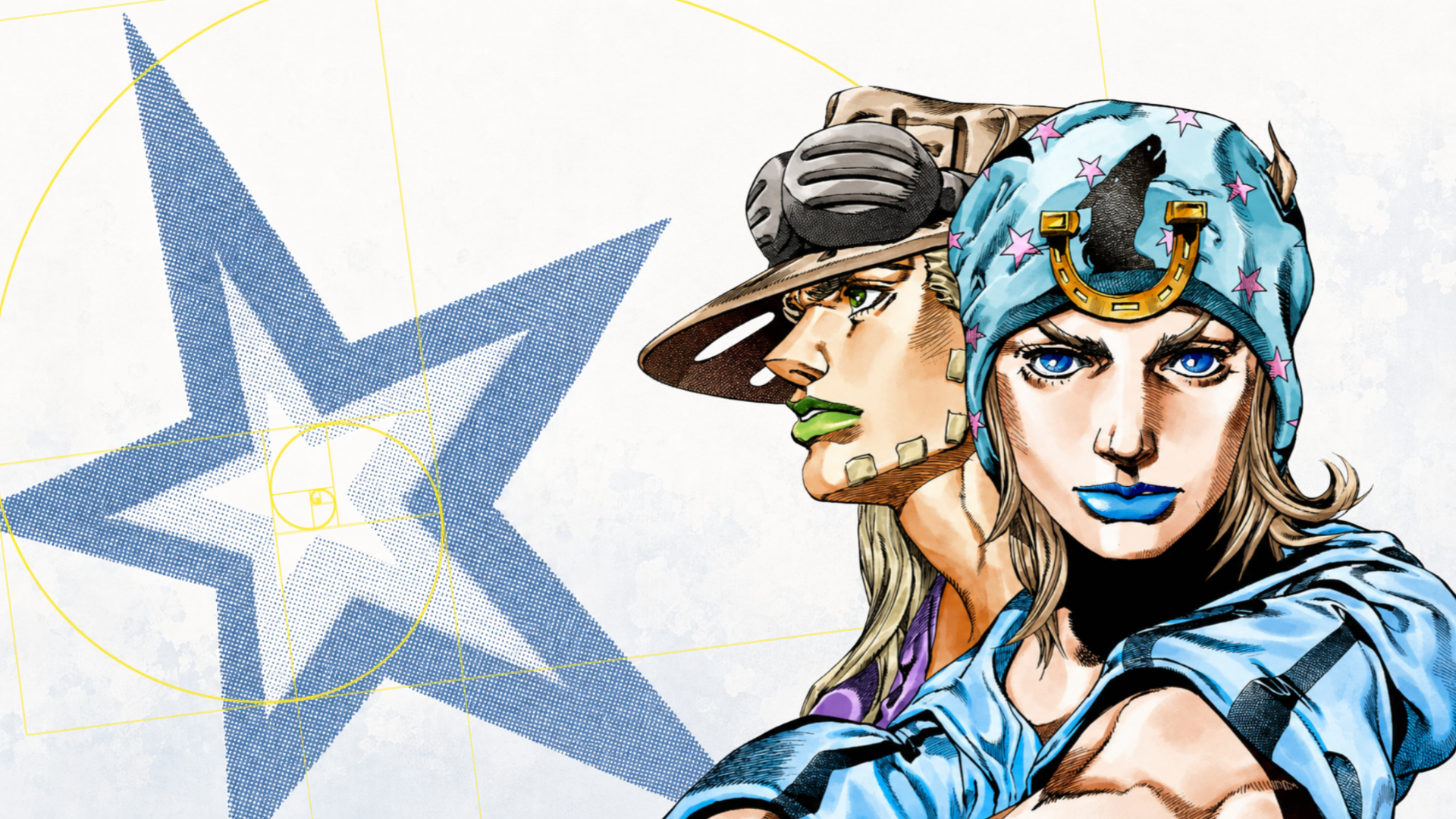
At the center of this sun-scorched odyssey is the finest dual-protagonist dynamic in modern manga: Johnny Joestar and Gyro Zeppeli. Their bond carries none of the immediate, idealized nobility of Jonathan Joestar, nor the effortless bravado of Jotaro Kujo. Instead, their camaraderie is forged in the grime of desperation, shared trauma, and spiritual survival.
Johnny Joestar: The Dark Egoist’s Redemption
Johnny Joestar is perhaps Araki’s most morally ambiguous protagonist. A former prodigy jockey struck down by hubris, paralyzed from the waist down, Johnny begins his journey not out of a desire to save the world, but out of a desperate, selfish urge to reclaim his mobility. Araki visualizes Johnny’s internal turmoil through the chilling motif of “dark determination”—a cold, ruthless flame in his eyes that signals a willingness to kill without hesitation to achieve his goals. His Stand, Tusk, mirrors this psychological evolution, graduating from a weak, nail-firing utility to an apocalyptic force of nature tied directly to the Golden Ratio. Johnny is fundamentally broken, making his path toward empathy and self-worth devastatingly resonant.
Gyro Zeppeli: The Executioner and the Legacy of the Spin
Counterbalancing Johnny’s brooding introspection is Gyro Zeppeli, a disgraced Neapolitan executioner operating under a mask of flamboyant theatricality, absurd dad jokes, and golden grillz. Beneath Gyro’s eccentric veneer lies a profound moral burden: he races to win amnesty for an innocent child condemned to die on his family’s execution block. Gyro does not merely act as the narrative’s emotional anchor; he is Johnny’s mentor in the ways of the Spin—a sacred, mathematical manipulation of kinetic energy derived from Fibonacci’s Golden Spiral. The Spin serves as Araki’s thematic successor to Hamon, an ancient discipline demanding perfect harmony with nature rather than brute psychic dominance.
The dialogue between these two—bickering over days of the week, composing songs about mozzarella cheese, and bleeding together beneath freezing desert skies—imbues Steel Ball Run with an aching, authentic humanity that David Production must preserve with utmost delicate care.
The Technical Hurdle: Why Animating Horses is Anime’s Final Boss
The true elephant—or rather, stallion—in the room regarding a Steel Ball Run anime is the staggering logistical nightmare of equestrian animation. In 2D television anime, horses are notoriously considered the most resource-intensive, structurally unforgiving subjects to animate. Their complex quadrupedal anatomy, the cadence of galloping muscles, the shifting perspective of saddles, and the sheer fluidity required for uninterrupted high-speed movement have broken countless production schedules.
In Part 7, horses are not incidental background set dressing; they are central combatants, pacing instruments, and character extensions. Hundreds of horses sprint across wide plains, navigate treacherous mountain trails, and engage in Stand warfare at breakneck speeds. David Production faces an extraordinary technical fork in the road:
Attempting pure 2D hand-drawn animation for 30+ episodes of non-stop cavalry maneuvers is financially and humanly untenable under typical broadcast constraints. Conversely, relying on clunky, unpolished 3D CGI models runs the catastrophic risk of triggering the uncanny-valley backlash that plagued projects like Berserk 2016. David Production’s past mastery of stylized CG—demonstrated across their stunning opening sequences and dynamic environmental rotations in Fire Force—hints at a middle path. A sophisticated hybrid approach, combining cell-shaded, high-frame-rate CGI models for complex pack-riding shots with hand-drawn close-ups and Araki’s iconic heavy line-work, appears to be the only viable route to cross this finish line.
Patriotism, Morality, and the Divine Corpse
No discussion of Steel Ball Run is complete without addressing its overarching antagonist, Funny Valentine, the 23rd President of the United States. Valentine is one of the most compelling political antagonists in modern fiction—a man whose sociopathic imperialist ambitions are veiled in genuine, deeply held patriotism. His pursuit of the scattered pieces of the holy Saint’s Corpse is guided by his infamous “first napkin” philosophy: the belief that power belongs exclusively to whoever seizes authority first, forcing the rest of the world to fall in line.
By pitting Johnny and Gyro against the head of state and his network of government-sanctioned assassins, Araki transforms a sports drama into a thrilling commentary on American myth-making, manifest destiny, and the cyclical nature of historical violence. It forces the audience into an uncomfortable ideological corner where the “villain” acts for the absolute prosperity of his nation, while the “hero” acts out of singular, personal obsession.
The Horizon: David Production’s Next Grand Stage
David Production has spent over a decade proving itself as the ultimate custodian of Araki’s vision. From the vibrant, punchy pop-art palettes of Diamond is Unbreakable to the gritty, high-contrast Italian noir of Golden Wind, the studio has consistently tailored its aesthetic identity to match each Part’s narrative soul. With the dust settled on Stone Ocean and David Production wrapping up side commitments like Urusei Yatsura, the studio’s calendar is clearing, leaving an unmistakable space open on the horizon.
Adapting Steel Ball Run is David Production’s Mount Everest. It requires unprecedented ambition, technical reinvention, and an unwavering commitment to Araki’s nuanced, adult storytelling. If they pull it off, it won’t just be the crowning jewel of the JoJo franchise; it will stand as a watershed milestone for television anime as an entire medium. The saddle is waiting, the golden spiral is turning, and the anime world is ready for the starter pistol to fire.
What are your biggest hopes and fears for the Steel Ball Run anime adaptation? Do you think David Production can seamlessly crack the equestrian animation code, or should they take extra years to perfect it? Drop your thoughts in the comments below, and keep it locked to Wibux.com for breaking updates on the next era of JoJo’s Bizarre Adventure.