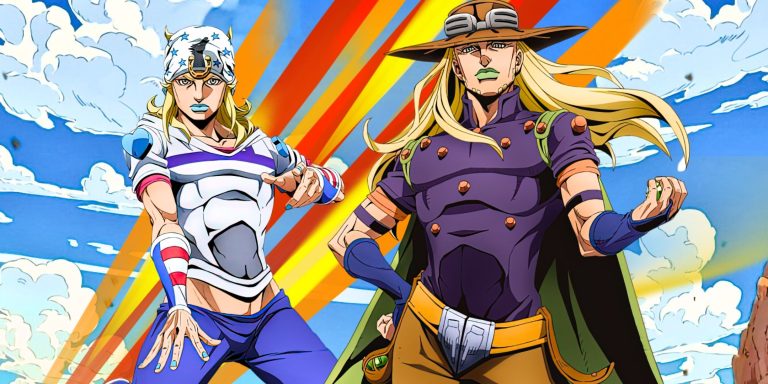
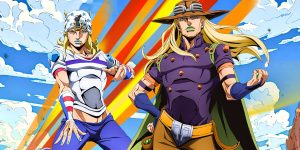
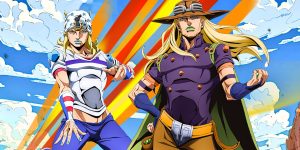
Ever since the melancholic final chords of Stone Ocean faded into a bittersweet rainstorm, the anime community has lived under the shadow of a single, inescapable question: When is Steel Ball Run? In the modern landscape of Japanese animation, few unadapted properties command the sheer mythological reverence held by Hirohiko Araki’s seventh serialized epic. Long heralded as the author’s magnum opus, JoJo’s Bizarre Adventure: Steel Ball Run is more than just another chapter in a generational lineage—it is an existential, thematic, and aesthetic rebirth that fundamentally reshaped the trajectory of graphic narrative storytelling.
Yet, as David Production remains notoriously tight-lipped regarding their production slate, the cultural hype surrounding Steel Ball Run has morphed from polite anticipation into a fever-pitch digital vigil. Between speculative leaks, viral fan animations, and analytical debates regarding technical viability, the prospect of witnessing Johnny Joestar and Gyro Zeppeli cross the American frontier has become the anime industry’s golden fleece. To understand the gravity of this impending adaptation, one must unpack not only the narrative brilliance of Araki’s reinvention, but the monumental technological mountain David Production must climb to bring it to life.
The Paradigm Shift: Why Steel Ball Run Stands as Araki’s Magnum Opus
To grasp the weight of the hype, one must contextualize the seismic shift that occurred during the mid-2000s when Araki transitioned serialization from the breakneck demands of Weekly Shonen Jump to the monthly, boundary-pushing pages of Ultra Jump. Unshackled from juvenile demographic constraints and crushing weekly deadlines, Araki transformed what initially masqueraded as a standalone 1890s historical Western into the definitive reset of the JoJo multiverse. The result was a gritty, morally ambiguous, 6,000-kilometer horseback sprint across North America—from San Diego Beach to New York City—competing for a staggering fifty-million-dollar purse.
From Shonen Tropes to Seinen Deconstruction
Unlike the binary good-versus-evil dynamics that characterized early JoJo parts, Steel Ball Run operates within shades of sun-bleached rust and ash. The race itself serves as a grandiose misdirection for a high-stakes geopolitical occult conspiracy: the search for the mummified relics of the Saint’s Corpse. By recontextualizing the American mythos through a hyper-stylized lens, Araki achieved a masterstroke of historical magical realism. The narrative effortlessly weaves indigenous spiritualism, cutthroat frontier survival, and the Machiavellian machinations of President Funny Valentine, whose chilling philosophy of the “first napkin” remains one of the most compelling political manifestos ever penned in manga format.
Johnny Joestar and Gyro Zeppeli: Character Psychology at the Edge of the Frontier
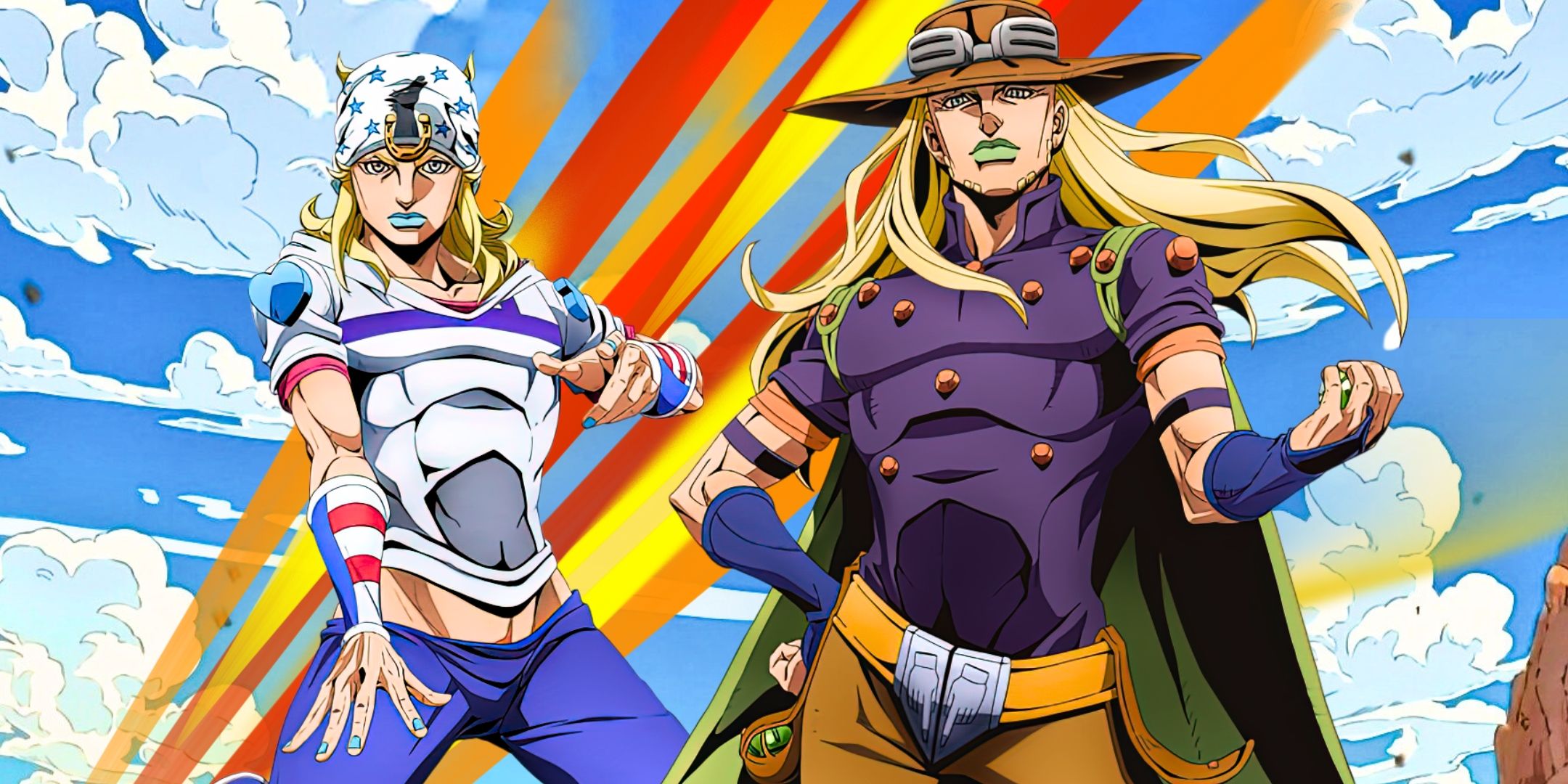
At the beating heart of this sprawling trans-continental odyssey lies the complex, deeply emotional duality between Johnny Joestar and Gyro Zeppeli. While previous entries anchored their narratives on aristocratic virtue (Jonathan) or charismatic defiance (Jotaro), Part 7 offers a stark, unprecedented psychological portrait of human vulnerability and co-dependency.
The Anti-Hero’s Hunger: Johnny’s Dark Determination
Johnny Joestar is undeniably Araki’s most flawed and fascinating protagonist. Stripped of his equestrian fame, his family’s affection, and the use of his legs following a senseless act of arrogance, Johnny begins the story not as an aspiring hero, but as a bitter, hollow husk. His motivation is ruthlessly selfish: when he witnesses Gyro Zeppeli’s mystical technique temporarily reactivate his paralyzed limbs, he joins the deadly race not out of nobility, but out of an insatiable desperation to bring his life from “negative to zero.” Throughout the journey, Johnny exhibits what Araki explicitly terms “Dark Determination”—a pitiless, cold-eyed resolve that blurs the line between protagonist and villain, especially as his Stand, Tusk, evolves from a pathetic nascent spirit into an eldritch force capable of tearing through dimensional barriers.
The Golden Ratio: Gyro Zeppeli’s Tragic Nobility
Acting as Johnny’s mentor, companion, and moral counterweight is Gyro Zeppeli, a disgraced Neapolitan executioner carrying the heavy spiritual mantle of his ancestral duties. Armed with the Spin—a centuries-old metaphysical technique harnessing the Fibonacci sequence and the Golden Rectangle—Gyro balances theatrical bravado, absurd humor (exemplified by his opera-length tributes to pizza mozzarella), and deep existential grief. The bond that develops between Johnny and Gyro transcends the standard shonen camaraderie; it is a profound masterclass in trauma bonding, mutual redemption, and philosophical mentorship that elevates Steel Ball Run to emotional heights never previously reached by the franchise.
The Elephant in the Room: David Production and the Equestrian CGI Gauntlet
If the narrative demands of Steel Ball Run are staggering, the technical demands placed on David Production are borderline terrifying. Across the anime industry, there is an unspoken axiom whispered among animators: never animate horses unless you are prepared to break the studio. Unlike the humanoid brawls and punch-ghost mechanics of Stardust Crusaders or Golden Wind, Part 7 takes place almost entirely on horseback, dynamic gallops, and shifting wilderness terrains.
The Technical Dilemma: Hand-Drawn Craftsmanship vs. 3D Hybrid Pipelines
Quadruped anatomy in motion is notoriously difficult to capture by hand. An animated horse galloping through dynamic camera angles requires an immense number of complex moving joints, constantly shifting muscular volumes, and difficult foreshortening. To animate an entire 30-plus-episode cour featuring dozens of simultaneous riders across open plains by hand would exhaust even the most gifted production pipelines at MAPPA or Ufotable.
Consequently, the industry consensus suggests that David Production must engineer a revolutionary hybrid CGI pipeline—similar to the stylistic 3D integration seen in Chainsaw Man or the cel-shaded mastery of Studio Orange’s Trigun Stampede. The core challenge lies in avoiding the uncanny, weightless CG horse models that plagued series like Berserk (2016) or early seasons of Kingdom. For Steel Ball Run to land its blows, the steeds must feel heavy, organic, and thoroughly caked in dust and blood. Fans are patient precisely because they recognize that rushing this production pipeline would compromise the visual integrity of Araki’s most detailed cross-hatching and dynamic paneling.
The Metaphysics of the Spin: Reimagining the Supernatural Combat System
Beyond logistics, an adaptation of Steel Ball Run signals a revolutionary shift in the visual lexicon of combat. For nearly four decades, the JoJo franchise has been synonymous with “Stands.” While Stands remain present in Part 7, they share the stage with the Spin, an intricate kinetic martial art rooted in sacred geometry, anatomy, and rotational physics. Translating the visual language of the Spin into sound and motion—the humming trajectory of the Steel Balls, the visual distortion of the golden spiral, and the horrifying, multi-dimensional shifts of Dirty Deeds Done Dirt Cheap (D4C)—presents a tantalizing creative playground.
David Production has built a legendary reputation on their creative visual choices: the shocking color-palette inversions, the kinetic Japanese onomatopoeia rendered as physical entities, and stylized sound design. For Steel Ball Run, these signature flourishes will need to mature alongside the material, leaning heavily into dusty, desaturated Western palettes punctured by neon supernatural anomalies and hyper-stylized psychedelic choreography.
The Road to San Diego Beach: What Comes Next?
As the cultural appetite for JoJo Part 7 intensifies, Warner Bros. Japan and David Production stand at a critical crossroads. The controversial batch-release format of Stone Ocean on Netflix inadvertently chilled the organic, week-to-week internet discourse that once defined Golden Wind‘s legendary run. The widespread consensus among the global fandom is clear: an adaptation of Steel Ball Run deserves prestige-tier treatment. It demands a weekly broadcast model that allows every tactical revelation, psychological breakdown, and catastrophic gunfight to dominate social timelines.
Whether an official announcement drops during an upcoming Jump Festa, an independent franchise anniversary, or a stealth reveal trailer, the reality remains unchanged: JoJo’s Bizarre Adventure: Steel Ball Run is the ultimate final frontier of modern anime adaptations. When the starting gun finally sounds on the shores of San Diego, it won’t just be Johnny and Gyro setting out on an impossible journey—it will be an entire medium holding its breath to see if animation can truly capture lightning in a bottle.
What are your biggest hopes and fears for David Production’s inevitable Steel Ball Run adaptation? Do you want to see pure 2D animation, or can a high-end 3D hybrid pull off the horses? Sound off in the comments below, and keep your sights trained on Wibux for breaking JoJo updates.