

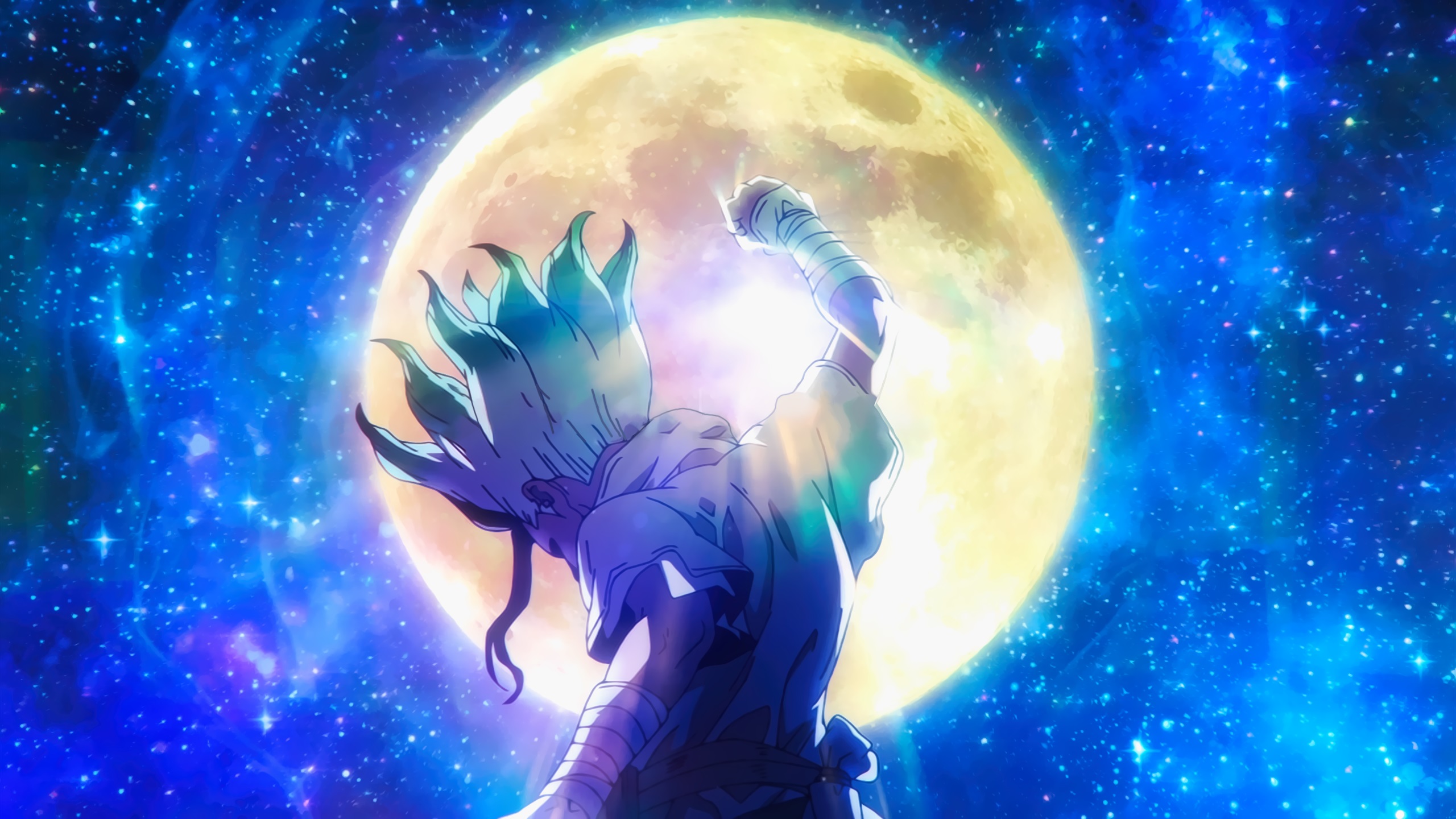
When Senku Ishigami broke free from his stone prison in the dawn of 5738 AD, modern shonen storytelling underwent an uncharacteristically intellectual renaissance. In an era dominated by cursed energy, blood-soaked katanas, and grimdark deconstructions of heroism, Dr. STONE dared to stake its entire narrative identity on an intoxicating counter-thesis: that human curiosity, cooperation, and the scientific method are the most miraculous superpowers in existence. Over three critically acclaimed seasons, Riichiro Inagaki and Boichi’s masterwork transformed basic chemistry, metallurgy, and early electronics into edge-of-your-seat spectacles. Now, with the official arrival of Dr. STONE: Science Future, the fourth and final season, the Kingdom of Science prepares for its crowning achievement—a literal moonshot that pits human ingenuity against an existential cosmic terror known simply as Why-Man.
The stakes couldn’t possibly be higher. The upcoming grand finale from TMS Entertainment moves the series from a terrestrial survival epic into full-blown aerospace hard science fiction. For longtime fans who watched Senku build clay pottery and brew crude sulfa drugs, witnessing the construction of a multi-stage rocket capable of lunar transit is a dizzying, emotional validation of humanity’s collective lineage. Yet, lurking beyond Earth’s exosphere lies the dark orchestrator of the global petrification event that wiped out civilization 3,700 years ago. As the anime hurtles toward this definitive showdown, Science Future isn’t merely wrapping up plot threads—it is mounting one of the most conceptually audacious conclusions in modern anime history.
From Primitive Kilns to the Lunar Regolith: The Audacious Engineering Odyssey
The transition into Science Future marks a breathtaking escalation in scope. The story has deliberately outgrown the scenic forests of Ishigami Village and the maritime trade routes of the Age of Exploration. To build a spacecraft capable of breaking orbit, Senku, Ryusui, Chrome, and the reconstituted global populace must industrialize the planet at breakneck speed. The narrative shifts into a thrilling game of global logistical chess: mining rare superalloys across the Americas, establishing mathematical supercomputers, and synthesizing petrochemicals in staggering quantities.
What makes Dr. STONE uniquely compelling as it approaches its endgame is its steadfast refusal to use narrative shortcuts. Even when tackling rocket propellants, trajectory physics, and life-support telemetry, Inagaki’s script honors the sweat-equity of scientific trial and error. The upcoming adaptation will showcase the sheer desperation and exhilaration of the rocketry arc—a sequence of catastrophic test fires, theoretical dead ends, and micro-scale breakthroughs that mirror humanity’s real-world Space Race, condensed into an exhilarating race against petrification.
The Tripartite Lunar Landing Unit
Unlike the vast crew that sailed aboard the Perseus, the lunar landing team demands an agonizingly strict economy of mass and payload. The final rocket can carry only three human souls to the surface of the moon, forcing the Kingdom of Science to select a balanced trinity representing intellect, combat supremacy, and unwavering resolve. This operational bottleneck injects immense psychological tension into the ensemble cast. The mission to the moon is functionally a suicide run—a one-way ticket unless their orbital mathematics and fuel-return calculations are calibrated down to the microgram.
The Enigma on the Lunar Surface: Confronting Why-Man
Ever since that chilling Morse code signal broke across Senku’s early radio receivers—repeating the rhythmic, synthesized cadence of “WHY?” across all global frequencies—Why-Man has stood as an omnipresent phantom over the narrative. The genius of Why-Man as an antagonist lies in its uncanny detachment. Unlike Tsukasa Shishio, who fought for ideological purity, or Hyoga, who championed ruthless meritocracy, Why-Man exhibits none of the emotional frailty of flesh-and-blood villains.
As Science Future approaches the Apollo landing site on the lunar surface, the nature of the Petrification Device—the Medusa—comes under the ultimate microscope. Why-Man is not simply a theatrical boss waiting to be punched into submission; it is a manifestation of an eerie, Fermi-paradoxical reality. The reveal of Why-Man’s origins, its biological or mechanical taxonomy, and its underlying rationale for turning billions of human beings into inanimate calcified statues will subvert conventional shonen tropes. The ultimate showdown will not be decided by who strikes hardest, but by an ideological debate over what constitutes life, consciousness, and the true cost of immortality.
TMS Entertainment’s Production Challenge: Animating Boichi’s Hyper-Detailed Vision
Adapting the final chapters of the manga presents TMS Entertainment with its steepest production challenge to date. Illustrator Boichi is internationally renowned for his manic, hyper-detailed linework, capturing intricate engine schematics, atmospheric re-entry burn, and expressive character micro-reactions with equal fervor. In earlier seasons, the studio balanced modest animation budgets with stylized comedic shortcuts, reserving fluid sakuga for key kinetic beats like Tsukasa’s martial arts or Magma’s brawls.
For Science Future, the split-cour finale demands a significant leap in visual fidelity. Translating the technical density of the Saturn-V-inspired rocket, the terrifying visual void of vacuum space, and the eerie desolation of the moon requires seamless integration between hand-drawn character work and sophisticated 3D mechanical CGI. Furthermore, the auditory landscape—spearheaded by composers Tatsuya Kato, Hiroaki Tsutsumi, and Yuki Kanesaka—must transition from tribal folk-symphonies to ambient, pulse-pounding synthetic minimalism suited for the terrifying silence of deep space.
The Antidote to Cynicism: Senku Ishigami and the Shonen Paradigm Shift
At its core, the cultural longevity of Dr. STONE stems from its profound emotional resonance, which directly subverts the fatalism of modern media. Senku Ishigami is not a messiah. He possesses no genetic destiny, no divine prophecy, and no miraculous physical prowess. His unyielding brilliance is entirely grounded in the cumulative inheritance of human civilization over two million years.
The lunar mission serves as the thematic fulcrum that connects Senku directly to his adoptive father, Byakuya Ishigami, and the international astronauts who watched the Earth turn to stone from the cupola of the International Space Station. The moon represents the ultimate poetic closure: the boy who spent his childhood stargazing and firing amateur backyard bottle-rockets is now fulfilling the legacy of the astronauts who preserved humanity’s genetic spark on Treasure Island. It is an unapologetic love letter to human curiosity—reminding audiences that while humanity can create weapons of catastrophic horror, it can also unite across borders, languages, and millennia to reach out and touch the stars.
A Journey 3,700 Years in the Making
Dr. STONE: Science Future is far more than a simple conclusion; it is the victory lap for one of Weekly Shonen Jump’s most refreshing, intellectually stimulating intellectual properties. By rejecting cynicism in favor of relentless curiosity, the series has proven that knowledge, perseverance, and solidarity make for an intoxicating narrative engine. As Senku, Chrome, Ryusui, and the Kingdom of Science strap into the cockpit and ignite the countdown on the launchpad, anime fans are about to witness an emotional, astronomical triumph that is, quite literally, ten billion percent exhilarating.
Are you ready for the Kingdom of Science to breach the atmosphere? What are your theories regarding Why-Man’s true identity and motives? Drop your thoughts, science theories, and favorite moments in the comments below, and stay tuned to Wibux.com for episode-by-episode breakdowns when Dr. STONE: Science Future premieres!