

When the theatrical box office receipts for Haikyu!! The Dumpster Battle (Gomi Suteba no Kessen) crossed the 10-billion-yen milestone in Japan earlier this year, it confirmed what die-hard fans of Haruichi Furudate’s seminal volleyball epic already knew: this was never just another sports movie. It was the culmination of a decade-long narrative promise. Now, as the cinematic showdown lands on global streaming platforms, couch-bound viewers across the globe are finally bearing witness to the franchise’s crown jewel—a clash so meticulously constructed, emotionally devastating, and kinetic that it redefines modern sports anime.
The “Battle at the Garbage Dump”—the mythic, generation-spanning confrontation between Karasuno High’s Crows and Nekoma High’s Cats—has escaped the confines of limited festival screenings and Japanese cinemas to hit living rooms everywhere. And while the jump from an IMAX auditorium to an OLED television screen might reduce the literal physical scale, the raw emotional weight of this 85-minute masterpiece remains entirely undiluted.
A Decade in the Making: The Weight of Unspoken History
To truly understand why The Dumpster Battle resonates on such an exorbitant frequency, one has to look back to the dirt courts of Tokyo and Miyagi where former head coaches Ikkei Ukai and Yasufumi Nekomata spent their youths. Theirs was a rivalry born of mutual stubbornness—two teams with diametrically opposed philosophies that sharpened each other like grindstones, yet never once managed to meet on the official national stage before their retirements.
When Karasuno and Nekoma finally lock eyes across the net at the Tokyo Metropolitan Gymnasium during the Spring Inter-High Tournament, they aren’t carrying animosity. This is where Furudate’s writing fundamentally subverts the tropes of standard shonen storytelling. There is no villain to slay, no grudge to settle, and no existential threat looming over the losers. Instead, this fixture is built on radical affection and absolute respect.
Every dig, dive, and quick set is punctuated by memories of Golden Week training camps, barbecue dinners, and late-night scrimmage matches in humid suburban gymnasiums. The tragedy hanging over the court is singular: unlike those summer practice games where a lost set simply meant rolling into a penalty lap of flying falls, there is no “one more game” here. One team advances toward glory; the other goes home, their third-years’ high school careers over forever.
The Psychological Chess Match: Kenma Kozume’s Birdcage
While the broader canvas belongs to Karasuno and Nekoma, the emotional spine of the film is an intimate character study tracking the evolving relationship between two fundamentally incompatible athletes: Karasuno’s irrepressible middle blocker Shoyo Hinata and Nekoma’s cerebral, disaffected setter Kenma Kozume.
Kenma has always stood out as an anomaly within sports anime. He doesn’t burn with fiery ambition; he doesn’t care about athletic glory; he views volleyball through the detached, utilitarian lens of a tactical RPG. Hinata, conversely, is a supernova of raw instinct, boundless stamina, and blinding verticality. For years, Kenma has treated Hinata as an intriguing glitch in the system—an impossible variable to be dissected and cataloged.
Clipping the Crows’ Wings
The tactical masterstroke of The Dumpster Battle lies in how systematically Kenma constructs a psychological cage around Karasuno’s offense. Knowing Hinata thrives on chaotic, open-tempo transitions, Kenma weaponizes Nekoma’s ironclad floor defense to force Karasuno into predictable, linear patterns. By calculating Hinata’s landing zones and manipulating ball placement, Kenma strips Hinata of his run-up space, effectively tethering the “Little Giant” to the earth.
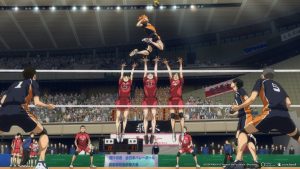
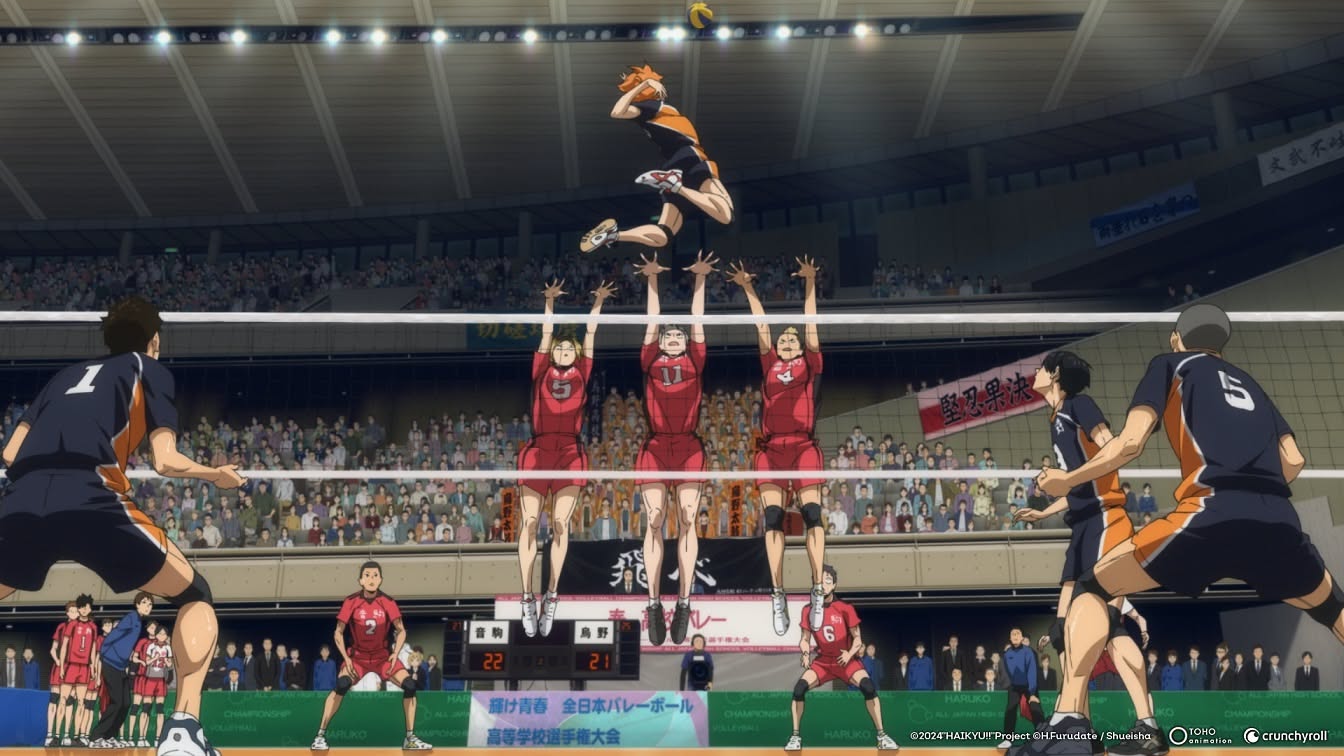
Watching Hinata suffocated under Kenma’s strategic clampdown is genuine psychological horror for fans who have watched the orange-haired dynamo evolve across four television seasons. Yet, it also sets the stage for one of Furudate’s greatest thematic breakthroughs: Hinata’s realization that brute athleticism cannot beat calculated containment—only pure, refined technique can. When Hinata finally unleashes his four-step approach, leaping skyward off a high open set to shatter Kenma’s calculations, it feels like an elemental force rupturing an artificial dam.
The Four Words That Changed Everything
Yet the film’s undisputed emotional climax doesn’t hinge on an impossible kill block or a searing service ace. It happens in the quiet exhaustion of the third set, where sweat burns the eyes, lungs gasp for oxygen, and the ball simply refuses to hit the wood. When Kenma—a boy who has spent an entire series muttering that volleyball is merely a chore he plays to pass the time—collapses onto the floor, looks at his childhood friend Tetsuro Kuroo, and mutters, “Kuro… it’s fun,” the entire franchise reaches its thematic apotheosis. The game was never about winning; it was about bringing a friend to life.
Kinetic Mastery: Production I.G’s Visual Symphony
Directing a feature film that covers an entire multi-volume manga arc within an 85-minute runtime is a terrifying structural gamble. Much of the credit for why The Dumpster Battle succeeds without collapsing under its own momentum belongs to returning series director Susumu Mitsunaka and the virtuosic animators at Production I.G.
Rather than relying solely on the hyper-stylized brush strokes and static impact frames of season four’s To the Top, Mitsunaka pulls the visual identity back toward the cinematic dynamism of the show’s early glory years, supercharging it with an astonishing theatrical budget. The physics of the volleyball court are rendered with staggering verisimilitude—the squeak of rubber soles against polished hardwood, the reverberating thud of a Mikasa ball hitting a forearm, and the subtle shifts in player balance during a multi-man synchronous attack.
The Climactic First-Person Sequence
The technical high-water mark of the film arrives during the penultimate match-point rally, executed almost entirely from Kenma’s first-person perspective. The camera sways, bobs, and blurs; sweat drips across the visual frame; peripheral vision narrows to a claustrophobic pinpoint as exhaustion sets in. We feel the suffocating drag of his heavy limbs and the erratic arc of the ball spinning toward him. It is a breathtaking, dizzying sequence that ranks among the finest pieces of pure sports animation produced in the last two decades, translating the raw physical agony and ecstasy of high-level athletics into visual poetry.
Pacing, Preservation, and the Runtime Debate
No critical appraisal of The Dumpster Battle can ignore the discourse surrounding its format. When Toho Animation initially announced that the final stretch of the manga would be adapted into a two-part theatrical project (Haikyu!! Final), the fandom rightfully panicked. How could a 33-chapter masterwork be condensed into an hour and a half without sacrificing the rich internal monologues of peripheral bench warmers and defensive specialists?
While purists will inevitably mourn the loss of certain slice-of-life interactions and micro-tactical explanations from the manga, the cinematic compression paradoxically elevates the thematic thrust of this particular match. Real-world volleyball is frantic, unrelenting, and over in the blink of an eye. By stripping away extraneous exposition and locking the audience inside the court alongside the players, the 85-minute runtime mirrors the breathless terror of youth sports: you spend hundreds of days preparing for a moment that slips through your fingers before you even realize you’re playing your final point.
The Final Whistle: Why This Is Sports Anime Royalty
As Haikyu!! The Dumpster Battle settles into its permanent home on global streaming services, it stands tall not just as a triumphant victory lap for an acclaimed franchise, but as a clinic in sports anime storytelling. It eschews the hollow melodrama of supernatural superpowers in favor of anatomical grit, tactical brilliance, and the quiet, radiant beauty of adolescent camaraderie.
The match between Karasuno and Nekoma was never just a game; it was a festival celebrating the brief, shining window of time when a high school gymnasium can feel like the center of the universe. With the first half of the two-part finale now enshrined in history, all eyes turn toward the looming shadow of Kamomedai and Shoyo Hinata’s ultimate reckoning with the true Little Giant. If Production I.G brings even half of this film’s relentless passion to the concluding chapter, anime history will have a new standard to aspire to for generations to come.
Have you streamed Haikyu!! The Dumpster Battle yet? Did Kenma’s first-person sequence blow you away, or do you wish the match had been stretched into a full television season? Sound off in the comments below, and keep it locked to Wibux.com for all your anime breakdowns and industry coverage!