
When the opening notes of “Jaka Jaan”—composed by Grammy winner Zedd alongside Yukinojo Mori—soar across the screen, a profound emotional wave washes over the anime world. The arrival of Dragon Ball Daima was originally framed as a celebratory landmark for the franchise’s staggering 40th anniversary. However, the untimely passing of creator Akira Toriyama in March 2024 transformed this vibrant animated odyssey into something vastly more poignant: the final, fully realized masterpiece of manga’s greatest architect. Where many feared another corporate-mandated spin-off engineered to sell merchandise, Daima immediately asserts itself as pure, unadulterated Toriyama whimsy, breathing kinetic life into the unexplored corners of his sprawling multiverse.
Far from a retread of past formulas, the premiere delivers an astonishingly confident blend of forensic canon reconstruction, breathtaking Sakuga animation, and an earnest return to foundational adventure. By plunging Son Goku and the Z-Fighters into the long-rumored Demon Realm (Makai), Dragon Ball Daima honors four decades of Kamehamehas by gracefully subverting the very power escalation that defined its modern era.
A Bittersweet Swansong: Toriyama’s Undiluted Creative Fingerprints
Unlike Dragon Ball Super, where Toriyama famously provided narrative outlines that were subsequently fleshed out and interpreted independently by Toyotarou and Toei Animation’s writing rooms, Daima was intensely personal. Toriyama served as the driving force behind the story, conceptualized the intricate lore, drafted the world design, and personally penned character scripts. From the moment the premiere begins, that idiosyncratic authorial voice is unmistakable.
The Tactile Whimsy of a Master Storyteller
The visual language of Daima immediately recalls the golden age of Dr. Slump and the early chapters of the original Dragon Ball. Toriyama’s lifelong fascination with industrial, round-chassis vehicles, peculiar culinary worldbuilding, and whimsical biological mechanics is on full display. The introduction of King Gomah, his sycophantic attendant Degesu, and the brilliantly eccentric Namekian elder Neva feels thoroughly authentic to the maestro’s late-career sensibilities. Even the naming conventions—punctuated by demon royalty casually snacking while reviewing security footage of Earth’s Majin Buu conflict—radiate Toriyama’s trademark deadpan humor, balancing apocalyptic stakes with domestic absurdism.
Unlocking the Makai: Canonizing Decades of Fringe Lore
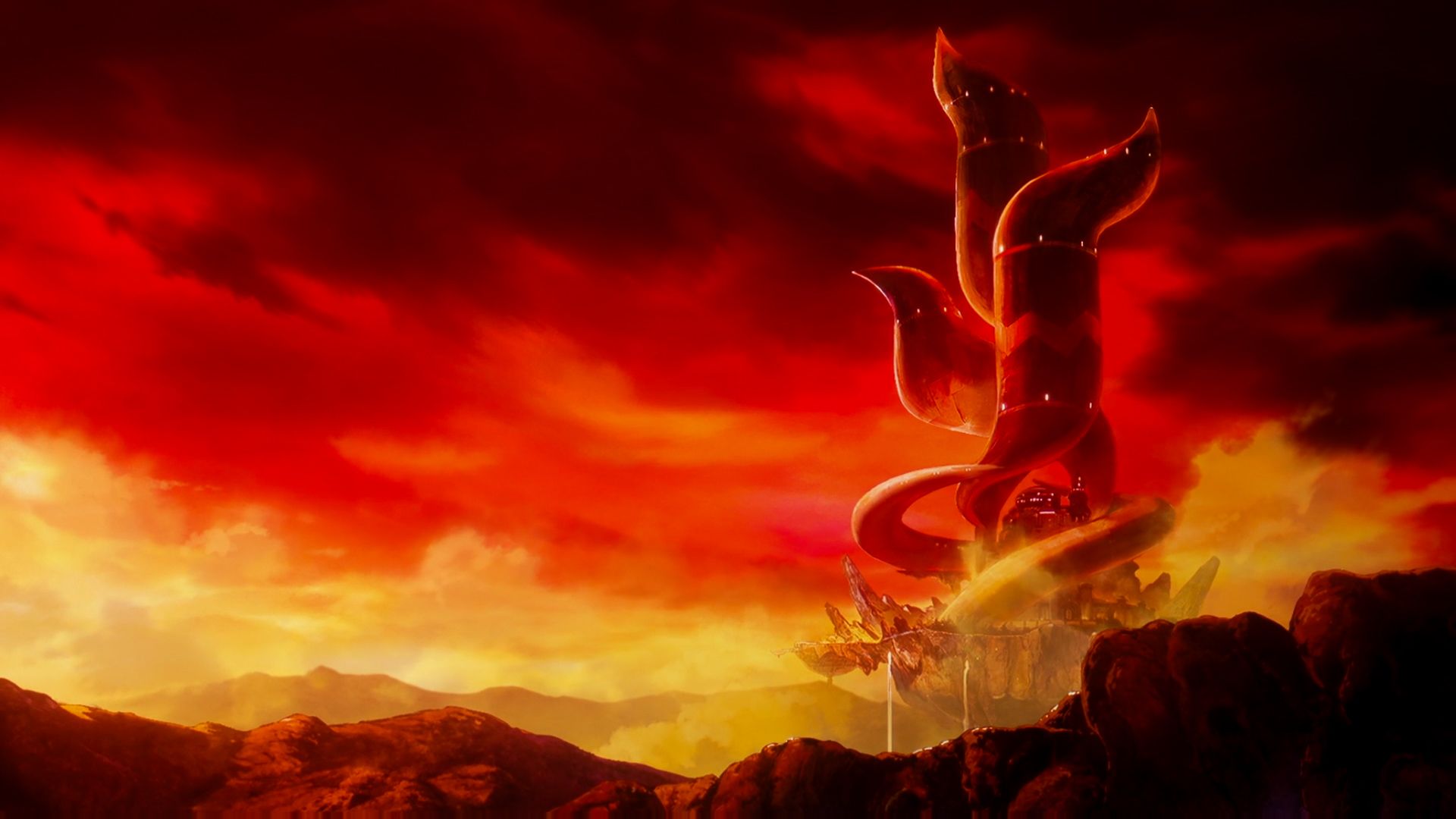
For decades, the Demon Realm existed as a tantalizing enigma on the fringes of Dragon Ball continuity. Dabura was introduced in the Majin Buu saga as the realm’s monarch, yet the geography, hierarchy, and metaphysics of his domain were largely left to non-canon properties like Dragon Ball Heroes and the Xenoverse video games. The premiere of Daima obliterates that ambiguity by codifying the Demon Realm into an intricate, three-tiered cosmic empire with its own geopolitical tensions and metaphysical rules.
Rewriting the Cosmic Hierarchy
The narrative engine of Daima begins with the death of Babidi and Majin Buu. With the cosmic vacuum left behind in the mortal realm, King Gomah seizes the throne of the Makai. Paralyzed by the terrifying revelation that Earth’s mortals vanquished both Dabura and Buu, Gomah formulates a preemptive tactical strike. Rather than unleashing a mindless brute, he turns to the ancient Namekian Neva to awaken the Demon Realm’s native Dragon Balls—monitored by the formidable “Tamagami” guardians.
Gomah’s wish—to diminish Earth’s warriors into prepubescent miniatures—is widely misunderstood on a surface level as a recycled Dragon Ball GT gimmick. In narrative context, however, it is a stroke of tactical paranoia. It neutralizes the physical mass, leverage, and sheer biological threat of Earth’s champions without requiring Gomah to match their incomprehensible god-like power levels. In doing so, Toriyama effortlessly bypasses the franchise’s suffocating power-scaling dilemmas, resetting the battlefield while expanding universe lore in a way that respects canonical history.
Mini But Mighty: The Martial Arts Paradigm Shift
Over the last decade, Dragon Ball discourse has grown fatigued by astronomical cosmic transformations. Between Super Saiyan Blue, Ultra Instinct, and Ultra Ego, conflicts had devolved into high-speed planetary laser shows that frequently abstracted the tactile joy of hand-to-hand choreography. Daima ingeniously remedies this exhaustion by shrinking its combatants.
The Kinematics of Classic Kung-Fu
Directing duo Aya Komaki (celebrated for her visionary work on One Piece) and Yoshitaka Yashima, supported by the stylistic philosophy of character designer Katsuyoshi Nakatsuru, deliver a visual feast in the opening episode. When Goku is transformed into a child, his center of gravity shifts, his reach is drastically curtailed, and his muscle memory is scrambled. This is not played merely for visual gags; it fundamentally reshapes the action design.
The return of Goku’s iconic Nyoibo (the Power Pole) is a visual and tactical manifesto for the series. Stripped of his effortless planetary destruction capabilities, Goku must rely on leverage, balance, momentum, and polearm martial arts. The action sequences in Daima favor weighted choreography, impact frames, dynamic perspective shifts, and environmental interaction over sheer beam struggles. It recaptures the kinetic thrill of Toriyama’s love for 1970s Hong Kong cinema, making every parry, sweep, and strike feel exceptionally tangible once more.
A Fresh Fellowship: Glorio and the Makai Expedition
While veterans like Piccolo, Vegeta, and the drastically de-aged Supreme Kai Shin anchor the Earthly dynamic, Daima shines brightest when it introduces foreign variables to disrupt the established team chemistry. The arrival of Glorio, a mysterious gunslinger-pilot hailing from the Demon Realm’s Second World, offers the show its most compelling new cipher.
Shattering the Saiyan Echo Chamber
Glorio’s presence reframes the narrative as an exploratory road trip rather than an apocalyptic defense arc. Armed with technological ingenuity, arcane knowledge of the Makai’s toxic atmospheres, and an enigmatic moral compass, Glorio serves as the ideal foil to Goku’s unyielding, naive enthusiasm. Coupled with Shin finally reclaiming narrative relevance after decades of being relegated to horrified background commentary, Daima fosters a tight-knit ensemble dynamic reminiscent of the original quest for the Dragon Balls in 1984. It is an adventurous fellowship driven by curiosity and camaraderie rather than immediate planetary dread.
The Verdict: A Triumphant Love Letter to 40 Years of Wonder
The global reception to Dragon Ball Daima has been nothing short of electric, converting early skeptics into vocal champions. By refusing to deliver another paint-by-numbers tournament arc, Toriyama opted instead to remind the world why we fell in love with his universe in the first place: the thrill of the unknown, the charm of peculiar creatures, the warmth of unbreakable bonds, and the sheer poetry of martial arts.
Dragon Ball Daima is not merely an exceptional premiere; it is an emotionally resonant victory lap for Akira Toriyama. It stands as a vibrant testament to an artist who never lost his childlike wonder, proving that even after forty years, the world of Dragon Ball still possesses the boundless magic to leave us completely spellbound.
What did you think of the Dragon Ball Daima premiere? Does Goku’s return to the Power Pole live up to the hype, or are you craving more Super Saiyan transformations? Drop your thoughts in the comments below, and stay tuned to Wibux.com for weekly episodic breakdowns and deep-dive lore analysis!