
For more than two decades, the Nasuverse has thrived on a delicate paradox: rigorous metaphysical rulebooks juxtaposed with the visceral, chaotic deconstruction of those very same constraints. Ever since Kinoko Nasu first codified the Holy Grail War in the snow-dusted alleys of Fuyuki City, fans have understood the ritual as an intimate tragedy—a hyper-localized clash of seven historical ghosts bound by the clockwork thaumaturgy of the Mage’s Association. Yet, when Ryohgo Narita introduced the Snowfield ritual in what originally began as an April Fool’s joke, the paradigm shifted irrevocably. Now, with the transition from the critically acclaimed Fate/strange Fake: Whispers of Dawn special into a full-scale, theatrical-grade television series, Type-Moon is entering its most ambitious, structurally brazen era since Fate/Zero redefined dark urban fantasy in 2011.
The greenlit television adaptation of Fate/strange Fake is not merely another spin-off designed to feed the insatiable commercial appetite of the modern anime ecosystem. It represents an unprecedented creative collision: the hyper-kinetic, ensemble-driven storytelling of Narita (Baccano!, Durarara!!) married to the labyrinthine cosmic hierarchy of Nasu’s foundational lore. Produced by A-1 Pictures, this project promises to shatter the glass ceiling of serialized anime production values while re-examining the foundational mythos of Heroic Spirits, divine morality, and human arrogance.
The Narita Engine: Hyper-Ensemble Chaos Meets Nasuverse Rigidity
To understand the revolutionary weight of Fate/strange Fake, one must first deconstruct the architectural differences between Kinoko Nasu and Ryohgo Narita. Nasu’s genius lies in insular, psychologically claustrophobic chamber dramas where character archetypes undergo rigorous philosophical interrogation. Narita, by contrast, is a master of the decentralized multi-POV sprawl. In his hands, the ritual is transplanted to the arid expanses of Snowfield, Nevada—a sterile, manufactured slice of Americana that serves as the testing ground for an unauthorized, counterfeit Holy Grail War.
Narita systematically strips away the nostalgic romanticism of traditional Masters and Servants. Instead of solitary mages seeking the Root in secluded Japanese basements, Snowfield is an geopolitical powder keg crawling with rogue alchemists, black-budget American military cabals, police chiefs masquerading as master tacticians, and ancient divine entities who treat the Mage’s Association with unadulterated contempt. The series operates like an explosive Robert Altman film or an adrenaline-fueled Guy Ritchie pastiche, where dozens of disparate narrative threads careen toward a singular point of catastrophic convergence.
The “False” and “True” Class Paradox
The dramaturgical brilliance of the narrative hinges on its deliberate conceptual corruption. The Snowfield ritual is fundamentally incomplete: it initially lacks the Saber class entirely and mimics the Third Magic with crude technological and thaumaturgical splices. Just as the seven “False” Servants establish their dominion over the American desert, the ritual attempts to self-correct by manifesting an auxiliary cycle of “True” Servants, doubling the roster and mutating the conflict from a duel of shadows into an apocalyptic civil war. By turning the very structure of the Servant summoning system into a dynamic mystery box, Narita ensures that veterans of the franchise are perpetually kept off-balance.
Mythic Collisions: Subverting the Servant Hierarchy
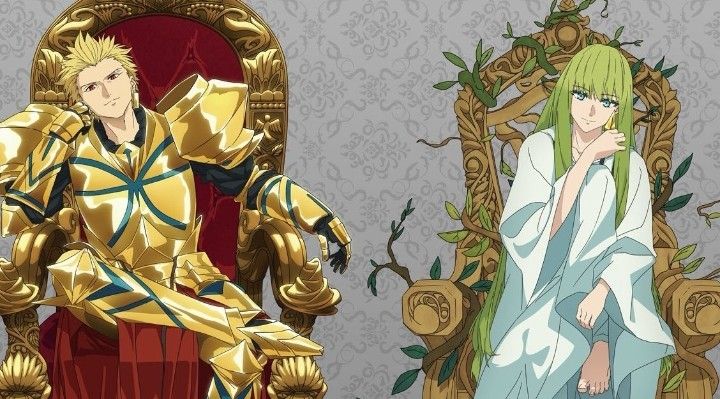
Nowhere is the series’ bravura more evident than in its staggering, almost reckless servant roster. Rather than relying on familiar faces to shore up audience loyalty, Fate/strange Fake weaponizes power creep as a thematic instrument. The narrative immediately establishes its stakes not through incremental skirmishes, but by detonating the single most anticipated rematch in Nasuverse history within its opening movements: the cataclysmic confrontation between Gilgamesh, the King of Heroes, and Enkidu, the Clay of the Gods.
Where previous adaptations treated the deployment of Noble Phantasms like Enuma Elish as the climax of an entire narrative arc, strange Fake treats divine planetary devastation as a morning greeting. The spectacle is jaw-dropping, but the emotional core is surprisingly tender; Narita understands the mythic loneliness of these two entities, framing their reality-rending clash not as petty malice, but as an affectionate dialectic written in the language of stars and divine chains.
Yet, the narrative avoids becoming a one-dimensional festival of god-level skirmishes by pairing its juggernauts with grotesque, conceptual horrors:
- Alcides (True Archer/Avenger): The mythological Heracles, robbed of his divine glory through Black Mud corruption and command-spell torture, stripped of his iconic immortality and remade into an agonizing, human-hating sniper who rejects the gods with venomous rage.
- Pale Rider (False Rider): A Servant that isn’t a person at all, but the primordial personification of the Biblical Fourth Horseman—a localized apocalypse of disease, quarantine, and psychological dread anchored to a comatose child Master.
- Richard I the Lionheart (False Saber): A romantic, fast-talking sovereign whose wide-eyed devotion to Arthurian myth stands in poignant contrast to modern geopolitical cynicism, serving as the thematic anchor for his beleaguered Master, Ayaka Sajyou.
Production Pedigree: A-1 Pictures and the New Sakuga Frontier
For over a decade, ufotable held an unchallenged monopoly over the visual aesthetic of prestige Type-Moon adaptations, pioneering an approach defined by composite-heavy lighting, seamless 3D spatial integration, and volumetric digital effects. However, the creative regime helming Fate/strange Fake at A-1 Pictures—led by the directorial dream team of Shun Enokido and Takahito Sakazume—chose a fundamentally different, artistically electrifying visual philosophy.
Enokido and Sakazume, both generational talents who rose through the ranks of the modern “web-gen” sakuga movement with legendary work on Fate/Apocrypha and Chainsaw Man, prioritize raw, kinetic hand-drawn animation over post-production polish. In their hands, the desert of Nevada feels vast, tactile, and dangerously volatile. The motion is frenzied yet geometrically precise, capturing the terrible weight of supersonic combat without sacrificing character acting or silhouette clarity.
This animation triumph is fortified by the legendary Hiroyuki Sawano, whose thunderous brass sections, distorted synths, and operatic vocal arrangements provide the definitive musical backdrop to an eschatological war staged on American soil. The sonic identity of the TV series discards the gothic melancholy of Yuki Kajiura in favor of an urgent, cinematic blockbuster atmosphere that directly mirrors Narita’s pulp-modern sensibilities.
Lore Implications: The Ultimate Nasuverse Convergence
Beyond its sheer kinetic bravura, Fate/strange Fake occupies an exceptional place within the broader cosmology of Type-Moon. Longtime scholars of Nasu’s works are aware of the bifurcated timelines that separate worlds where Heroic Spirit invocation is possible from those dominated by the aristocratic horror of the Dead Apostle Ancestors (as seen in Tsukihime). Strange Fake audaciously plants its flag directly at the intersection of these two realities.
By folding in covert operations from the Clock Tower’s Department of Policies, direct interference from Dead Apostles, and callbacks to the unproduced concepts of Fate/Prototype, the series functions as the ultimate canon crucible. It bridges the gap between old-school visual novel esotericism and the sweeping multi-world scope of Fate/Grand Order, proving that the franchise can evolve into a coherent, overarching macro-narrative without losing the bespoke idiosyncrasies of its foundational texts.
The Verdict: An Anomaly Primed to Redefine the Genre
The impending arrival of the complete Fate/strange Fake television series marks the definitive end of the franchise’s creative adolescence. It is a work that refuses to play by the rules of its predecessors, trading suburban shadows for neon-lit American highways, and gentlemanly duels for multi-vectored divine assassinations. Supported by an anime production team operating at the bleeding edge of kinetic craft, Narita’s magnum opus is primed to redefine not only what a Fate adaptation can look like, but how ambitious ensemble anime can be in the modern streaming era.
As the stage lights illuminate the blood-soaked sands of Snowfield, only one question remains for the fandom: Are you prepared to abandon the safety of Fuyuki’s rules, or will the spectacle of the False Grail War consume your expectations whole? Drop your thoughts, favorite Servant matchups, and production theories in the comments below!