Ever since Emporio pulled the metaphorical trigger against Enrico Pucci in the reality-resetting climax of Stone Ocean, the international anime community has held a singular, collective breath. The closing montage of Part 6 felt like an emotional eulogy to the original Joestar bloodline, but seasoned manga readers knew better: the end was merely a prelude to a rebirth. For years, the rumblings surrounding an anime adaptation of JoJo’s Bizarre Adventure: Steel Ball Run have oscillated between frantic insider speculation and breathless artistic reverence. Part 7 is not simply another episodic chapter in Hirohiko Araki’s multi-generational saga; it is widely considered the mangaka’s absolute magnum opus—a work that redefined sequential art in Japan and fundamentally transformed what a supernatural adventure could achieve.
As industry eyes fixate on David Production’s studio pipeline, the anticipation surrounding Steel Ball Run has grown into an unprecedented cultural event. Adapting this 1890 cross-continental equestrian race across the United States involves creative, financial, and logistical stakes of Olympian proportions. From the psychologically complex anti-heroism of Johnny Joestar to the daunting technical realities of illustrating thousands of frames of running horses, David Production stands before its most treacherous and glorious frontier yet.
The Seinen Evolution: Hirohiko Araki’s Magnum Opus
To understand why Steel Ball Run occupies such an exalted tier in pop-culture discourse, one must look at the artistic conditions under which it was forged. When serialization began in 2004 within the pages of Weekly Shonen Jump, it was initially uncoupled from the mainline JoJo moniker. However, the true creative renaissance occurred when Araki migrated the series to the monthly seinen publication Ultra Jump in 2005. Free from the breakneck weekly deadlines and demographic constraints of typical shonen fare, Araki’s storytelling matured exponentially.
The pacing transformed. The panels expanded into sweeping, panoramic vistas of the American frontier, drenched in isolation, grime, and an existential yearning for redemption. Araki swapped out the metropolitan sprawl of Morioh and the claustrophobic prisons of Florida for an unforgiving landscape of salt flats, parched deserts, and snow-choked forests. More importantly, the narrative pivoted away from absolute binaries of good and evil. In Steel Ball Run, the pursuit of the mystical Holy Corpse—the anatomical relics of an unnamed saint scattered across the continent—is motivated not by megalomania, but by wounded human desire, fractured faith, and ideological desperation.
Johnny Joestar and Gyro Zeppeli: A Study in Broken Men and Shared Destinies
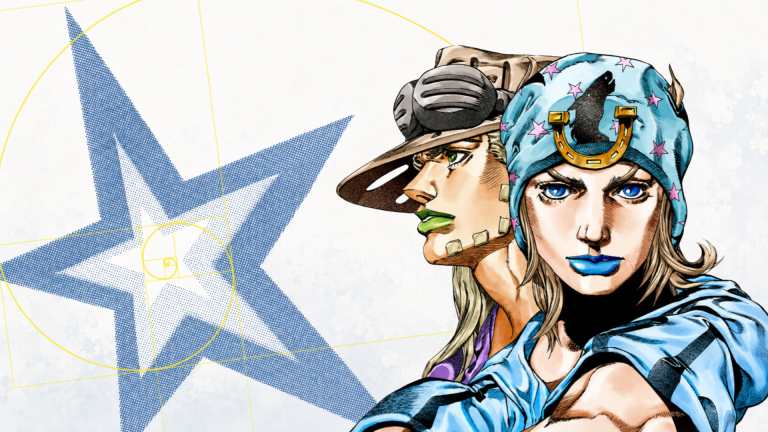
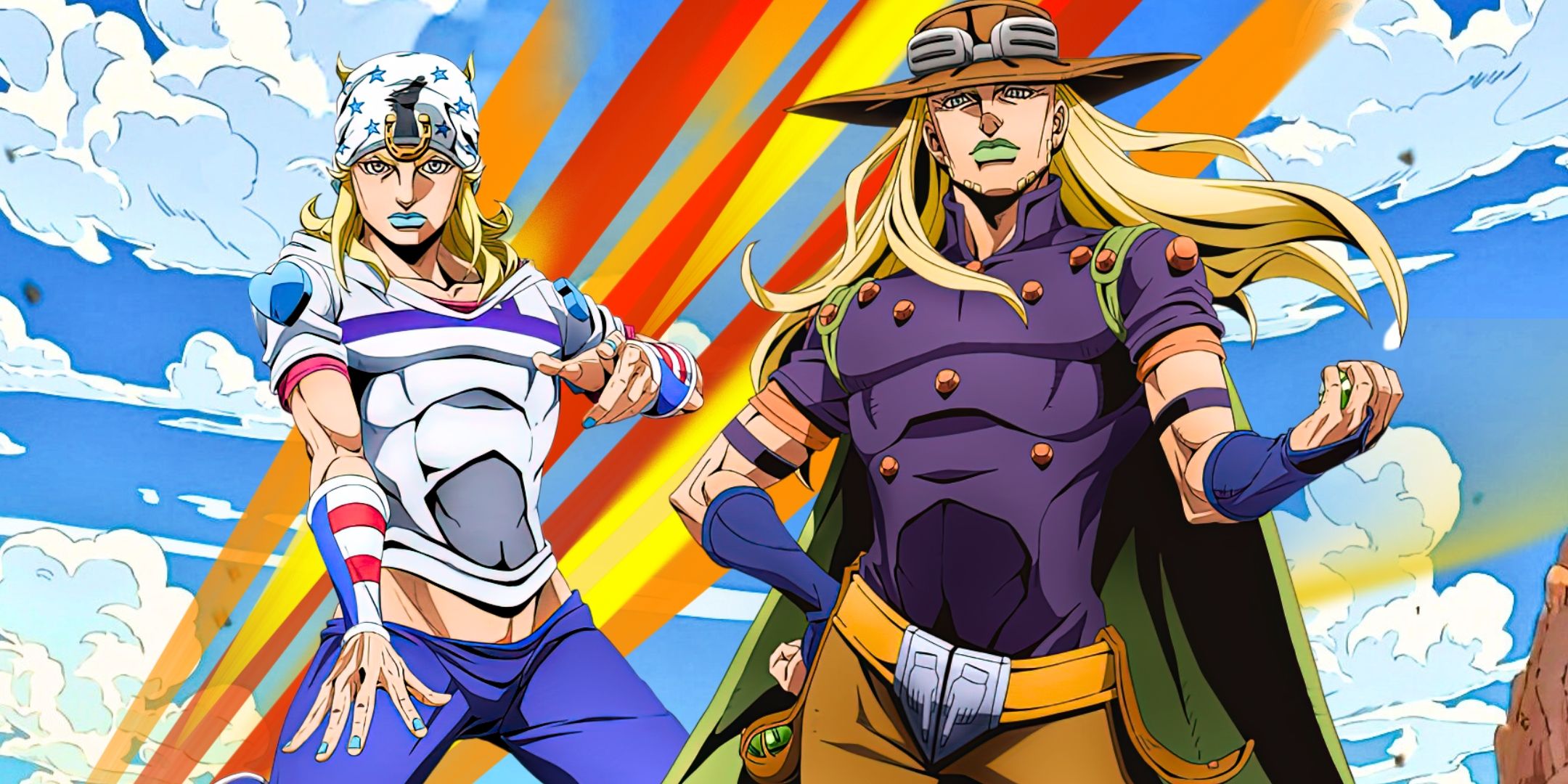
At the center of this 6,000-kilometer cross-country odyssey is what stands as undeniably the most nuanced, emotionally resonant duo in Araki’s entire canon: Johnny Joestar and Gyro Zeppeli.
Johnny Joestar: The Dark Determination of a Fallen Prodigy
Unlike his upright namesake Jonathan Joestar, Johnny begins his arc stripped of virtue, glory, and mobility. A former horse-racing prodigy whose reckless arrogance resulted in a gunshot wound that paralyzed him from the waist down, Johnny is profoundly unlikable in the narrative’s opening moments. He is selfish, bitter, and hollowed out by trauma. His motivation to enter the Steel Ball Run race isn’t to save the world; it is sparked purely by a flicker of personal hope when he touches Gyro’s spinning spheres and temporarily twitches his legs.
Araki endows Johnny with what the narrative overtly terms “Dark Determination”—a cold, unflinching willingness to kill or cross moral boundaries to regain his dignity and discover what he terms “negative to zero.” Johnny is not striving to become a hero; he is simply crawling out of the psychic abyss. His Stand, Tusk, reflects this profound psychological maturation, evolving across four distinct “Acts” from a weak, nail-shooting familiar into an earth-shattering dimensional terror.
Gyro Zeppeli: The Golden Ratio and Zeppeli Honor
Serving as Johnny’s foil, reluctant mentor, and emotional anchor is Gyro Zeppeli, a disgraced executioner from the Kingdom of Naples entering the race to secure royal amnesty for an innocent child condemned to death. Flamboyant, idiosyncratic, and armed with gold-plated teeth, Gyro introduces the Spin—a supernatural martial art grounded in Renaissance mathematics and the Golden Rectangle. Gyro is the ideological heir to William and Caesar Zeppeli, yet he feels profoundly modern: world-weary, prone to absurd comedy, yet shackled to a family legacy of cold detachment that he constantly struggles to dismantle.
The chemistry between Johnny and Gyro forms the beating heart of Part 7. Their nighttime campfire conversations, deadpan musical gags, and mutual codependency elevate the narrative far above standard battle-manga conventions. If David Production fails to capture the fragile, quiet intimacy of these two lost souls bonding beneath the cold starry desert sky, no amount of flashy combat sakuga can redeem the adaptation.
The David Production Dilemma: The Nightmare of Equestrian Animation
Why has the adaptation taken so long to manifest? The answer boils down to an infamous animator’s aphorism: horses are the graveyard of 2D production. In the realm of hand-drawn animation, equines represent an absolute geometric nightmare. Capturing the muscular anatomy, skeletal momentum, and shifting perspective of dozens of galloping horses requires master-level draftsmanship that few modern animators can sustain over multiple consecutive seasons.
David Production has proven their mettle with stylized character models and dynamic camera work across previous seasons, but Steel Ball Run is fundamentally an open-world Western. Every race checkpoint demands hundreds of kinetic frames featuring thundering hooves, kicking dirt, dynamic camera tracking, and evolving character poses. The industry’s standard modern workaround—utilizing pure, low-framerate 3DCG models for background steeds—poses massive artistic risks. If handled clumsily, jarring CGI could obliterate the gritty, ink-drenched prestige aesthetic Part 7 demands.
To succeed, David Production will likely have to pioneer a bespoke hybrid workflow, much like Studio Orange executed in Trigun Stampede or MAPPA’s dynamic vehicular work in Chainsaw Man. By integrating heavily shaded 3D rigs for baseline anatomical trajectory with meticulously hand-drawn 2D keyframes for close-up impacts and rider close-ups, the studio could bypass the uncanny valley and preserve Araki’s trademark line-heavy hatching style.
Broadcast Strategy: Avoiding the Netflix Batch Pitfall
Beyond the technical drawing board lies an equally critical conversation regarding distribution. The community’s collective memory is still smarting from the release rollout of Stone Ocean. When Netflix released Part 6 in sporadic, fragmented “batches,” it effectively suffocated the global JoJo discourse. The serialized, week-to-week fan theorizing, viral meme cultivation, and shared cultural rhythm that made Stardust Crusaders and Golden Wind global sensations were severely muted.
Steel Ball Run cannot afford the batch-drop model. Part 7 is structured like a serialized prestige drama—dense, deliberate, and packed with jaw-dropping cliffhangers. The race checkpoints, the shifting alliances between eccentric rival racers (such as Diego Brando and Mountain Tim), and the slow-burning political conspiracy engineered by President Funny Valentine demand weekly community dissection. Restoring the weekly simulcast format on global platforms like Crunchyroll or prime-time Japanese television is essential to granting this grand narrative the cultural dominance it deserves.
The Road to San Diego: Final Verdict
The anticipation surrounding the anime adaptation of Steel Ball Run is not merely routine fan impatience; it is the recognition of an impending watershed moment for modern anime. Hirohiko Araki’s epic is an intricate tapestry woven from American history, existential philosophy, quantum physics, and body horror. It is a work that asks what it truly means to heal from personal ruin and whether pursuing a miraculous destiny is worth shedding one’s humanity.
David Production stands at a historic crossroads. If the studio takes the necessary pre-production time to conquer its technical hurdles and crafts a release pipeline worthy of the source material, Part 7 will not merely honor Araki’s legacy—it will reset the parameters of what an anime adaptation can achieve in the modern era. The starting pistol is waiting to fire, and the world is already at the starting line.
How do you think David Production should tackle the legendary horse animation of Part 7? Are you willing to wait longer for full hand-drawn glory, or should they embrace cutting-edge CGI? Let your voice be heard in the comments below!