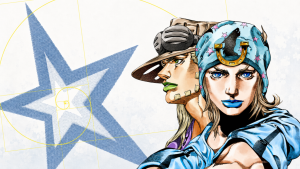


Ever since the bittersweet, universe-resetting notes of Stone Ocean faded into the anime ether, the global anime community has collectively held its breath for a single, monumental horizon: JoJo’s Bizarre Adventure: Steel Ball Run. To understand the sheer gravity of this anticipation is to understand that Steel Ball Run (Part 7) is not merely another chapter in Hirohiko Araki’s generational chronicle; it is widely heralded as his undisputed magnum opus. Consistently vying with Kentaro Miura’s Berserk for the highest-rated manga spots across critical aggregators worldwide, Part 7 represents a seismic transformation in Araki’s craft—a historical, gritty, supernatural Western that deconstructs the Joestar mythos while pioneering one of the most sublime narratives ever printed.
Yet, between the deafening online fervor and the silence from Warner Bros. Japan and David Production, a palpable question lingers: When will the greatest race in manga history gallop onto our screens, and more importantly, can modern animation technology actually handle it? As rumors mount and production whispers circulate, we delve into the cultural weight, philosophical depth, and logistical warfare surrounding the impending adaptation of Steel Ball Run.
The Seinen Metamorphosis: A 3,700-Mile American Odyssey
When Steel Ball Run originally serialized in Weekly Shonen Jump in 2004, it was initially presented as an independent Western racing story, divorced from the explicit JoJo moniker. It wasn’t until its transfer to the monthly seinen magazine Ultra Jump in 2005 that Araki unleashed the full, unbridled scope of his vision. Unshackled from weekly shonen constraints, Araki allowed the pacing to breathe, the artwork to develop hyper-detailed neoclassical cross-hatching, and the thematic framework to evolve into something far more morally complex and visceral.
Set against the backdrop of an alternate 1890s America, the narrative revolves around the Steel Ball Run race—a grueling 3,700-mile cross-country equestrian trek from the shores of San Diego to the avenues of New York City. Offering a staggering $50 million grand prize, the spectacle draws outlaws, Native warriors, international royalty, and ruthless opportunists. But underneath the dust and adrenaline lies a clandestine holy war. President Funny Valentine aims to assemble the mummified Corpse of an unnamed, Christ-like Saint, bestowing supreme patriotic prosperity on America at the expense of all global misfortune. Part 7 effortlessly blurs the lines between sports drama, political thriller, and divine horror, establishing a world where ideological purity is just as lethal as a bullet.
Johnny Joestar & Gyro Zeppeli: Flawed Humanity and “Dark Determination”
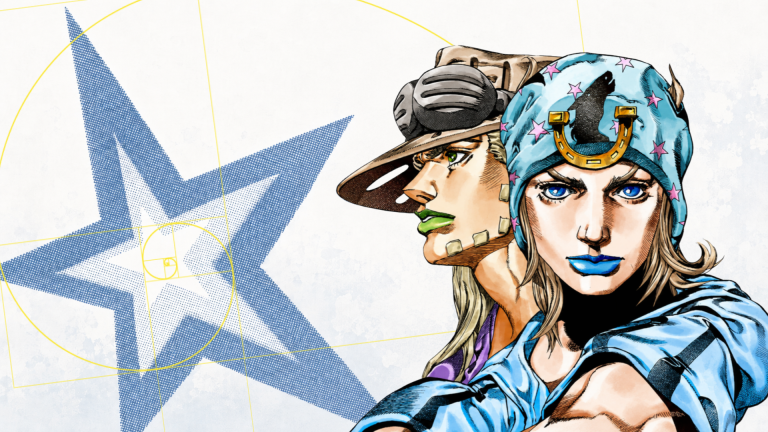
At the beating heart of Steel Ball Run is what is arguably the most impeccably crafted protagonist duo in manga history: Johnny Joestar and Gyro Zeppeli. Their partnership stands as a radical departure from the archetypal heroism of earlier parts, operating with an emotional depth rarely seen in action-adventure serialized fiction.
The Broken Prodigy and the Reluctant Executioner
Johnny Joestar is unlike any Joestar who came before him. Stripped of his former glory as an arrogant, paraplegic former horse-racing prodigy, Johnny is introduced not as a virtuous champion, but as a deeply bitter, desperate man. He doesn’t embark on the Steel Ball Run to save the world; he rides because, upon touching one of Gyro Zeppeli’s rotating steel spheres, his legs briefly twitched. Johnny’s pursuit isn’t about reaching “positive” virtues—it is a desperate, clawing struggle just to bring his life back from “negative to zero.” Araki paints Johnny with what he explicitly terms “Dark Determination,” marked by flaming, unblinking eyes that reveal a protagonist willing to kill and sacrifice everything for his personal redemption.
Contrasting Johnny’s brooding melancholy is Gyro Zeppeli, a disgraced Neapolitan executioner who radiates boisterous bravado, gold-toothed eccentricity, and absurd musical whimsy (immortalized by the iconic “Pizza Mozzarella” gag). Yet beneath Gyro’s manic exterior lies a crushed soul struggling against his family’s brutal heritage, entering the race solely to earn royal clemency for an innocent boy sentenced to death. As the race advances, their dynamic transitions from transactional allies to a fraternal bond of transcendent vulnerability. Gyro serves as Johnny’s spiritual compass, while Johnny becomes the anchor that keeps Gyro tethered to his humanity amidst the carnage of the frontier.
Beyond Stands: The Spin, Geometry, and Spiritual Evolution
While Stands were the hallmark of Araki’s series since Stardust Crusaders, Steel Ball Run retools the franchise’s power dynamic through the introduction of The Spin. Rooted in ancient Neapolitan anatomical and medicinal practices, the Spin is a martial art harnessing rotational kinetic energy through natural geometry.
The Golden Ratio and Metaphysical Warfare
Rather than merely relying on spectral brawlers to exchange punches, Steel Ball Run frames combat around the Golden Ratio—the divine proportion found ubiquitously throughout nature. By observing the logarithmic spirals of nautilus shells, sunflower seeds, and running horses, the user achieves infinite rotational energy. This scientific-yet-mystical system gives birth to unique evolutionary Stands: Johnny’s Tusk, which matures through distinct “Acts” as his psychological trauma heals, and Gyro’s Ball Breaker, an avatar of rotational gravity that can pierce dimensional barriers.
The battles in Steel Ball Run read like tense sniper duels, dynamic chase sequences, and metaphysical confrontations. Encounters against enigmatic foes like Ringo Roadagain, whose stand Mandom rewinds time by exactly six seconds in the pursuit of the “True Man’s World,” challenge the philosophy of self-worth and resolve. The physical stakes feel earned, bone-breaking, and brutally unforgiving in a way that anime has yet to capture with this level of stylistic sophistication.
The David Production Dilemma: The Equestrian Animation Hurdle
For all of Steel Ball Run‘s narrative majesty, bringing it to life presents one of the most terrifying technical hurdles in contemporary television animation. The elephant in the room—or rather, the horse—is the reason why an adaptation has taken years to materialize.
Breaking Down the Horsepower Nightmare
In classical hand-drawn 2D animation, quadrupeds are notoriously labor-intensive to draw; galloping horses, with their intricate skeletal muscle systems and four independent leg cycles, are an animator’s worst nightmare. Steel Ball Run doesn’t feature horses simply as background transportation; they are main characters executing complex maneuvers, drifting around canyons, sprinting side-by-side at breakneck speeds, and serving as conduits for the Golden Spin. Animating a 3,700-mile race with hundreds of distinct equines across 30 to 40 episodes entirely in hand-drawn 2D is commercially unfeasible and historically unsustainable.
This reality leaves David Production with critical stylistic choices:
1. The 3D-CGI Hybrid Approach: Following in the footsteps of studio Orange (Trigun Stampede) or MAPPA’s high-octane Attack on Titan titan clashes, David Pro could utilize bespoke cel-shaded 3D horse assets overlaid with dynamic 2D character models for the jockeys. While controversial among anime purists, high-end CGI offers kinetic camera pans and structural consistency impossible to achieve under traditional TV schedules.
2. The Extended Pre-Production Compromise: David Production could pivot to an elongated, split-cour or seasonal OVA-style release schedule, allowing specialized in-house animation directors to meticulously preserve the tactile line-work of Araki’s art style for close-up action, reserving CG only for mid-ground marathon packs.
Furthermore, David Production and Warner Bros. must learn from the release model of Stone Ocean. The batch-drop distribution on Netflix severely damaged Part 6’s organic cultural momentum, extinguishing the weekly speculative discourse that made Golden Wind a worldwide trending sensation. For Steel Ball Run to claim its rightful throne, a triumphant return to traditional weekly episodic broadcasts is non-negotiable.
The Road Ahead: The Horizon of a Masterpiece
There is no timeline where Steel Ball Run remains unadapted. The commercial weight of the JoJo intellectual property, combined with Part 7’s untouchable legacy as Hirohiko Araki’s storytelling apex, guarantees that David Production is already navigating the logistical wilderness behind closed doors. When Johnny Joestar finally climbs onto his mount, Slow Dancer, and the starter pistol fires in San Diego, it will mark the beginning of an era that could fundamentally reset the standard for what serialized anime can accomplish.
The journey across the American frontier was arduous, tragic, and beautiful for Gyro and Johnny. When that journey arrives on our screens, the anime landscape will never be the same. Run, don’t walk, toward the horizon.
What do you think is the biggest challenge facing David Production for the Steel Ball Run anime? Are you team 2D purism, or will you accept high-grade CGI for the horses? Let your voice be heard in the comments below, and stay tuned to Wibux.com for all breaking anime industry reports!