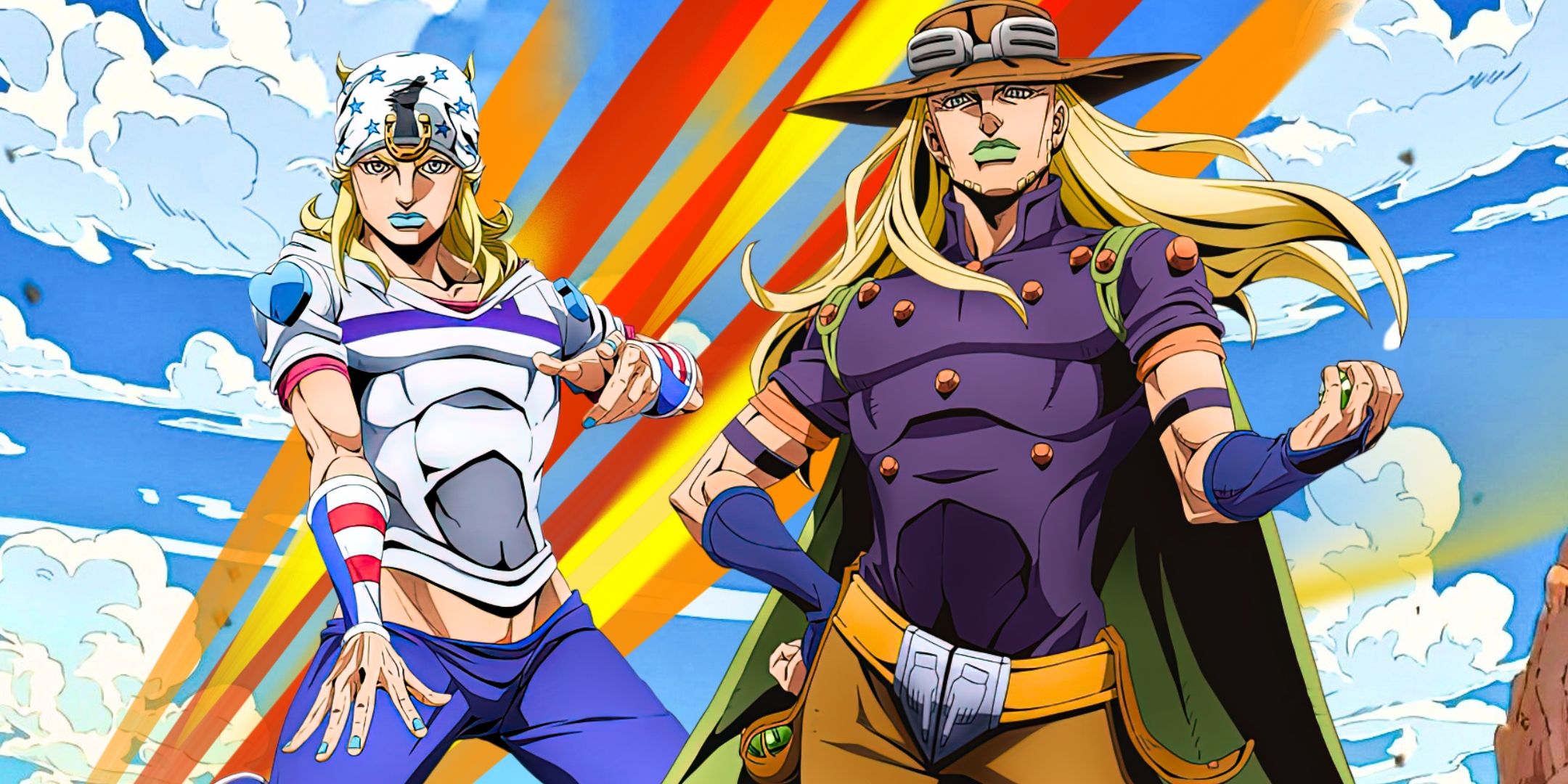
Every medium harbors its holy grail—a work of such staggering ambition that its transition to the screen feels less like a conventional production schedule and more like an impending tectonic shift. In the contemporary anime landscape, nothing commands that mythic aura quite like JoJo’s Bizarre Adventure: Steel Ball Run. Ever since David Production brought the tragic, cosmos-resetting climax of Stone Ocean to a close, the international fandom has cast its gaze toward a new frontier. Not just forward, but sideways: into an alternate 1890, across a dust-swept American continent where an anomalous transcontinental horse race becomes the stage for miracles, mutilation, and divine intervention.
Widely regarded as Hirohiko Araki’s absolute magnum opus, Steel Ball Run (Part 7) is not merely another chapter in the generational Joestar saga. It represents the creative liberation of an author reinventing himself. But as chatter swells across online forums, social spaces, and industry insider circles, the question isn’t whether an anime adaptation will break the internet—it’s whether modern television animation can actually shoulder the colossal weight of Araki’s most demanding vision.
The Ultra Jump Evolution: Araki’s Rebirth and the SBR Mythos
To understand the ravenous hunger for a Steel Ball Run anime, one must first recognize what Part 7 did for Araki as a creator. Originally serialized in Weekly Shonen Jump in 2004 under the standalone title Steel Ball Run, the series soon transferred to the monthly seinen imprint Ultra Jump in 2005. That editorial pivot transformed everything. Freed from the brutal deadlines, rigid content constraints, and frantic pacing of weekly shonen publication, Araki unleashed a masterclass in visual storytelling.
The panels expanded into breathtaking double-page vistas of the American wilderness, rendered with hyper-detailed crosshatching, tactile textures, and high-fashion aesthetics reminiscent of Renaissance anatomy sketches. More critically, the narrative breath broadened. The race wasn’t just a sequence of Stand encounters; it became an existential pilgrimage. For years, manga ranking aggregators like MyAnimeList have positioned Steel Ball Run hovering right alongside Berserk at the absolute pinnacle of sequential art. Adapting Part 7 is not merely honoring a franchise; it is translating an untouchable sacred text of modern Japanese graphic literature.
A Symphony of Flaws: Deconstructing Johnny Joestar and Gyro Zeppeli
The Broken Prodigy and the Cynical Healer
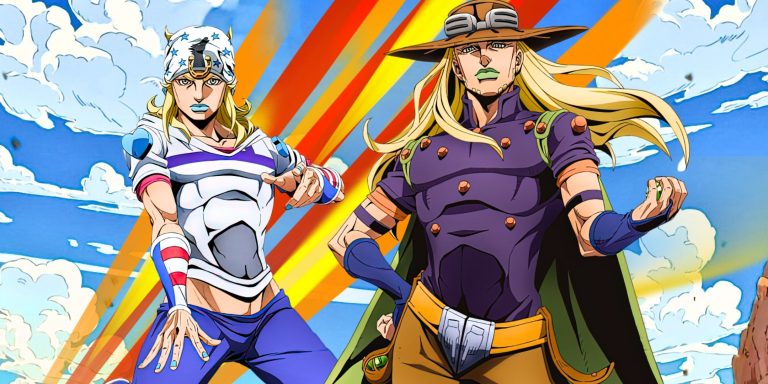
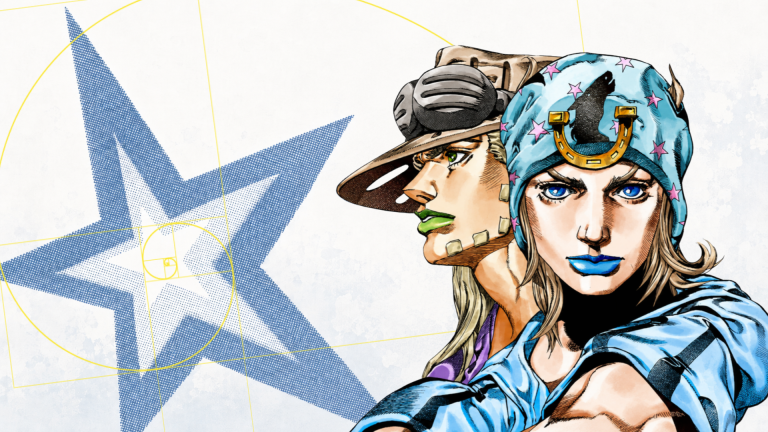
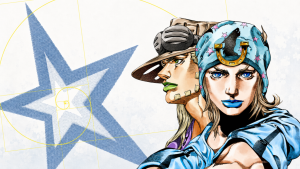
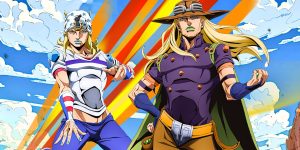
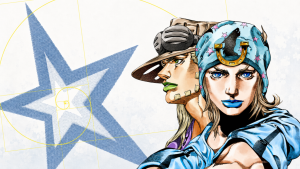
At the beating heart of Steel Ball Run is the most intricately realized duo Araki has ever penned: Johnny Joestar and Gyro Zeppeli. In stark contrast to Jonathan Joestar’s peerless Victorian nobility or Jotaro Kujo’s stoic invulnerability, Johnny begins as a thoroughly broken human being. A former prodigy jockey rendered paraplegic through an act of sheer arrogance, Johnny is bitter, resentful, and utterly devoid of heroism. He doesn’t enter the grueling trans-American race to save the world; he enters because a freak encounter with Gyro Zeppeli’s mystical steel spheres momentarily caused his dormant legs to twitch. Johnny’s driving force is desperate, raw, and often terrifying—an internal flame that Araki explicitly characterizes as a “dark determination,” a chilling readiness to kill or be killed to claw back from negative back to zero.
The Spin and the Golden Ratio
Complementing Johnny’s brooding volatility is Gyro Zeppeli, a disgraced Neapolitan royal executioner armed with absurd comedic timing, bespoke grillz, and the ancient art of the Spin. By discarding the traditional Hamon system and reimagining Stand manifestations through the Golden Ratio—an omnipresent mathematical constant found within nature—Araki grounds their abilities in physical, quasi-scientific mastery before ascending into mind-bending metaphysics. Watching Johnny’s Stand, Tusk, evolve across multiple “Acts” alongside his psychological maturation provides the exact narrative payoff that anime adaptations thrive upon. Their dynamic isn’t a superficial shonen rivalry; it is a profound, messy brotherhood forged over bad jokes, cold wilderness campfires, and bloody standoffs.
The Equestrian Nightmare: David Production’s Technical Frontier
If the narrative of Part 7 is universally celebrated, the logistics of animating it border on sheer terror. Ask any veteran key animator or animation director about their worst operational nightmare, and the answer is almost universal: horses.
Equestrian anatomy involves an unforgiving network of moving joints, muscle twitches, shifting weight distributions, and perspective shifts. Steel Ball Run is not a story where horses sit parked in the background; it is a story where dozens of thoroughbreds, wild mustangs, and draft beasts gallop at breakneck speeds across dynamic 3D environments, colliding, leaping rivers, and dodging supernatural projectiles across hundreds of miles of terrain. Animating this purely in traditional 2D hand-drawn frames would require a sustained budget and talent pipeline that almost no contemporary television studio can sustain without collapsing production schedules.
David Production, which has lovingly nurtured the anime adaptation of JoJo’s Bizarre Adventure since 2012, faces a monumental artistic crossroad:
- The Hybrid Pipeline: The most feasible production model relies on hyper-stylized 3DCG models for the horses during wide-angle, high-velocity race sequences, seamlessly composited with hand-drawn 2D close-ups of riders, facial acting, and close-quarters Stand clashes.
- The Stylistic Precedent: David Production demonstrated exceptional digital staging with the fire effects and fluid movement in Fire Force, and Orange proved with Trigun Stampede that CG can capture kinetic dynamism. However, JoJo fans are notoriously sensitive to visual disruptions. If the equine models look disjointed or weightless, the immersion evaporates.
- The Schedule Reality: Unlike the hurried, divisive batch drop that marred the cultural momentum of Stone Ocean on Netflix, an adaptation of Steel Ball Run demands an expansive, meticulously budgeted production cycle. An announcement can only responsibly arrive when pre-visualization and asset development are ironclad.
Manifest Destiny Meets Divine Intervention: The Sacred Corpse
The thematic scope of Part 7 elevates it beyond a mere sports drama or western skirmish. As the racers trek eastward from San Diego to New York City, the race unveils its true, sinister raison d’être: the discovery of the mummified parts of a Holy Corpse—heavily implied to be that of Jesus Christ—scattered across the continent. This relic doesn’t just grant Reality-altering Stands; it confers absolute, unyielding geopolitical luck.
Enter President Funny Valentine, widely heralded as one of the finest antagonists across the entirety of anime and manga. Driven by an unshakeable, zealot-like patriotism, Valentine’s Stand, Dirty Deeds Done Dirt Cheap (D4C), allows him to slip between parallel dimensions, weaponizing infinite realities in service of his doctrine of “taking the first napkin.” The clash between Johnny’s selfish yearning for personal redemption and Valentine’s ruthless, utilitarian American exceptionalism transforms the climax of Steel Ball Run into an intellectual and philosophical showdown that will ignite discourse across the anime community for months on end.
The Long Road to the Starting Line: What Comes Next?
There is no question that David Production and Warner Bros. Japan are painfully aware of what Steel Ball Run represents. It is the bridge into the modern, prestige era of the JoJo universe—a work capable of attracting an audience far beyond typical battle-shonen enthusiasts, pulling in admirers of cinematic westerns, historical epics, and psychological character studies.
Whenever the starting gun finally sounds—whether via an extravagant festival announcement or a surprise promotional teaser—the anime community will be waiting at the starting line. Until then, fans must hold their breath, keep their eyes on the horizon, and remember Gyro’s immortal lesson: the shortest route was a detour, and the detour was our true path.
How do you think David Production should tackle the legendary horse animation of Part 7: full hybrid 3DCG, or raw hand-drawn sakuga? Drop your predictions in the comments below, and stay tuned to Wibux.com for all your frontline anime breakdowns!