Ever since the cosmic, melancholy notes of Jolyne Cujoh’s saga faded into the Florida rain at the climax of Stone Ocean, the anime community has existed in a collective state of breathlessness. The resetting of Hirohiko Araki’s multiverse didn’t just mark the end of the generational Joestar-Brando blood feud; it carved open the gateway to the sacred cow of modern manga: JoJo’s Bizarre Adventure: Steel Ball Run. Sitting comfortably as the second highest-rated manga of all time on MyAnimeList, Part 7 is universally heralded as Araki’s undisputed magnum opus. Consequently, every trade show, studio trademark registration, and oblique social media post from David Production sends seismic shockwaves through the fandom.
Yet bringing Steel Ball Run to the small screen is not merely an exercise in capitalizing on an intellectual property. It represents a monumental creative pivot, a technical minefield that has broken lesser studios, and the arrival of two of the most emotionally complex protagonists in serial fiction. As the whispers turn to deafening roars, we break down why the adaptation of this trans-American equestrian epic is both anime’s greatest promise and David Production’s ultimate reckoning.
The Seinen Rebirth: Araki’s Shift from Pulp to Prestige
To understand the immense anticipation surrounding Part 7, one must contextualize its genesis. When Steel Ball Run kicked off in Weekly Shonen Jump in 2004, it was initially presented without the “JoJo” prefix—a calculated attempt to liberate Araki from the mechanical shackles of nearly two decades of continuity. However, the watershed moment occurred when the series migrated to the monthly pages of Ultra Jump in 2005. Free from the breakneck pacing and strict content guidelines of shonen demographics, Araki underwent an artistic renaissance.
Part 7 morphed into a gritty, sprawling, historical supernatural western set across the sun-bleached expanse of 1890s America. The narrative engine is the Steel Ball Run race itself: a grueling, 3,800-mile cross-continental equestrian dash from San Diego Beach to New York City, boasting a staggering $50 million purse. But underneath the dust, sweat, and muzzle-smoke lies an operatic dissection of American ambition, manifest destiny, and theological determinism. It is a mature, uncompromising epic that demands an elevated cinematic language—one far removed from the hyper-saturated, episodic brawl-fests of the series’ early days.
Johnny Joestar and Gyro Zeppeli: Deconstructing the JoJo Dynamic
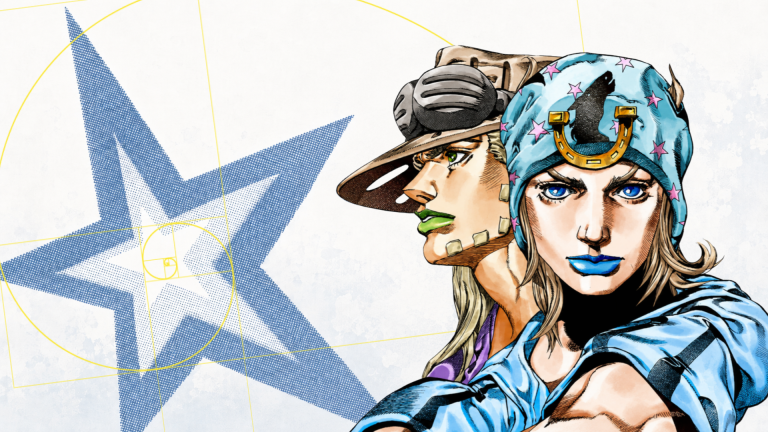
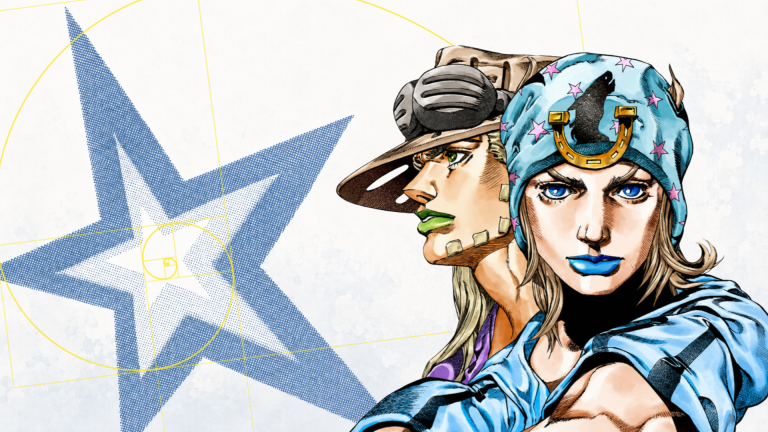
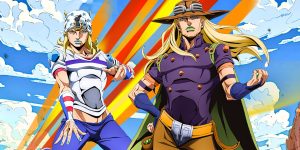
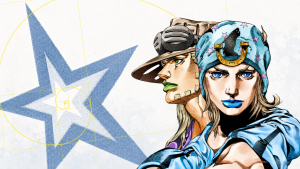
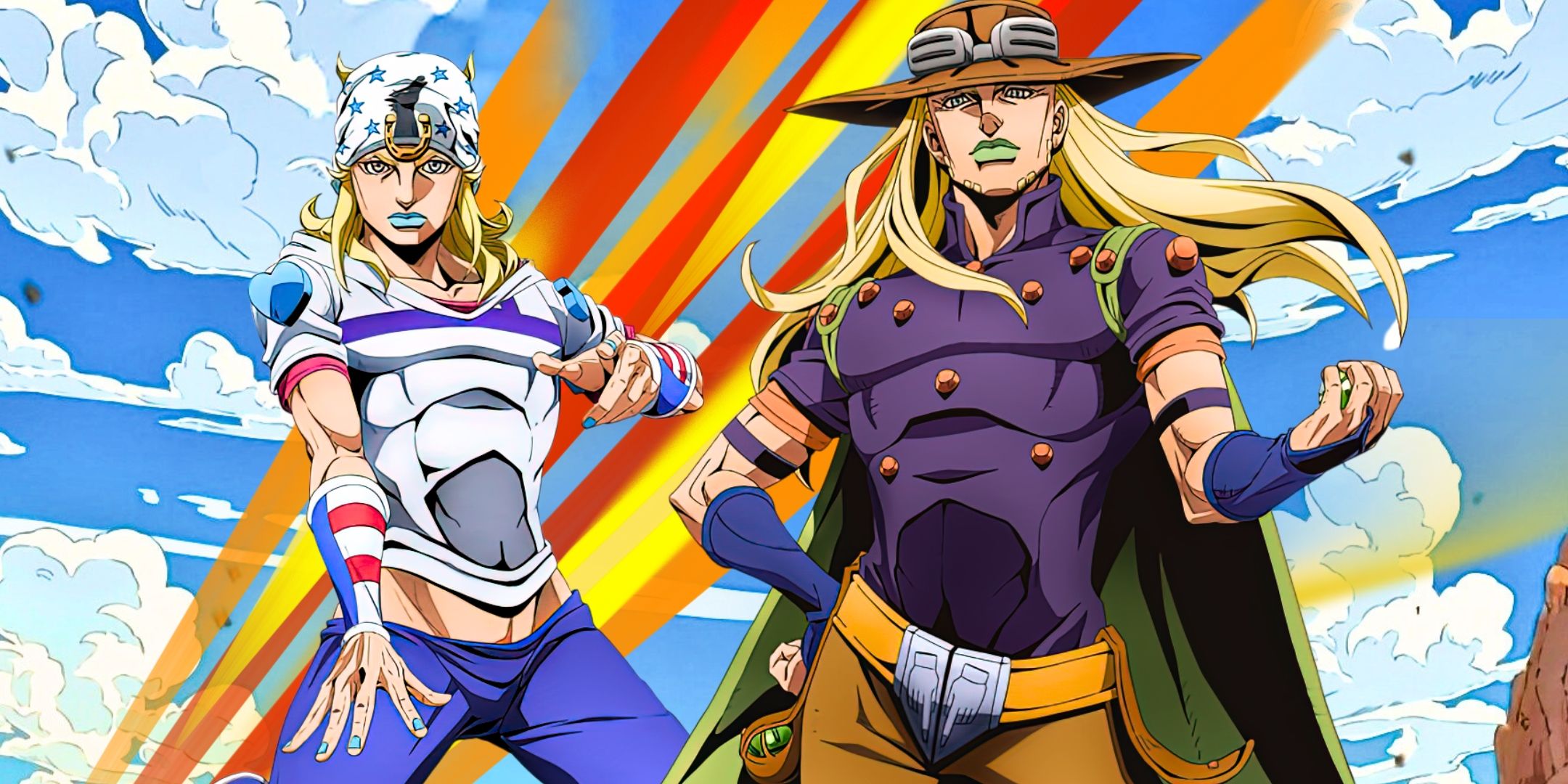
At the beating heart of this grand trans-continental tourney lies a duo whose chemistry redefined Araki’s character writing: Johnny Joestar and Gyro Zeppeli.
The Darkness in Johnny’s Eyes
Johnny Joestar is unlike any previous JoJo. He is not a paragons of virtue like Jonathan, a trickster genius like Joseph, or a stoic crusader like Jotaro. Paralyzed from the waist down following a self-inflicted brush with hubris, Johnny begins the story bitter, cynical, and emotionally broken. He enters the deadly race not for patriotic glory, but because of a fleeting brush with Gyro’s mysterious kinetic art, which causes his legs to twitch for a solitary second. Johnny’s journey is propelled by what Araki explicitly terms “dark determination”—a chilling, borderline villainous resolve where he is entirely willing to kill or sacrifice others to regain his dignity. This vulnerability and moral ambiguity present a transformative challenge for whichever voice actor steps into Johnny’s stirrups.
Gyro Zeppeli: The Soul of the Golden Spiral
Counterbalancing Johnny’s brooding desperation is Gyro Zeppeli, a disgraced Neapolitan royal executioner armed with mystical spinning steel spheres and a gold-toothed grin etched with the words “GO! GO! ZEPPELI.” Gyro serves as mentor, brother-in-arms, and the narrative’s moral compass, riding to win the race to secure an amnesty for an innocent child condemned to die by the Neapolitan state. The back-and-forth between Johnny and Gyro—ranging from nonsensical, endearing campfire gags about the days of the week to visceral, shared trauma on the battlefield—forms the greatest emotional core in the entire franchise. Capturing their dynamic requires a nuanced tonal balance between absurd comedy and Shakespearean tragedy.
The Anatomy of Miracles: The Spin, Tusk, and the Holy Corpse
Narratively, Steel Ball Run succeeds because its power systems serve directly as metaphors for personal evolution. In place of conventional Stand battles, Part 7 introduces the Spin—an ancient discipline utilizing the Golden Ratio (the Fibonacci spiral found throughout the natural world) to generate infinite rotational momentum.
When the Spin merges with traditional Stand capabilities, it manifests as Johnny’s Stand, Tusk. Unlike previous protagonists who unlock their powers instantly, Johnny must develop Tusk through four distinct ACTs, each evolutionary stage marking a profound psychological breakthrough in his acceptance of his physical reality and grief. From firing spinning fingernails like bullets to tearing open dimensional barriers via the Infinite Rotation, the choreography of these battles defies traditional anime physics.
Woven through this kinetic ballet is the search for the relics of the Saint’s Corpse—an explicit, supernatural surrogate for Jesus Christ scattered along the race route. Opposing our heroes is the 23rd President of the United States, Funny Valentine, whose stand Dirty Deeds Done Dirt Cheap (D4C) allows him to traverse parallel realities. Valentine’s nationalist utilitarianism makes him arguably Araki’s most compelling antagonist, challenging audiences with the provocative question: Is a leader evil if his atrocities are executed with unyielding, selfless patriotism?
The Elephant in the Stable: David Production’s Equestrian Nightmare
Why hasn’t a trailer dropped yet? The answer comes down to four legs, rhythmic gaits, and thousands of frames of muscle deformation. Simply put: horses are the single most difficult subject to animate in the medium.
In industry history, studios have notoriously struggled with equestrian movement. Hand-drawing dozens of galloping steeds across dynamic camera angles for 30 to 40 episodes is a production suicide pact; conversely, poorly integrated 3D CGI horses can plunge an entire project into an immersion-shattering uncanny valley, as seen in controversial modern adaptations like Berserk (2016) or select sequences of Attack on Titan.
David Production has cemented itself as an auteur studio, known for its bold kinetic typography, signature color shifts, and fierce loyalty to Araki’s distinct cross-hatching. However, tackling Steel Ball Run demands a radical technological leap. Insiders hypothesize that the studio may implement an ambitious hybrid pipeline: cel-shaded, motion-captured 3D horse models meticulously retouched with hand-drawn 2D keyframes for close-quarters Stand clashes. The sheer logistical hurdle of this pipeline explains the uncharacteristic silence since the conclusion of Stone Ocean. David Production cannot simply churn this out; they must reinvent their entire visual architecture.
The Starting Gun Awaits
The cultural appetite for JoJo’s Bizarre Adventure: Steel Ball Run has crossed the threshold from eager anticipation to mythic urgency. It represents the pinnacle of Hirohiko Araki’s creative powers—a genre-blending masterwork that subverts the tropes of the very medium he helped define. If David Production can conquer the physical ordeal of its equestrian setting and retain the literary depth of Johnny and Gyro’s odyssey, they will not just release another hit anime; they will deliver one of the defining television masterworks of the decade.
Until the official whistle blows at San Diego Beach, fans can only wait, watch the horizons, and remember the Golden Rule: The shortest route was a detour. It was the detour that was our shortest path.
What do you think is the biggest hurdle David Production faces with Steel Ball Run? Which voice actors do you envision bringing Johnny and Gyro to life? Sound off in the comments below!