

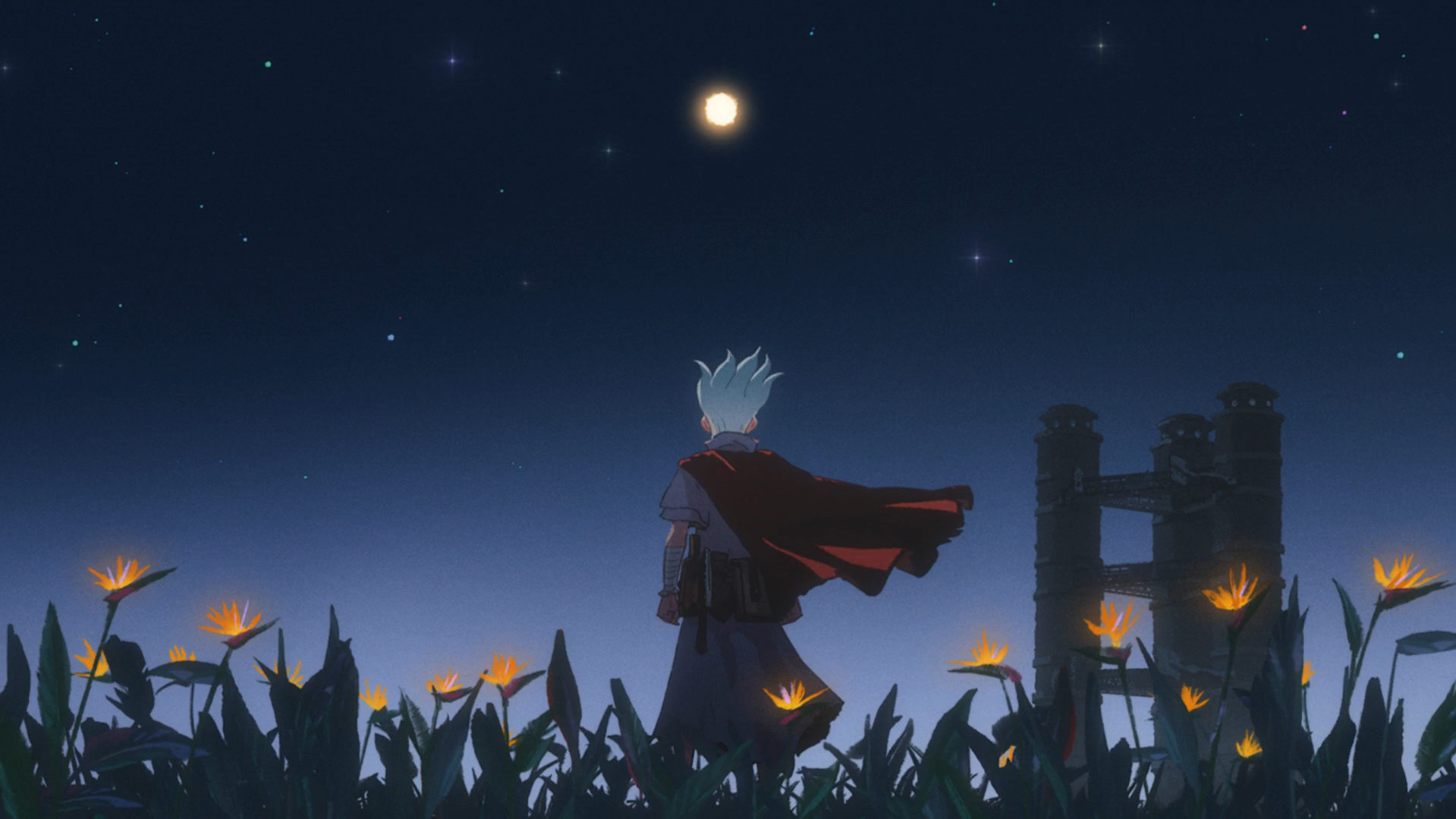
When Senku Ishigami woke up in the year 5738 after millennia entombed in calcium carbonate, he didn’t pray to the gods or lament the collapse of civilization. Instead, he calculated the seconds that had passed, fashioned crude clothing out of tree bark, and declared that humanity would claw its way back to modern civilization through sheer, stubborn empiricism. Now, after three blockbuster seasons charting the resurgence of technology from clay pots to oceanic hydrofoils, Dr. STONE: Science Future arrives to tackle the impossible. The final season of TMS Entertainment’s acclaimed adaptation isn’t just an endgame; it is an epochal leap from terrestrial survivalism into the freezing silence of the cosmos.
This fourth and final installment, officially titled Science Future, represents the culmination of Riichiro Inagaki and Boichi’s monumental manga narrative. With the petrification mystery pulling the Kingdom of Science across five continents to gather the raw resources needed for an Apollo-class mission, the series prepares for its grandest, most perilous set piece: a direct lunar confrontation with the voice behind humanity’s doom—the chilling, synthetic specter known only as Why-Man.
From Stone Knives to Saturn V: The Unprecedented Scope of ‘Science Future’
Most shonen climaxes converge on a blasted battlefield where rival warriors trade planet-shattering punches. Dr. STONE completely subverts this trope by framing its final conflict through the lens of industrial logistics. Before Senku can even think about confronting Why-Man, the Kingdom of Science must achieve in a matter of months what took real-world humanity centuries: global resource extraction, precision metallurgy, automated programming, and the development of high-thrust liquid-fuel rocketry.
The pacing of Science Future bridges the gap between historical documentary and adrenaline-fueled adventure. Viewers will witness the construction of satellite relays, the formulation of synthetic rubber, and the grueling trial-and-error cycle of rocket engine design where failure doesn’t mean a bruised ego—it means catastrophic atmospheric detonation. Inagaki’s narrative reminds us that scientific advancement is a relay race across generations, and this season raises the dramatic stakes by proving that no singular genius can reach the stars alone.
The Industrial World Tour
Unlike the localized turf wars of the Ishigami Village arc, the road to the moon requires global synchronization. The narrative takes the crew of the Perseus across oceans to establish resource outposts—from the iron belts of America to the rubber reserves of Southeast Asia. This worldwide industrialization serves as a breathtaking testament to human unity, illustrating that conquering the cosmos requires dismantling geographical and ideological borders.
The Enigma of Why-Man: Deconstructing Dr. STONE’s Cosmic Horror
Since his terrifying debut via a spliced radio transmission repeating the Morse code for “W-H-Y,” Why-Man has cast a chilling shadow over the series. What makes this antagonist uniquely horrifying is his complete detachment from conventional shonen villainy. Why-Man doesn’t seek political dominion like Tsukasa Shishio, nor is he blinded by religious megalomania like Hyoga. He is an eerie, omnipotent anomaly broadcasting from the lunar sea—a digital phantom commanding thousands of Medusa petrification devices.
As Senku and his comrades close in on the source of the radio signals, the narrative pivots into existential mystery. Is Why-Man an artificial intelligence running an obsolete conservation algorithm? An extraterrestrial entity viewing humanity’s carbon footprints as a threat? Or perhaps something far more intimately tied to human evolution itself? The answers awaiting audiences on the moon challenge the very philosophy of life, mortality, and technological ambition, turning a lighthearted edutainment series into a brilliant piece of speculative hard science fiction.
A Transgenerational Promise: Byakuya’s Ghost and Senku’s Lunar Crew
At the beating heart of Dr. STONE is an emotional through-line spanning thousands of years: the bond between Senku and his adoptive father, Byakuya Ishigami. When the petrification light enveloped the Earth, Byakuya looked down from the International Space Station, helpless to save the world below, yet determined to leave behind the foundational seeds his son would one day need to rebuild it.
The lunar mission represents the poetic closure of this transgenerational pact. When Senku breaks through the exosphere, he enters the exact domain where Byakuya spent his final days peering through the station’s cupola. Selecting the three-person crew for the lunar lander requires a gut-wrenching synthesis of psychological fortitude and physical capability. The dynamic between the chosen astronauts—combining unmatched tactical intellect, razor-sharp instincts, and raw martial willpower—creates an excruciatingly tense pressure cooker where the slightest miscalculation means suffocating in the dark void of space.
The Weight of Mortality in the Cold Void
Space travel does not forgive human error. While the Medusa petrification device previously acted as an unorthodox panacea capable of healing fatal injuries, the lunar voyage strips away these safety nets. In the vacuum of space, Senku’s greatest asset—his rational mind—faces its ultimate stress test against cosmic radiation, catastrophic depressurization, and the haunting, silent presence of an alien adversary.
TMS Entertainment’s Final Lap: Translating Boichi’s Masterpiece to the Screen
Adapting the final stretch of Dr. STONE presents an immense visual challenge for TMS Entertainment. Illustrator Boichi’s manga panels during the space race arc are renowned for their staggering, hyper-detailed mechanical schematics, expressive facial kinetics, and sweeping cosmic horizons. Director Shuhei Matsushita and the animation staff must capture both the hyper-technical minutiae of circuit boards and the sweeping grandiosity of Earth seen from orbit.
Equally critical is the musical landscape. Composers Tatsuya Kato, Hiroaki Tsutsumi, and Yuki Kanesaka have redefined the series through eclectic soundscapes, blending primitive Celtic folk instruments with modern electronic synthesizers. For Science Future, the soundtrack must expand once again—weaving atmospheric, ambient soundscapes with triumphant, full-orchestral crescendos that echo the golden age of space exploration cinema. The audio-visual execution of the rocket ignition alone holds the potential to be one of the most euphoric moments in modern anime history.
The Paradigm Shift: Why Senku’s Finale Redefines the Shonen Formula
The enduring triumph of Dr. STONE lies in its radical optimism. In a pop-culture landscape saturated with post-apocalyptic cynicism and grimdark survival fantasies, Inagaki and Boichi presented an alternate path: civilization isn’t inherently corrupt; it is a precious, hard-won miracle. Science is not framed as a weapon of environmental exploitation, but as a labor of deep, unconditional love for humanity.
By bringing the story to a close on the barren plains of the moon, Dr. STONE: Science Future elevates Senku Ishigami from an eccentric high school chemist to a modern folk hero of human enlightenment. The final battle against Why-Man is not about annihilation—it is about dialogue, understanding, and the audacity of naked apes daring to cross the stars to ask the universe “Why?” and answering with “Because we can.”
Dr. STONE: Science Future is shaping up to be an emotionally shattering, scientifically exhilarating climax. Are you ready for the final countdown? Drop your theories on Why-Man’s true identity in the comments below, and let us know which Kingdom of Science invention has blown your mind the most across the series!