Ever since the cosmic, melancholy reset of Stone Ocean faded to black in late 2022, a deafening hum has echoed through every corner of the anime landscape. For over a decade, David Production pulled off what was once deemed impossible: translating Hirohiko Araki’s kaleidoscopic, runway-fashion-infused manga into one of the most culturally dominant multimedia franchises of the 21st century. Yet, every bloodline feud, every color palette shift, and every iconic Stand cry has merely felt like a prelude to the true summit. We have arrived at the precipice of JoJo’s Bizarre Adventure: Steel Ball Run, widely revered not just as Araki’s magnum opus, but as one of the finest serialized graphic fiction narratives ever created.
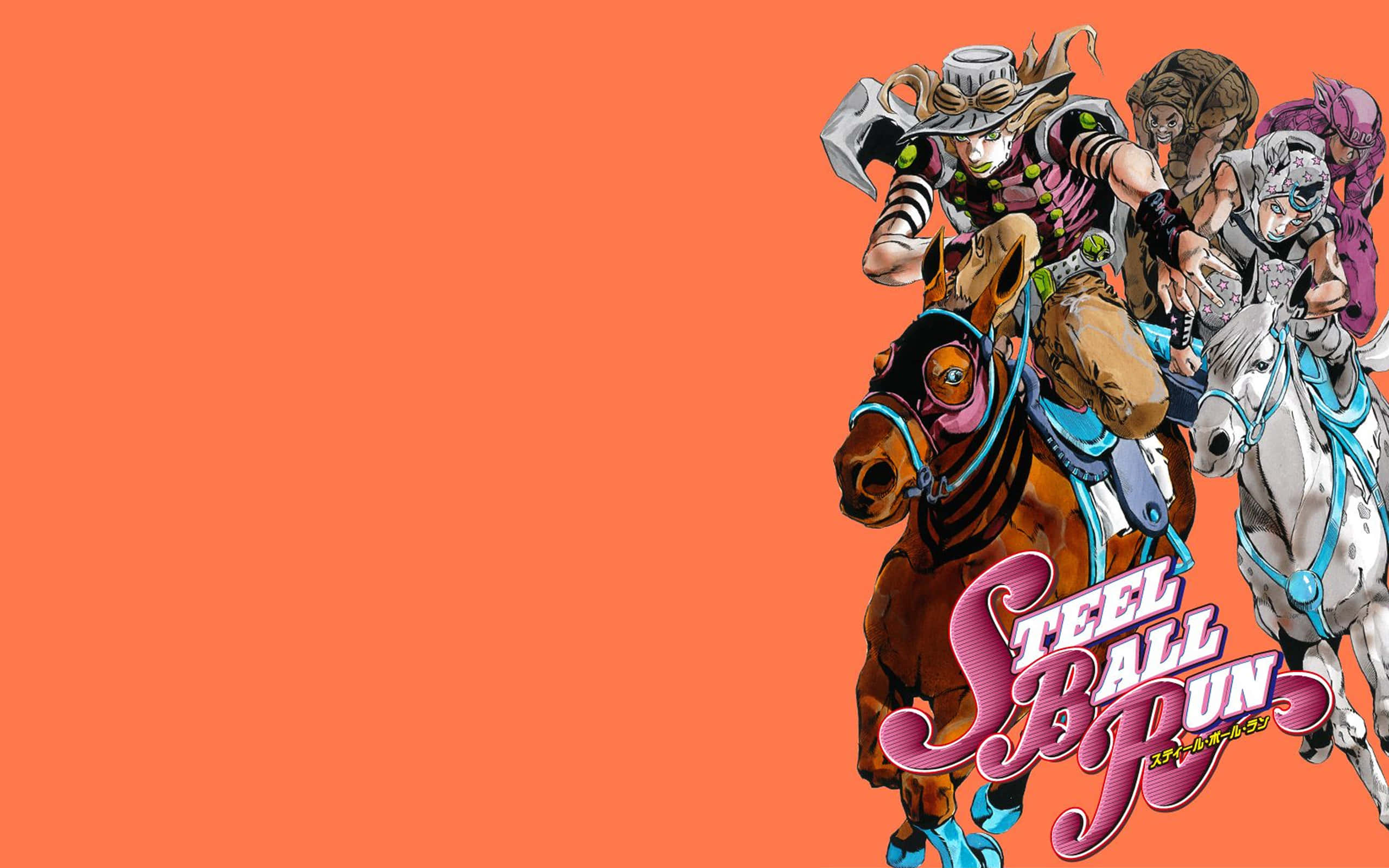
The anticipation surrounding a potential Steel Ball Run anime is no ordinary hype cycle. It is a potent cocktail of artistic reverence and logistical anxiety. Bridging a complete narrative reboot, an intricate western period piece, and an 1890 trans-continental horse race spanning 6,000 kilometers, Part 7 challenges the very structural limits of modern Japanese TV animation. As rumors swirl and production hushes descend over David Production and Warner Bros. Japan, the anime community finds itself obsessing over the ultimate question: How does an animation studio adapt a masterpiece that seems almost aggressively designed to defy adaptation?
From Shonen Spectacle to Seinen Masterpiece: The Genesis of Steel Ball Run
To understand the sheer magnitude of the buzz, one must appreciate the context of Steel Ball Run’s inception. When the manga debuted in 2004, it was initially serialized in Weekly Shonen Jump simply as Steel Ball Run, omitting the famous “JoJo” prefix in a coy bid to disarm readers. However, the turning point came in 2005 with its migration to the monthly seinen publication Ultra Jump. Unshackled from the punishing weekly deadlines and demographic constraints of Shonen Jump, Araki’s craft underwent an astonishing evolution.
The Ultra Jump Metamorphosis
The transition allowed Araki to drastically expand his canvas. The rough-edged, punchy brawl dynamics of previous parts gave way to photorealistic landscapes, historical verisimilitude, moral nihilism, and an excruciatingly deliberate pace. Steel Ball Run shed the familiar melodrama of generational blood curses to deliver an unforgiving exploration of trauma, ambition, and American manifest destiny. It is a story where the lines between heroes and villains are completely dissolved; the eccentric President Funny Valentine pursues an extreme brand of patriotism that is just as compelling—and terrifying—as the protagonists’ selfish desperation. Adapting this means David Production cannot simply recycle the vibrant, camp-heavy visual language of Stardust Crusaders or Diamond is Unbreakable; they must embrace a gritty, sun-bleached cinematic prestige.
The Broken Jockey and the Royal Executioner: Johnny, Gyro, and the Spin
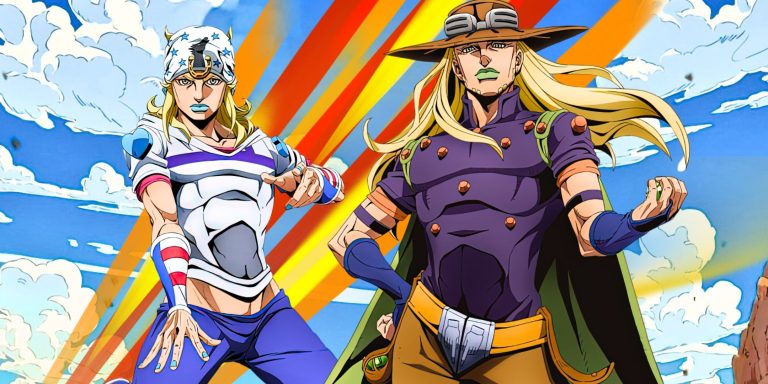
At the beating heart of Part 7’s critical acclaim is the finest dual-protagonist dynamic in manga history. The narrative eschews the righteous crusaders of the past, introducing Johnny Joestar—a disgraced, paraplegic former jockey prodigy whose fall from grace was catalyzed by his own staggering arrogance. Johnny is not fighting to save the world; he is a broken young man attempting to crawl out of absolute zero, driven by an unyielding, almost feral hunger to regain the use of his legs and reclaim his dignity.
Johnny Joestar’s “Dark Determination”
Araki frequently refers to Johnny’s defining trait as his “dark determination”—the pitch-black glint in his eye indicating an utter willingness to kill anyone who stands between him and his goal. This psychological nuance sets Johnny apart from previous JoJos. His Stand, Tusk, evolves alongside his mental state across four distinct acts, transitioning from a desperate self-defense mechanism into a reality-shattering manifestation of the Golden Rectangle. Animating Johnny requires nuanced character acting: his physical vulnerability, dragging himself through the dust, must contrast viscerally with the sheer cosmic lethality of his nail bullets.
Gyro Zeppeli and the Mathematical Elegance of the Spin
Opposite Johnny stands Gyro Zeppeli, a disgraced executioner from the Kingdom of Naples whose boisterous, grill-flashing exterior masks a devastating weight of ancestral guilt. Rather than relying on a traditional Stand from the outset, Gyro wields The Spin—an ancient supernatural martial art rooted in the Fibonacci sequence and the Golden Ratio. The Spin revitalizes the kinetic charm of early JoJo Hamon battles, but infuses it with rigorous physical and geometric logic. Visualizing the Spin on screen will require inventive artistic flourishes: kinetic vector lines, atmospheric distortion, and David Production’s trademark visual onomatopoeia pushed to their absolute conceptual limits.
The Equestrian Nightmare: David Production’s Herculean Challenge
Despite the narrative brilliance, industry insiders and veteran animators know the grim reality of Part 7: horses are an animator’s absolute nightmare. In the animation medium, quadrupeds are notoriously time-consuming and expensive to render by hand. Their anatomical complexity, the shifting muscular weight of their galloping strides, and the fluid motion of their manes demand an elite level of draftsmanship that is nearly impossible to sustain over a multi-cour television production.
The Perils of 3D CGI vs. Hand-Drawn Locomotion
Steel Ball Run is not just a story that features a horse; it is an epic cross-country race with dozens of horses sprinting across shifting terrain—from the scorching sands of the San Diego beaches to the blizzard-swept plains of the American Midwest. The prevailing industry consensus is that David Production will have to rely heavily on modern 3D CGI models for background race sequences, reserving high-end 2D hand-drawn cuts for close-ups and climactic Stand clashes.
However, recent anime history has made fans wary of blended 3D/2D approaches. The real challenge for the studio’s creative leadership will be seamlessly integrating cel-shaded CGI horses with Araki’s hyper-detailed, crosshatched art style. If the studio can harness the hybrid mastery seen in productions like Chainsaw Man or Studio Orange’s portfolio, they can revolutionize sports-action cinematography. If they stumble, the immersion will collapse beneath the uncanny weight of rubbery, weightless equestrian models.
The Distribution Dilemma: Escaping the Netflix “Batch Drop” Curse
Beyond the technical drawing board lies an equally contentious issue: release methodology. When David Production and Warner Bros. Japan partnered with Netflix for the worldwide rollout of Stone Ocean, the decision to drop episodes in three massive batches over twelve months proved disastrous for the show’s cultural footprint. The communal weekly ritual—the Monday morning memes, the frantic Twitter theory threads, and the collective musical-reaction videos—was stripped away, leaving Jolyne Cujoh’s epic journey stranded in algorithmic obscurity.
For Steel Ball Run, the community’s mandate is loud and unyielding: the race must be run week-by-week. Part 7’s episodic structure, marked by tense checkpoints and sudden, terrifying encounters with assassin Stand users (like the lethal ambush of Ringo Roadagain and his time-rewinding Mandom), is fundamentally optimized for weekly cliffhangers. A traditional terrestrial television broadcast schedule, paired with a simultaneous global simulcast, is paramount to returning the franchise to its undisputed throne at the center of pop-culture discourse.
Verdict: The Horizon Beckons for Araki’s Greatest Triumph
The buzz surrounding JoJo’s Bizarre Adventure: Steel Ball Run is more than idle speculative chatter; it represents an industry-defining moment. Adapting this story means honoring a masterwork that reinvented how long-running manga can evolve, mature, and transcend its original boundaries. It is a grueling, sand-choked, grease-stained American tragedy dressed in the sublime threads of Italian high-fashion and supernatural sci-fi.
David Production has earned the trust of millions over their historic run, but *Steel Ball Run* is the final boss of their portfolio. If they can capture the quiet beauty of a campfire conversation between Johnny and Gyro under an expansive Montana night sky with the same fidelity as the earth-shattering reality warps of D4C, they will not merely deliver a great anime—they will cement a generational masterpiece.
What are your biggest hopes and fears for the Steel Ball Run adaptation? Do you want to see a full weekly broadcast, and who is your dream voice cast for Johnny and Gyro? Let us know in the comments below, and stay tuned to Wibux.com for breaking updates on the anime world’s greatest race.