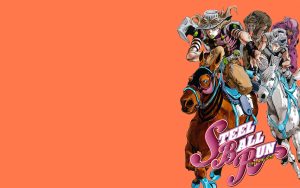
Ever since the bittersweet, reality-shattering finale of JoJo’s Bizarre Adventure: Stone Ocean aired in late 2022, a collective, breathless hush has fallen over the global anime community. The multi-generational tragedy of the Joestar bloodline reached its cosmic terminus in the Ireneverse, closing a thirty-year narrative loop that defined Hirohiko Araki’s legacy. Yet for seasoned manga connoisseurs and anime enthusiasts alike, the conclusion of Part 6 was never the end of the conversation—it was merely the prelude to the promised land. That promised land is Steel Ball Run.
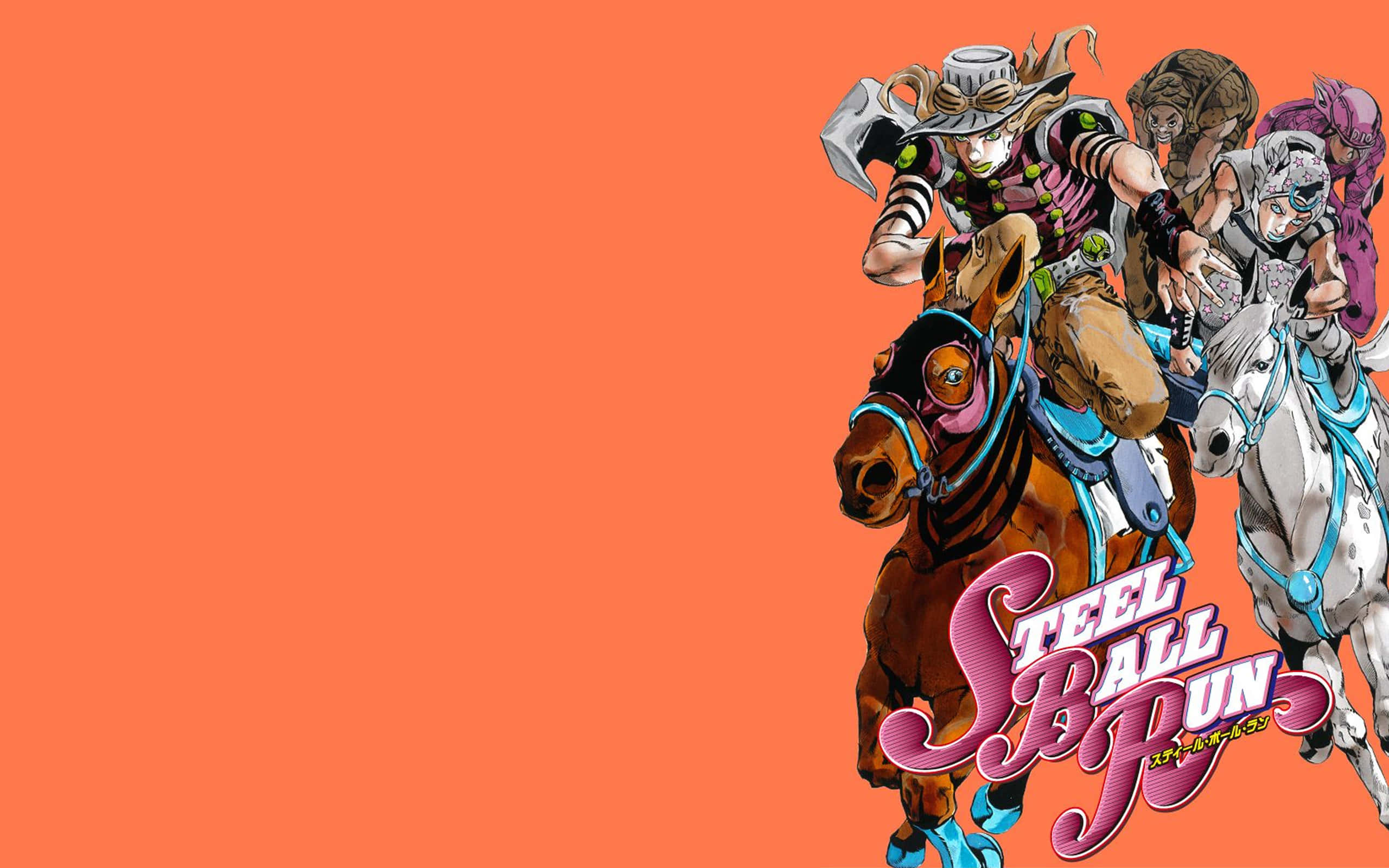
Consistently locked in a fierce battle with Berserk for the highest-rated manga of all time on aggregators like MyAnimeList, Steel Ball Run (Part 7) is widely heralded as Araki’s undisputed magnum opus. Combining the raw aesthetic of American revisionist westerns, high-stakes equestrian racing, and mind-bending Stand metaphysics, the hype surrounding its eventual anime adaptation has reached a fever pitch. But as David Production remains uncharacteristically silent, fans and industry insiders are forced to confront the dual nature of this anticipation: an overwhelming hunger to see Johnny Joestar and Gyro Zeppeli brought to life, tempered by the staggering technical challenges inherent in adapting a work of this scale.
The Seinen Rebirth: Why Part 7 Hits Differently
To understand the ravenous appetite for a Steel Ball Run anime, one must first appreciate the seismic structural shift Part 7 represented in Araki’s career. Serialized initially in Weekly Shonen Jump in 2004 before transitioning to the monthly seinen imprint Ultra Jump in 2005, Steel Ball Run shattered the creative constraints that had previously bound the series. Liberated from weekly deadlines and the moral guardrails of shonen demographics, Araki engaged in an unrestrained reinvention of his own lore.
Set against the sprawling canvas of 1890s North America, Steel Ball Run abandons the familiar Joestar family tree in favor of an alternate continuity. The narrative is framed around a grueling, 3,800-mile cross-country horseback race with a $50 million purse. Yet, the secular spectacle quickly morphs into an esoteric pilgrimage. Contestants aren’t merely surviving desert flash floods, assassin ambushes, and cutthroat competitors; they are unwitting pawns in a geopolitical race to assemble the scattered, mummified relics of a divine figure known simply as the Saint’s Corpse.
This tonal maturation allowed Araki to delve into visceral violence, psychological horror, and profound existential philosophy. It transformed what could have been a gimmick into an operatic tragedy wrapped in frontier dust and gunpowder.
Johnny, Gyro, and the Geometry of the Spin
A Subversion of the Joestar Archetype
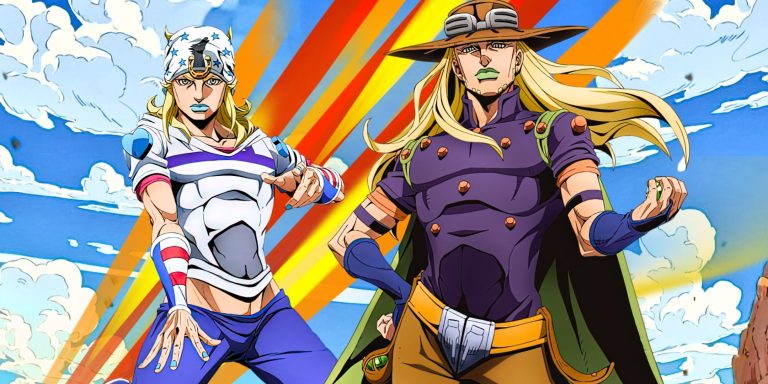
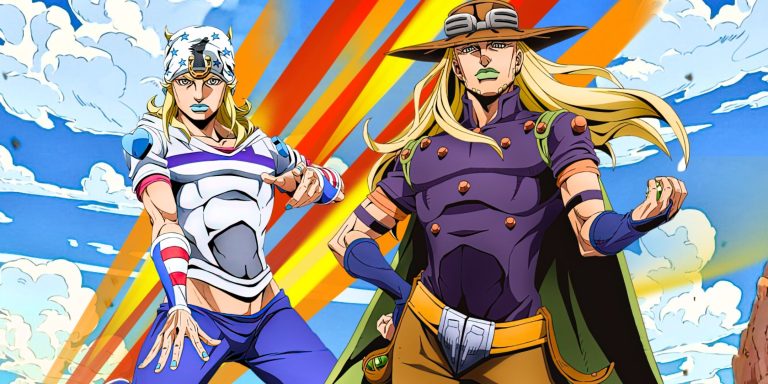
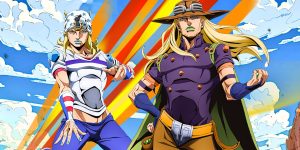
At the beating heart of Steel Ball Run is the complex, deeply human dynamic between Johnny Joestar and Gyro Zeppeli. Unlike the charismatic, righteous paragons that came before him—such as Jonathan or Jotaro—Johnny is introduced as a broken, paraplegic former horse-racing prodigy whose downfall was orchestrated by his own hubris. Bitter, selfish, and paralyzed from the waist down, Johnny’s motivation is shockingly un-heroic: he doesn’t want to save the world; he merely wants to rediscover his “negative to zero”—the ability to stand on his own two feet once more.
Araki frequently paints Johnny with what characters call the “dark determination” in his eyes—a ruthless, unblinking willingness to kill if it means securing his goal. His Stand, Tusk, evolves in tandem with his emotional maturation and mastery of rotational mechanics, transforming from a diminutive fingernail-shooting anomaly into an interdimensional, unstoppable force of nature.
The Tragedy and Wit of Gyro Zeppeli
Counterbalancing Johnny’s brooding desperation is Gyro Zeppeli, a disgraced Neapolitan executioner’s son armed with steel spheres and an absurdist sense of humor. Gyro is the de facto protagonist for the story’s initial acts—a flamboyant, grill-wearing mentor whose quest is driven by a secret, noble desire to win the race and save an innocent child condemned to death back home. The camaraderie between Johnny and Gyro remains the most nuanced, emotionally resonant relationship Araki has ever penned, oscillating between lighthearted campfire banter about mozzarella cheese and agonizing sacrifices on the salt flats of Utah.
The Metaphysics of the Golden Ratio
Part 7 also brilliantly reinvents the franchise’s power systems. While Stands remain present, they are inextricably tied to the Spin (Kaiten)—an ancient Neapolitan martial art based on the Fibonacci sequence and the Golden Rectangle. The Spin elevates combat into applied mathematical mysticism, where kinetic energy harnessed from organic curves and horse gaits can warp gravity and breach dimensional walls. Visualizing this unseen kinetic force is David Production’s greatest thematic opportunity—and their most terrifying animatic challenge.
The Technical Everest: Can David Production Tame the Horse?
The principal barrier separating Steel Ball Run from an immediate greenlight is not narrative complexity, but raw logistics: animating quadrupeds. In the lexicon of traditional 2D sakuga, horses are widely regarded as an animator’s nightmare. Their complex skeletal dynamics, undulating musculature, and rhythmic quadrupedal gait cycles demand immense labor and hyper-precise anatomical understanding.
Now, multiply that challenge by a hundred. Steel Ball Run does not merely feature horses standing in stables; it demands scenes of dozens of thoroughbreds galloping at breakneck speeds through dense forests, muddy rivers, and blistering deserts, all while their riders fire revolvers, unleash supernatural stands, and trade blows at 40 miles per hour.
David Production has built a legendary reputation across Parts 1 through 6 for their stylistic fidelity, ingenious kinetic typography, and dramatic color-palette shifts. However, industry insiders recognize that tackling Part 7 in pure 2D is virtually impossible under contemporary production budgets and timelines. The studio will almost certainly need to implement a hybrid pipeline, utilizing sophisticated 3D CG models for the horses overlaid with hand-drawn 2D detailing to preserve Araki’s cross-hatched, high-contrast aesthetic.
If handled poorly, the anime risks falling into the uncanny-valley pitfalls that marred productions like Berserk (2016). If handled with the artistic reverence seen in Studio Orange’s work or the blended CGI wizardry of modern Chainsaw Man, it could permanently redefine the standard for equestrian action in Japanese animation.
Funny Valentine and the Moral Grey of Frontier Ideology
A masterclass narrative requires an equally captivating antagonist, and in 23rd U.S. President Funny Valentine, Araki delivered arguably his finest villain. Driven by an uncompromising, ultra-nationalist vision of American exceptionalism, Valentine seeks the Saint’s Corpse to make his nation an untouchable superpower by redirecting all misfortune from American soil to other regions of the world.
Armed with Dirty Deeds Done Dirt Cheap (D4C)—a Stand capable of traversing parallel dimensions by pressing himself between two objects—Valentine challenges Johnny and Gyro not just physically, but philosophically. Valentine’s infamous discourse on “taking the first napkin” is a brilliant critique of political momentum, power dynamics, and the herd mentality of human civilization. Unlike Dio Brando’s unadulterated vampiric malevolence or Diavolo’s paranoid narcissism, Valentine operates under a conviction of absolute righteousness, forcing the audience to question who the true villain of the trans-American expedition really is.
The Inevitable Stampede: The Horizon for JoJo Fandom
As David Production quietly expands its portfolio with diverse projects like Urusei Yatsura and Undead Unluck, the silence on JoJo Part 7 should not be misconstrued as abandonment. Rather, it suggests calculated preparation. Adapting Steel Ball Run requires a fundamental overhaul of the studio’s pipeline, a generous production window, and substantial capital investment to honor the visual density of Araki’s prime artwork.
When the starting gun finally fires, Steel Ball Run will not just be another seasonal anime release; it will be an event of generational significance for the medium. From the arid plains of San Diego to the bustling streets of Manhattan, the race across America is the ultimate frontier for David Production. The saddle is waiting, the golden ratio is aligned, and when the announcement finally arrives, the entire anime world will be ready to ride.
Are you confident David Production can pull off the horses of Steel Ball Run, or should they rely heavily on full 2D sakuga? Drop your thoughts, dream voice casts, and wild theories in the comments below!