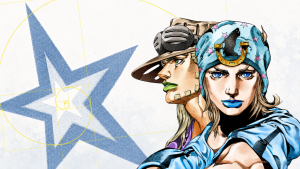


Ever since the cosmic reset of Stone Ocean drew Jolyne Cujoh’s tragic yet triumphant crusade to a close, an electrifying silence has hung over the anime industry. For casual observers, the conclusion of the original Joestar bloodline’s multi-generational war against DIO’s lingering curse felt like a definitive curtain call. But for the initiated—the millions of manga connoisseurs who hold Hirohiko Araki’s canon as high art—it was merely the prelude to the main event. The anime world stands on the precipice of adapting what is universally hailed as Araki’s undisputed masterpiece: JoJo’s Bizarre Adventure: Steel Ball Run.
Consistently locked in a death match with Kentaro Miura’s Berserk for the highest-rated manga spots across global community databases, Part 7 isn’t just another installment in a legendary franchise. It is a monumental reinvention—a genre-transcending, blood-soaked historical epic wrapped in supernatural prestige. As whispers of greenlit production and conceptual storyboards swirl around Tokyo’s animation corridors, the discourse surrounding David Production’s next frontier has evolved from cautious optimism into an unprecedented fever pitch.
The Seinen Evolution: Araki’s Trans-American Odyssey
To understand the sheer magnitude of the buzz surrounding Steel Ball Run, one must contextualize its revolutionary birth. Serialized in 2004, the series initially discarded the JoJo moniker, launching simply as Steel Ball Run in Weekly Shonen Jump before migrating to the monthly, mature pastures of Ultra Jump in 2005. That editorial pivot unleashed Araki from the structural constraints of standard shonen pacing, violence, and morality. Unshackled, he delivered an intoxicating, 1890s-set cross-country horse race spanning 6,000 kilometers from San Diego to New York City.
The premise reads like an adrenaline-fueled fusion of classic American Western cinema, Cormac McCarthy’s stark frontier brutality, and hyper-stylized occult conspiracy. Competing for a jaw-dropping $50 million grand prize, thousands of eccentric jockeys dash across treacherous salt flats, scorching deserts, and frozen plains. Yet the race serves merely as a deceptive smokescreen for a much darker narrative: a clandestine quest orchestrated by the 23rd President of the United States, Funny Valentine, to retrieve the mummified, miraculous relics of Jesus Christ to grant America undisputed global hegemony. It is audacious, blasphemous, thrilling, and distinctly JoJo.
Flawed Humanity and the Mechanics of the Spin
At the beating heart of Part 7’s narrative majesty lies a character dynamic unmatched in modern Japanese sequential art. Steel Ball Run fundamentally discards the clear-cut, moral black-and-white archetypes of earlier iterations, choosing instead to explore raw human vulnerability, regret, and the agonizing pursuit of redemption.
Johnny Joestar: The Anti-Hero in Pursuit of “Zero”
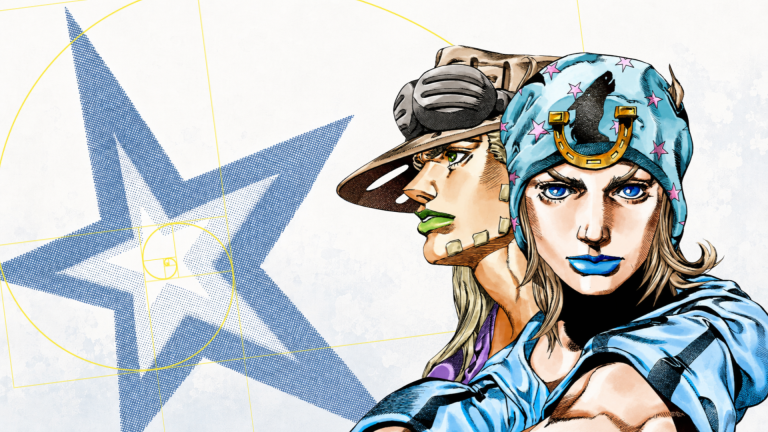
Unlike his noble ancestor Jonathan Joestar, Johnny Joestar is defined not by virtue, but by failure. A former horse-racing prodigy whose reckless arrogance and narcissism led to a devastating gunshot wound that left him paraplegic, Johnny begins the story as a bitter, discarded shell of a man. His motivations are fiercely personal, devoid of altruism. When he discovers that the enigmatic Gyro Zeppeli’s mystic rotating sphere can momentarily cause his paralyzed legs to twitch, Johnny enters the grueling race with a singular, desperate obsession: not to win glory, not to become a hero, but simply to drag his life from a “negative state” back to “zero.” Araki endows Johnny with what characters within the text call “dark determination”—a ruthless, unblinking willingness to kill if it means securing his second chance at life.
Gyro Zeppeli and the Golden Ratio
Standing in parallel contrast is Gyro Zeppeli, a disgraced Neapolitan executioner’s son wielding the sacred art of the “Spin.” Gyro is the flamboyant, charismatic soul of the narrative—a master of steel spheres imbued with kinetic rotation governed by the Fibonacci sequence and the divine Golden Ratio. The Spin operates as Araki’s metaphysical evolution from Part 1 and 2’s Hamon, yet far more grounded in sacred geometry, physics, and biological resonance. The dynamic between Johnny and Gyro—anchored by absurd comedic interludes about days of the week and gourmet mozzarella, balanced against existential life-or-death philosophies—forges an emotional gravity that David Production must preserve with immaculate precision.
The Technical Nightmare: David Production and the Equestrian Hurdle
While the demand for a Steel Ball Run adaptation is deafening, its prolonged absence is no mystery to industry veterans. Animating horses is widely considered the ultimate baptism by fire for any animation studio. Unlike bipedal characters or mechanical vehicles, quadrupeds require an extraordinarily complex understanding of musculoskeletal motion, shifting weight centers, and dynamic foreshortening. Multiplying that difficulty across dozens of horses galloping shoulder-to-shoulder in high-speed tactical Stand battles presents an astronomical logistical nightmare.
David Production, the studio that poured unprecedented passion into bringing Parts 1 through 6 to life with chromatic shifts and signature onomatopoeic kineticism, faces its greatest trial yet. The industry consensus suggests a purely hand-drawn 2D production of Steel Ball Run across a multi-cour run would break even the most well-funded production lines. The solution inevitably points toward a high-end hybrid workflow: implementing hyper-detailed 3D CGI horse rigs masked with cel-shaded shaders, blended seamlessly with hand-drawn character frames for close-up combat and dramatic beats.
For David Production to preserve Araki’s lush, hyper-detailed artistic renaissance—which reached its zenith during Part 7 with intricate anatomical cross-hatching and sprawling panoramic horizons—the studio will require extended pre-production timelines, monumental budgetary backing, and potentially a strategic co-production partnership. The hyper-scrutiny from the anime fandom on early CG teasers will be merciless, meaning David Production cannot afford a misstep.
Antagonism and Ideology: The Menace of Funny Valentine
Any deep analysis of Steel Ball Run remains incomplete without interrogating its central antagonist, President Funny Valentine, and his multiverse-fracturing Stand, Dirty Deeds Done Dirt Cheap (D4C). Valentine represents an evolution in Araki’s villainy, stepping away from the hedonistic psychopathy of Yoshikage Kira or the grand delusions of Diavolo in favor of a terrifying brand of absolute, utilitarian patriotism.
Valentine’s philosophical conviction—epitomized by his legendary “First Napkin” monologue—posits that societal power belongs solely to the individual who sets the precedent, claiming the right to dictate global morality by securing power first. The clash between Valentine’s grand imperialist vision and Johnny Joestar’s hyper-individualistic struggle creates a moral friction rarely seen in the medium. In Steel Ball Run, the antagonist fights for the perceived future of his entire nation, while the protagonist kills for his own selfish survival. Translating this subversive ideological conflict onto the screen is the final artistic frontier the production team must conquer.
The Horizon Awaits the Starting Gun
The enduring cultural buzz around Steel Ball Run is not standard anime hype; it is a collective reckoning with what happens when a creator’s magnum opus meets the highest tier of serialized animation. Part 7 offers an unrepeatable alchemy of grit, heart-wrenching tragedy, bizarre absurdity, and jaw-dropping kinetic power. It marks the transition of JoJo’s Bizarre Adventure from a cult classic shonen into an untouchable titan of the seinen canon.
David Production stands before a monumental challenge that will define the studio’s legacy for the next decade. If they navigate the brutal terrain, master the geometry of the Spin, and deliver an adaptation worthy of the manga’s storied pages, Steel Ball Run won’t just dominate seasonal anime charts—it will redefine what a prestige anime adaptation can achieve.
What are your biggest hopes and technical concerns for David Production’s eventual adaptation of Steel Ball Run? Do you believe hybrid CGI is the only realistic way to handle Araki’s equestrian marathon? Drop your theories, favorite moments, and casting picks in the comments below, and stay tuned to Wibux.com for breaking JoJo updates!