
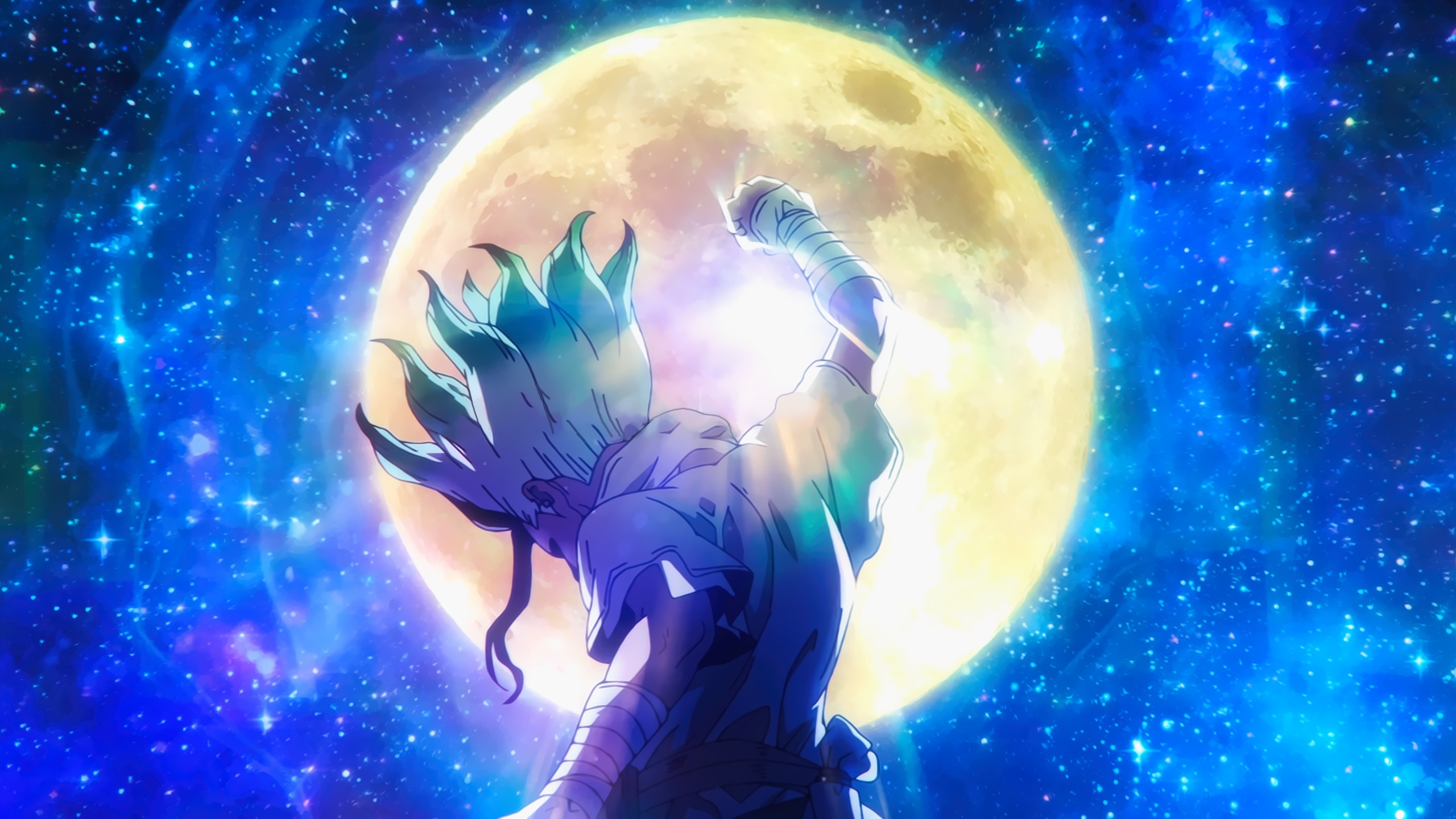
When Senku Ishigami cracked open his rocky shell in 5738 AD, the modern anime landscape was knee-deep in cursed energy, supernatural demon slayers, and grimdark deconstructions of heroism. In a medium defined by magic systems, Dr. STONE dared to treat periodic tables, sulfur pits, and vacuum tubes as the ultimate superpowers. Now, as TMS Entertainment gears up for Dr. STONE: Science Future—the fourth and definitive final season of the franchise—the series stands on the precipice of its grandest, most audacious narrative arc: building a lunar spacecraft from scratch to confront humanity’s ultimate petrifier, the enigmatic Why-Man, directly on the Moon.
For longtime fans and industry observers alike, this impending finale represents something far more profound than a standard shonen victory lap. It is the culmination of a thematic odyssey that champions human resilience, scientific curiosity, and historical continuity over brute force. With the production confirmed as a multi-cour endeavor designed to adapt the entirety of Riichiro Inagaki and Boichi’s remaining manga chapters, Science Future is poised to deliver modern anime’s most logistically jaw-dropping climax.
From Mud Bricks to the Saturn V: The Logistics of a Stone-Age Apollo Mission
The journey to the Moon in Dr. STONE is not a sudden narrative leap; it is an agonizing, step-by-step masterclass in industrial scaling. Up to this point, Senku’s Kingdom of Science operated within relatively insular geographies, whether securing the sulfanilamide cure in Ishigami Village or crossing the Pacific to the Americas. However, confronting an existential threat stationed in deep space requires an entirely different magnitude of production, necessitating the total re-industrialization of planet Earth.
To construct a functional space program without 21st-century infrastructure, Senku must institute a global network of specialized hub cities. Viewers will witness the narrative transform into a whirlwind geopolitical logistical campaign:
Establishing Corn City in the Americas to produce high-grade bio-ethanol fuel; founding Superalloy City to extract the rarest elements required for heat-resistant rocketry; and formulating Math City to tackle the staggering astronomical calculations that computers once handled effortlessly. What makes Science Future so gripping is its refusal to handwave the gargantuan difficulty of aerospace engineering. The anime will chronicle the tragic trial-and-error cadence of rocketry—fuel instabilities, launchpad combustions, and the crushing psychological weight of failures before achieving orbital escape velocity.
The Haunting Silence of the Cosmos: Decoding Why-Man
Ever since the Kingdom of Science first managed to broadcast a radio transmission across the ocean, only to be interrupted by a synthetic, rhythmic voice chanting “WHY, WHY, WHY” in Morse code and vocal frequency, Why-Man has reigned as one of the most chilling, uncanny antagonists in modern anime history. Unlike the ideological warlords Senku has conquered—such as Tsukasa Shishio’s neo-primitive crusade or Hyoga’s brutal elitism—Why-Man does not present an alternative moral philosophy. Why-Man presents an existential void.
The Existential Horror of the Petrification Devices
The core mystery that ignited the entire story—how millions of humans were instantaneously turned to stone by a blinding green flash—has evolved from a magical inciting incident into a terrifying mechanical puzzle. Known within the lore as the Medusa devices, these hyper-advanced relics challenge humanity’s understanding of biology and physics. Why-Man’s operational motive appears utterly alien to the characters: is the petrification a global execution, an act of uninvited preservation, or an evolutionary trap?
The thematic contrast here is breathtaking. Senku’s science is messy, communal, passionate, and iterative—built on the blood, sweat, and shared memory of human civilizations past and present. Conversely, Why-Man embodies stagnant, cold perfection: a consciousness that weaponizes absolute silence to enforce a perpetual cosmic hibernation. The lunar showdown is fundamentally a philosophical trial: does the universe belong to dynamic, chaotic mortality, or static, sterile eternity?
The Chosen Crew: Character Evolution at the Edge of the Exosphere
A mission to the Moon demands an excruciating calculus of human life. In early mission briefings, Senku is forced to confront the grim reality of a potential one-way voyage, leading to intense tactical and emotional deliberations over who will comprise humanity’s lunar strike team. The dynamic of this chosen crew highlights the narrative maturity Inagaki poured into the manga’s closing stretches.
The narrative stakes peak when analyzing the historical bridge between Senku and his late adoptive father, Byakuya Ishigami. When the initial petrification wave swept over Earth thousands of years ago, Byakuya gazed down from the International Space Station, helpless to save the world below, yet determined to leave behind the foundational seeds for his son. In Science Future, the axis flips entirely. Senku must breach the upper atmosphere to gaze down upon the world Byakuya fought so valiantly to preserve. This generational resonance elevates the mission beyond mere survivalism; it transforms the rocket launch into a sweeping act of filial piety and ancestral communion.
TMS Entertainment’s Production Crucible: Adapting Boichi’s Maximum-Detail Art
From an animation production standpoint, TMS Entertainment faces its most intimidating assignment yet. Illustrator Boichi’s visual work across the final lunar arc represents some of the most intricate, mechanically exhaustive draftsmanship published in Weekly Shonen Jump during the late 2010s and early 2020s. Drawing vacuum tubes and wooden sailing ships is one thing; animating multistage rockets, circuit-board micro-soldering, and zero-gravity spacewalks requires an elite tier of technical direction.
By opting for a multi-cour rollout, the production committee has wisely avoided the fatal trap of pacing compression that has plagued so many high-profile shonen finales. Director Shinya Iino and the creative staff have consistently balanced punchy comedic sight gags with sweeping, photorealistic beauty. To succeed, the final season must deliver jaw-dropping sakuga sequences during the orbital ascents and the desolate, high-contrast, terrifying starkness of the lunar surface, where sound does not travel and the safety margin between life and catastrophic depressurization is a fraction of a millimeter.
The Ten Billion Percent Finale: Science as the Ultimate Shonen Spirit
In an era where mainstream anime discourse often defaults to debates over power-scaling tiers and studio crunch, Dr. STONE has quietly mounted one of the most cohesive, ethically grounded runs in modern television. It subverts the traditional heroic archetype: Senku never punches through a mountain, unlocks a hidden bloodline transformation, or summons a celestial entity. His power is simply remembering what centuries of collective human minds worked out before him.
As Dr. STONE: Science Future readies its engines, it promises to culminate this radical optimism. The confrontation with Why-Man is not just a battle to reclaim humanity’s status as the dominant terrestrial species—it is a passionate defense of curiosity itself. In a world increasingly beset by real-world cynicism and existential anxieties, watching humanity start from nothing, conquer fire, reconstruct semiconductors, and physically launch itself across the cosmic vacuum to demand an answer from the universe is the ultimate tonic.
Over to you, Wibux readers: Will Senku’s final gambit satisfy the colossal hype built since Season 1, or can Why-Man’s identity ever truly live up to years of fan speculation? Drop your launch theories, animation expectations, and final-arc predictions in the comments below!