Ever since the bittersweet, universe-resetting chords of “Distant Dreamer” faded at the climax of Stone Ocean, the international anime community has held a collective, suspended breath. For over a decade, David Production has pulled off one of modern animation’s most miraculous feats: translating Hirohiko Araki’s idiosyncratic, fashion-forward, anatomical fever dreams into six globally celebrated television adaptations. Yet, despite the triumphant, multi-generational sprawl of the Joestar bloodline from Victorian England to a maximum-security prison in Florida, every seasoned fan understands that the preceding decades were merely the prologue. The true summit looms on the horizon: JoJo’s Bizarre Adventure: Steel Ball Run.
Widely regarded not just as Araki’s magnum opus, but as one of the greatest manga runs in the medium’s history—consistently nestled within the top echelon of MyAnimeList rankings alongside Berserk and Vinland Saga—Steel Ball Run is a monumental cultural artifact. The transition from weekly Shonen Jump to the monthly, mature pastures of Ultra Jump in 2004 liberated Araki’s narrative inhibitions. What followed was a hyper-detailed, morally ambiguous, 6,000-kilometer cross-country equestrian race across 1890s America. As whispers and industry leaks concerning an impending anime announcement intensify, the collective hype is balanced by an equally massive question: how can any studio realistically adapt this technical leviathan?
The Trans-American Crucible: Araki’s Masterpiece of Reinvention
To view Steel Ball Run simply as “Part 7” is to fundamentally misunderstand its weight. Unshackled from decades of convoluted continuity, Araki utilized an alternate universe setting to strip his mythos down to its rawest, most daring thematic elements. The narrative backdrop is the Steel Ball Run race, a cutthroat, transcontinental spectacle conceived by eccentric promoter Steven Steel, offering a staggering $50 million grand prize. Racers set off from San Diego Beach, braving scorched deserts, treacherous mountain passes, and dense Midwestern forests en route to New York City.
Beneath the sporting dust, however, lies an occult conspiracy that redefines the franchise’s supernatural foundations. The race is merely an elaborate geopolitical front designed to gather the scattered mummified relics of an unnamed Saint—heavily implied to be Jesus Christ—whose divine fragments grant miraculous, localized Stand abilities to those deemed worthy.
Manifest Destiny and the Twisted Morality of Funny Valentine
This shift from petty gang disputes and family blood feuds to international statecraft gives the series an operatic gravity. The race’s ultimate mastermind, President Funny Valentine, stands among manga’s most complex antagonists. Driven by an uncompromising ideology of American exceptionalism and armed with his inter-dimensional Stand, Dirty Deeds Done Dirt Cheap (D4C), Valentine views the pursuit of the Saint’s Corpse as a sacred obligation to ensure his nation secures the “first napkin” at humanity’s geopolitical table. Araki weaves real American historical figures, early-industrial tension, and apocalyptic religious folklore into a breathless neo-Western epic that transcends conventional battle-shonen boundaries.
Deconstructing the Hero: Johnny Joestar and Gyro Zeppeli
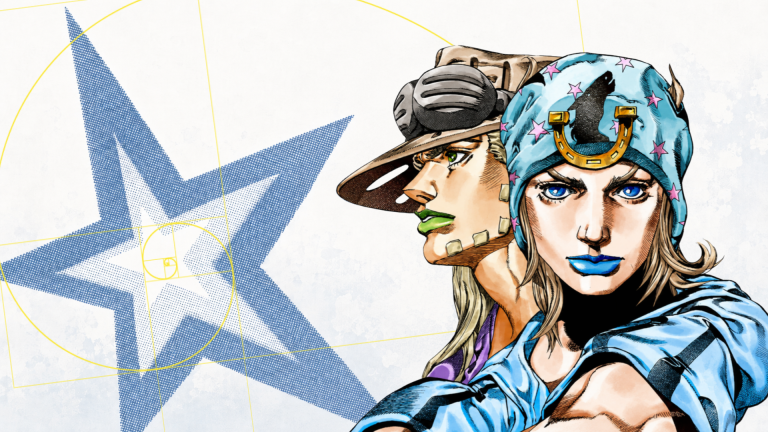
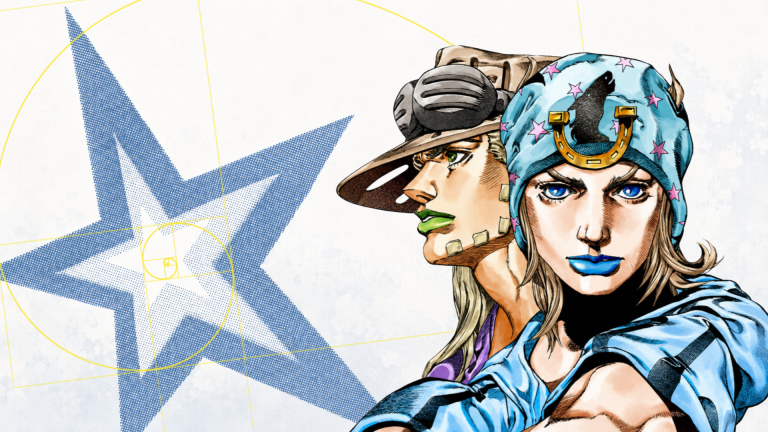
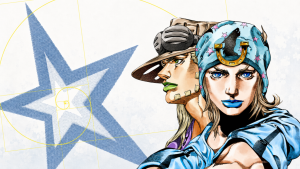
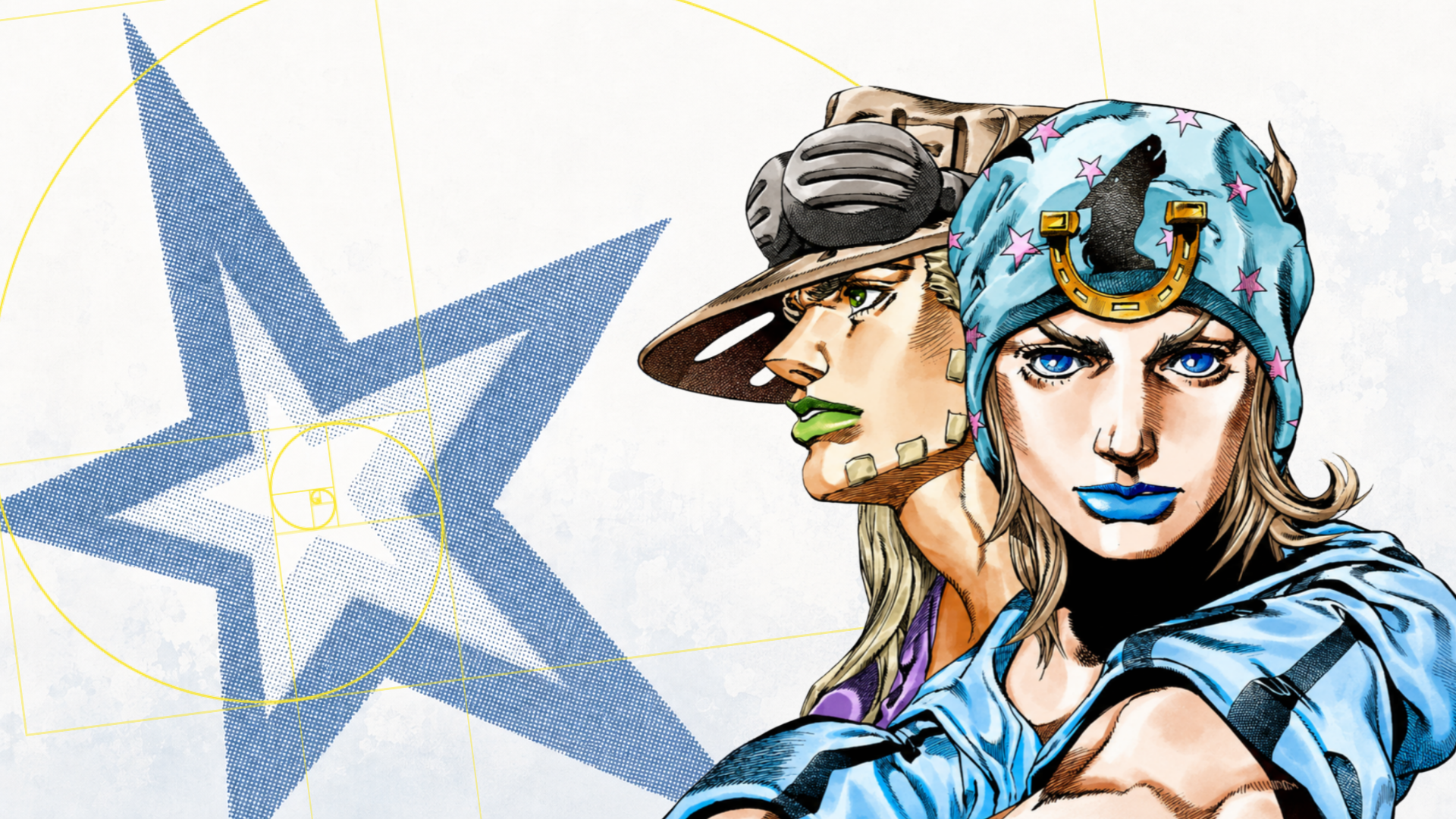
At the beating heart of this cross-country odyssey is the finest duo Araki has ever penned: Johnny Joestar and Gyro Zeppeli. In stark contrast to the stoic heroism of Jonathan or the effortlessly cool swagger of Jotaro, Johnny Joestar begins his journey at absolute rock bottom. A former prodigy jockey whose hubris cost him his career, his family’s love, and the use of his legs, Johnny is a deeply flawed, cynical paraplegic fueled not by righteous justice, but by an obsessive, raw desperation to get back to “zero.”
Johnny’s defining visual hallmark is the “dark determination” burning in his eyes—a chilling, predatory glare that surfaces whenever his survival or goal is threatened. His Stand, Tusk, mirrors this tortuous path to physical and psychological salvation, evolving through distinct “Acts” as Johnny grapples with trauma, guilt, and the harsh mechanics of personal autonomy.
Serving as Johnny’s mentor, companion, and philosophical foil is Gyro Zeppeli, a disgraced executioner from the Kingdom of Naples entered into the race to win royal amnesty for an innocent child condemned to death. Gyro is flamboyant, absurdly superstitious, quick to compose ridiculous musical ditties about mozzarella cheese, and burdened with unbearable filial duty. The bond forged between these two outcasts—built on campfire banter, shared near-death trauma, and reciprocal redemption—provides the narrative with its poignant emotional core.
The Spin: The Golden Ratio as Cosmic Geometry
Where earlier parts relied on the breathing martial art of Hamon or pure psychological Stand clashes, Steel Ball Run introduces the Spin. Rooted in Neapolitan state secrets, the Spin is a supernatural manipulation of rotational energy governed by the Golden Rectangle—the mathematical ratio of perfection observed throughout nature. Gyro’s use of spinning steel balls to contort human anatomy, bend light, and pierce dimensional barriers represents Araki’s most elegant marriage of real-world physics, classical Renaissance art, and supernatural manga choreography.
The Technical Frontier: The Equestrian Animation Challenge
If the thematic depth of Steel Ball Run makes it an enticing prospect for adaptation, its physical logistics represent an animator’s worst nightmare. The central issue can be summarized in a single word: horses.
In classical hand-drawn 2D animation, quadrupedal motion is notoriously labor-intensive, notoriously expensive, and historically punishing to maintain on television production timelines. Unlike human anatomy, a galloping horse requires complex skeletal foreshortening, kinetic muscle deformation, shifting weight distribution, and flowing manes. Steel Ball Run does not merely feature occasional horses; its entire cast lives, duels, bleeds, and charges on horseback across varying, dust-choked terrain across dozens of continuous high-speed chapters.
David Production has built a legendary reputation on their creative compositing, striking pop-art color palette swaps, and inventive 2D-to-3D visual flourishes. However, the studio’s pipeline faces unprecedented pressure here:
- The Hybrid CGI Dilemma: To maintain schedule feasibility, the production will likely need to rely on 3D CGI models for the horses during wide-angle races, reserving lush, hand-drawn sakuga cuts for dramatic close-ups and pivotal Stand clashes. If executed poorly, this approach risks shattering the gritty, grounded immersion essential to the Western aesthetic.
- Atmospheric Scale: The sweeping vistas of the American landscape demand a broader, more cinematic aspect ratio and dynamic background rendering that surpasses the claustrophobic corridors of Morioh or Green Dolphin Street Prison.
- The Ultra Jump Detail: Araki’s monthly illustrations in Steel Ball Run feature hyper-dense crosshatching and surgical anatomical precision. Simplifying these character models enough for TV animation while retaining their raw, illustrative weight is an immense balancing act for the character designers.
Industry insiders have long speculated that David Production’s calculated pause following the conclusion of Part 6 was not a lack of interest, but an essential pre-production war room session. Securing specialized mechanical/animal CGI talent, securing a generous budget, and planning out an episodic structure capable of handling over 90 long-form chapters are massive logistical hurdles that demand extraordinary patience.
Why Steel Ball Run is the Crown Jewel of Anime Anticipation
The anticipation surrounding Part 7 is unprecedented because Steel Ball Run marks the moment Hirohiko Araki graduated from a master of stylized pop spectacle to a master of high literary genre fiction. It is a story where every bullet fired feels devastating, every drop of water in the desert is fought for, and the philosophical inquiries into luck, misfortune, and destiny coalesce into an unforgettable emotional payoff.
Whenever the promotional curtain is finally raised—whether through a sudden jump-festa teaser, a cryptic tweet, or a full-scale Warner Bros. Japan live stream—it will herald David Production’s boldest creative gamble to date. If they conquer the logistical beast that is this 19th-century equestrian sprint, they will not only cement Araki’s global legacy; they will deliver one of the most sublime artistic spectacles the anime medium has ever witnessed.
Now it’s your turn to chime in. Are you prepared to wait another two years if it means getting flawless hand-drawn equestrian sakuga, or do you trust modern 3D CGI hybrid workflows to deliver the race? Which voice actor do you envision embodying Gyro’s chaotic bravado? Sound off in the comments below, and keep your browser locked to Wibux.com for all your breaking anime dispatches.