
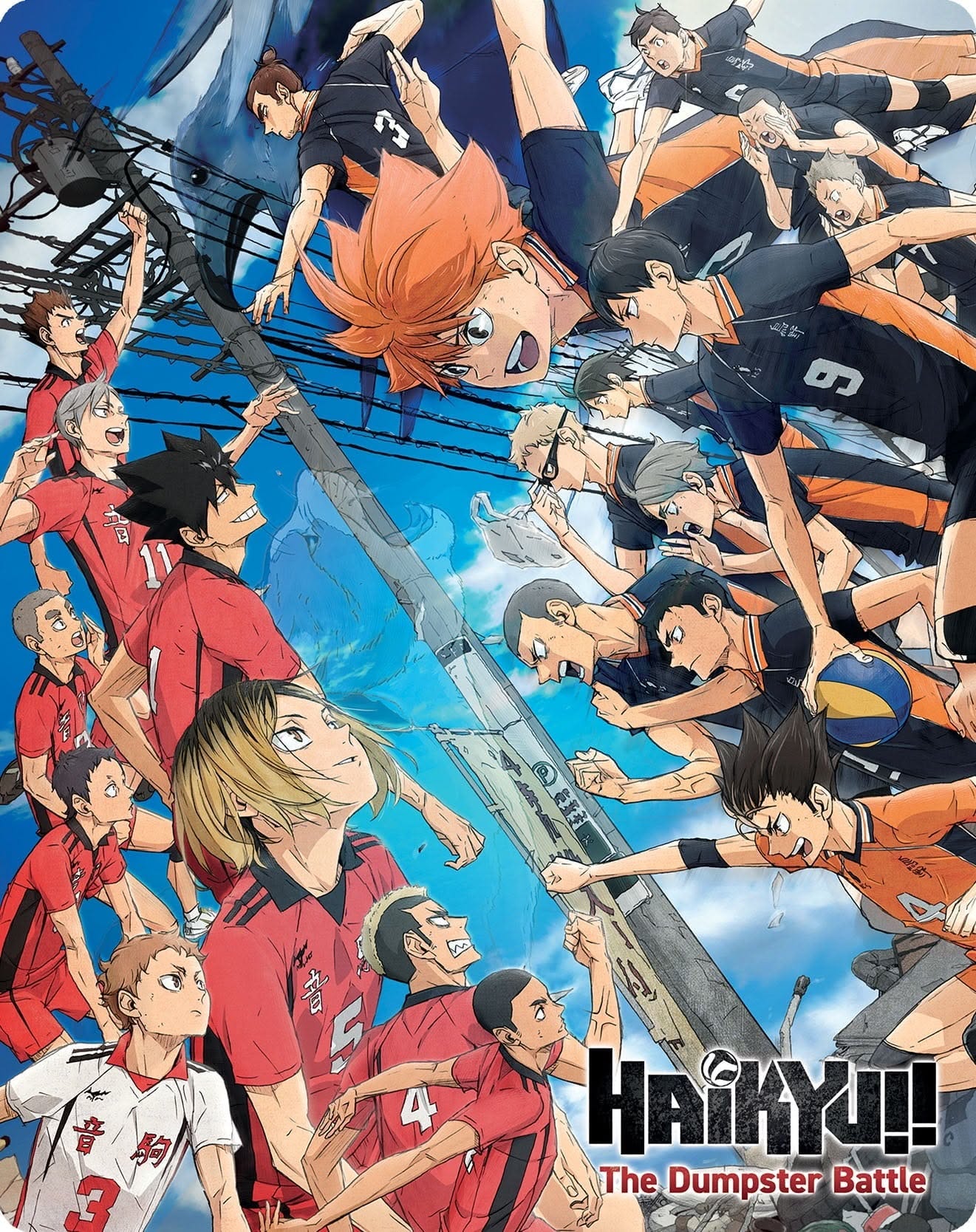
For nearly a decade, sports anime enthusiasts held their collective breath for a singular, fated clash: the official, high-stakes showdown between the Crows of Karasuno and the Cats of Nekoma. It was a promise whispered through decades of fictional history, passed down from former coaches Ikkei Ukai and Yasufumi Nekomata, and kept alive through grueling summer training camps. Now, with Haikyu!! The Dumpster Battle officially arriving on global streaming platforms, international fans no longer need to rely on festival screenings or imported theatrical runs to witness anime history. What they are treated to is not just an exceptionally animated feature film, but a masterwork of kinetic storytelling that solidifies the Karasuno versus Nekoma dynamic as the gold standard of modern shonen rivalries.
Clocking in at a razor-sharp 85 minutes, director Susumu Mitsunaka’s return to the franchise bypasses standard cinematic bloat, opting instead for a breathless, hyper-focused pressure cooker of a match. The result is an audiovisual triumph that captures the frantic, sweat-stained essence of Haruichi Furudate’s manga while reminding the global anime community why Haikyu!! reigns supreme in the sports genre.
The Inherited Destiny: A Rivalry Forged Without Malice
The sports anime landscape is historically littered with antagonistic rivalries. From the bitter resentment of classic shonen setups to the psychological intimidation popularized by modern tournament arcs, viewers are conditioned to expect animosity across the net. Haikyu!! subverts this entirely with the Battle at the Garbage Dump (Gomisuteba no Kessen). Karasuno and Nekoma do not hate each other; they are mirrors reflecting parallel philosophies, bound together by mutual affection, tactical respect, and an ancient generational grudge that has transformed into kinship.
Karasuno represents perpetual evolution—a flock of scavengers willing to test wild, chaotic combinations, flinging themselves relentlessly into the air. Nekoma represents the ground game—an unshakeable feline unit defined by defensive receiving, fluid transitions, and a refusal to let the ball touch the hardwood. It is an irresistible force colliding with an immovable object. Because both teams sharpened each other’s claws during the Tokyo training arcs, every point scored in this match feels intimate. There are no villains on the court, only teenagers pouring every ounce of their youth into a game with an absolute, unforgiving expiration date: once the whistle blows, one team’s high school career is over forever.
The Tactical Web: Kenma Kozume’s Chessboard vs. Shoyo Hinata’s Wings
Deconstructing the Sun
At the center of The Dumpster Battle lies the intellectual and emotional tug-of-war between Karasuno’s Shoyo Hinata and Nekoma’s brain, setter Kenma Kozume. Kenma has always been an anomaly in shonen sports: introverted, physically unimposing, and openly indifferent to the romanticized hustle of athletic culture. Volleyball was simply a game he played because his childhood friend Tetsuro Kuroo asked him to. Yet, against Hinata, Kenma’s analytical brain activates in terrifying fashion.
The film excels at illustrating Kenma’s tactical entrapment. Rather than attempting to match Hinata’s supernatural athleticism, Kenma systematically dismantles his runway. By exploiting Karasuno’s rotational weaknesses and directing Nekoma’s serves with surgical precision, Kenma slowly pins Hinata into the backcourt. Viewers literally watch the court shrink through Hinata’s eyes as his spatial freedom evaporates. It is a psychological horror sequence masquerading as a high school volleyball match, visualizing Kenma’s metaphor of “clipping the crow’s wings.”
The Breakthrough of Pure Instinct
Yet, the genius of this thematic conflict is that Kenma’s cage only exists to force Hinata’s evolution. When Kageyama provides Hinata with the necessary height on an open toss, Hinata doesn’t just jump—he takes flight. The thematic contrast reaches its apex here: Kenma’s calculated, video-game logic is ultimately shattered by Hinata’s unrelenting, biological love for the jump. It is an escalating duel where neither player diminishes the other; instead, they force each other to operate at the absolute ragged edge of their capabilities.
Production I.G’s Masterclass: Kinetic Cinematography and That Unforgettable POV Shot
When it was first announced that the National Tournament’s final arcs would be adapted into a two-part film project rather than a full television season, the fandom erupted in fierce debate. Critics questioned whether an 85-minute runtime could possibly do justice to the manga’s most meticulously choreographed match. While some character-building B-plots were understandably truncated, Production I.G silenced the skeptics through pure, unadulterated cinematic craft.
The animation pedigree on display here rivals the very best action cinema of the decade. The camera maneuvers through the court with three-dimensional fluidity, dipping beneath diving receives, tracking the vicious top-spin of a jump serve, and floating momentarily alongside spikers at the peak of their vertical leaps. Sound design plays an equally pivotal role: the deafening squeak of rubber soles against polished wood, the rhythmic intake of ragged breaths, and the visceral, cannon-like thud of leather meeting palm grounds the spectator in the physical agony of the third set.
The crown jewel of the film’s direction arrives during the climactic final rally, presented almost entirely through an unbroken, first-person point-of-view shot from Kenma. The screen blurs with perspiration, the field of view narrows, the audio dampens into muffled heartbeats, and the ball feels suffocatingly heavy. By placing the audience directly inside Kenma’s physically exhausted, hyper-stimulated body, Production I.G creates one of the most immersive, emotionally exhausting sequences in sports animation history. You don’t just watch the rally—you survive it.
The Four Syllables That Broke the Fandom: “Tanoshii” and Emotional Catharsis
For all its tactical brilliance and technical wizardry, The Dumpster Battle earns its classic status through its emotional payoff. The climax does not hinge on an impossible, gravity-defying super-spike; it ends on an anti-climax dictated by simple human friction: a sweat-soaked ball slipping harmlessly through exhausted fingers. The game ends not with a bang, but with a breath.
In that breathless aftermath comes the moment fans have anticipated for years. Kenma, lying flat on the floor, lungs burning and body spent, looks up at Kuroo and utters words he has never spoken across hundreds of chapters: “Kuro… tanoshii” (“Kuro, this is fun”).
It is a moment of monumental emotional resonance. Kuroo’s tearful, joyous celebration is not for a victory on the scoreboard, but for a victory of the soul—he successfully shared his love for the game with his best friend. In that instant, Haikyu!! reminds us of its core philosophy: the scoreboard tracks winners and losers, but the court is a sanctuary where people learn who they truly are.
The Global Streaming Verdict: A Defining Landmark for Sports Anime
The transition of Haikyu!! The Dumpster Battle from a record-shattering box-office juggernaut to global streaming platforms is a monumental cultural win for the anime community. It democratizes access to a cinematic triumph that captures the absolute zenith of Haruichi Furudate’s storytelling and Production I.G’s directorial vision.
While the looming prospect of condensing the remaining Kamomedai match and the sprawling final arcs into the promised sequel film still sparks valid structural concerns, The Dumpster Battle stands tall as an undeniable masterpiece in its own right. It proves that sports anime, when elevated by passionate direction and rich character psychology, can deliver the same emotional gravitas, technical artistry, and narrative tension as any prestige cinema on the market.
Whether you are a veteran fan returning to relive the heartbreak and triumph of the third set, or a newcomer experiencing the crows and cats for the first time on your home screen, one thing is abundantly clear: the Battle at the Garbage Dump was worth every second of the wait.
Now that Haikyu!! The Dumpster Battle is officially streaming worldwide, where does this match rank in your all-time sports anime showdowns? Did Kenma’s POV sequence leave your heart racing as fast as ours? Drop your thoughts, reactions, and favorite moments in the comments below!