

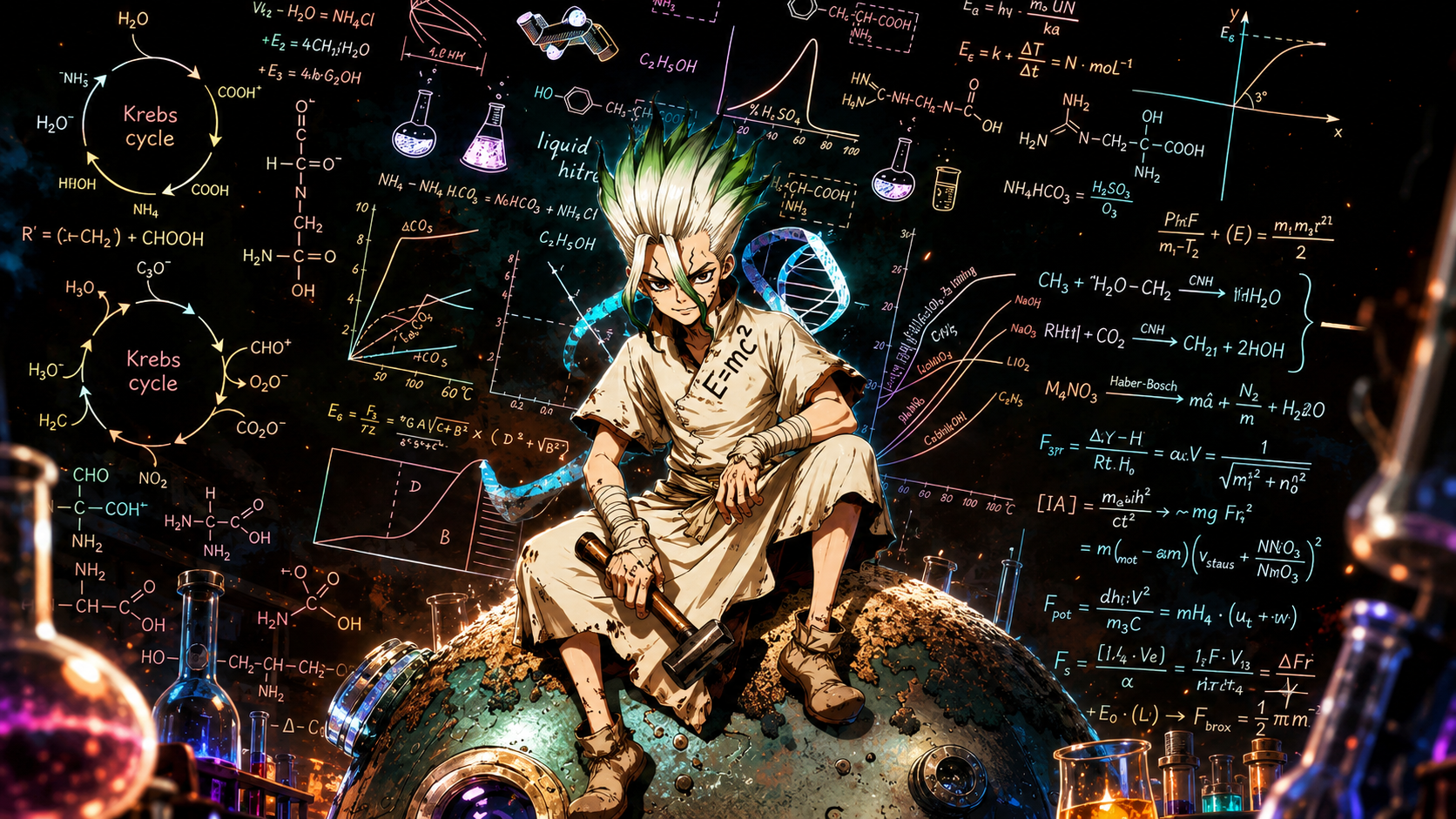
When Riichiro Inagaki and Boichi first introduced Dr. STONE to the pages of Weekly Shōnen Jump in 2017, the premise felt like a charmingly eccentric detour from traditional shonen orthodoxy. Instead of ki blasts, spirit energy, or cursed techniques, its protagonist brandished the periodic table. Fast-forward past petrified civilizations, primitive kingdoms, global seafaring expeditions, and the continental industrialization of the New World, and the narrative now stands perched on the edge of the ultimate frontier: the lunar surface. With the announcement and impending rollout of Dr. STONE Science Future—confirmed to be the fourth and final season, adapted across multiple split cours—the series prepares to execute the most audaciously earned climax in modern anime history.
This is not merely the end of a seasonal run; it is the culmination of a decade-defining masterclass in pedagogical storytelling. The boy who woke up in a savage world armed with nothing but calcium carbonate and a 3,700-year-long internal stopwatch is about to point a multi-stage rocket directly at the moon. Waiting for him on that barren, airless rock is Why-Man—the elusive, synthetic specter behind the green light that froze humanity in time. For anime enthusiasts and science geeks alike, Science Future promises an emotional, mechanical, and philosophical spectacle that will redefine how we view the shonen finale.
The Cosmic Escalation: From Stone Axes to the Apollo Playbook
Shonen power creep usually manifests as exponential increases in combat power—planetary destructions, dimensional rifts, and divine transformations. Dr. STONE subverted this dynamic completely by framing human ingenuity itself as the ultimate escalation. The road to the moon has been paved with sweat, grease, and thermodynamic realism. To build a moon-landing craft from scratch, the Kingdom of Science did not rely on hand-waving miracles; they engaged in an exhaustive global scavenge hunt, synthesizing plastics, mining aluminum, calculating rocketry trajectories, and constructing functional supercomputers from thousands of vacuum tubes and ferrite cores.
In Science Future, this ambition hits escape velocity. The narrative stakes transition from regional survival to pure aerospace engineering. The logistics alone are staggering: the Kingdom of Science must build a modular three-person spacecraft capable of reaching translunar injection, landing on the surface, and returning safely, all while facing extreme resource scarcity. It is human civilization’s greatest historical achievement condensed into a singular, high-stakes sprint, validating Senku’s foundational ethos that science is the steady, democratic accumulation of small, hard-won truths across millennia.
The Why-Man Enigma: Deciphering Anime’s Most Haunting Antagonist
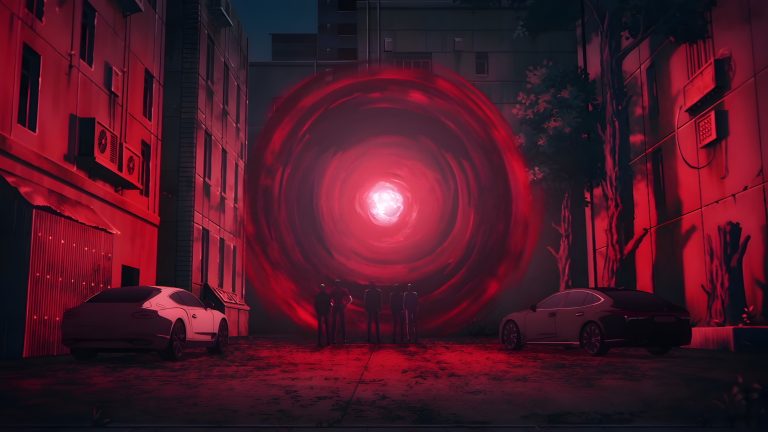
Few anime antagonists have cast as long and terrifying a shadow with so little screen time as Why-Man. First introduced as a localized radio anomaly relentlessly broadcasting the Morse code for “W-H-Y” across humanity’s newly reclaimed airwaves, the entity was instantly distinct. It lacked the theatrical megalomania of Shishio Tsukasa or the ruthless pragmatism of Dr. Xeno. Instead, Why-Man presented as a chilling, unyielding cosmological horror—an omnipotent voice mimicking Senku’s own vocal frequencies, demanding to know why humanity refused to remain dormant.
The Synthetic Whispers of Despair
The confrontation awaiting viewers in Science Future is an ideological masterstroke. Why-Man is not merely a final boss to be punched into submission; it is a walking ontological question mark. Why freeze humanity? Was the petrification ray—the enigmatic Medusa device—an act of cosmic execution, or an unhinged, twisted offer of eternal preservation? The late-stage manga chapters peeled back the layers of this mystery with calculated precision, juxtaposing humanity’s innate drive for chaotic progress against an entity whose logic functions on cold, unfeeling self-preservation. When Senku, Kohaku, and their hand-picked lunar strike team touch down in the Sea of Tranquility, their primary weapon will not be a firearm, but an argument for the validity of organic life.
Science vs. Stagnation: The Ideological Core
Inagaki crafts Why-Man as the thematic inversion of Senku Ishigami. Where Senku views suffering, labor, and mortality as necessary components of discovery, Why-Man offers an immutable, petrified stasis free from pain, hunger, and entropy. The final showdown is fundamentally a debate between the dynamic terror of human freedom and the seductive peace of eternal stone. It tests the soul of the series: Is consciousness worth the agonizing cost of existence?
TMS Entertainment’s Magnum Opus: Translating Boichi’s Hyper-Detailed Pen to Screen
From an aesthetic perspective, Dr. STONE Science Future presents a titanic challenge for TMS Entertainment. Throughout the earlier seasons, director Shinya Iino and subsequent creative leads established a bright, kinetic visual language that softened the hyper-muscular, hyper-detailed rendering of Boichi’s original manga illustrations. However, the lunar arc demands a drastic shift in cinematic grammar. The narrative pivots from lush green jungles and azure oceans to the oppressive, stark monochrome of deep space.
Translating Boichi’s jaw-dropping, mechanically accurate splash pages into fluid 2D and 3D hybrid animation requires an unprecedented level of production discipline. The technical fidelity of the rocket launches, the zero-gravity orbital maneuvers, and the claustrophobic dread of extravehicular activity (EVA) must balance hyper-realism with the series’ signature comedic elasticity. Furthermore, the sweeping, orchestral-meets-folk score spearheaded by Tatsuya Kato, Hiroaki Tsutsumi, and Yuki Kanesaka faces its biggest test yet. The musical landscape must transition from triumphant tribal anthems to ambient, cosmic minimalism—echoing the isolation of the void before crescendoing into humanity’s definitive triumph.
The Weight of 3,700 Years: Byakuya’s Ghost and the Psychology of the Final Trio
Beneath the blueprints and telemetry calculations beats the deeply sentimental core of the story: legacy. The mission to the moon is not just Senku’s dream; it is the physical realization of Byakuya Ishigami’s faith in his son. Decades before Senku broke free from the stone, Byakuya and his fellow International Space Station astronauts looked down at a silenced Earth, dedicated the remainder of their shortened lives to preserving resources, and left behind the foundational stories that kept the embers of civilization warm.
Every bolt tightened on the Kingdom of Science’s spacecraft is a collaborative effort echoing across nearly four millennia. The dynamic between the final mission crew—Senku, the hyper-intuitive powerhouse Kohaku, and their hand-picked operational vanguard—crystallizes this generational relay. Furthermore, the narrative demands closure for secondary heavyweights like Ryusui Nanami, whose rapacious desire for the world drove the industrial revolution forward, and Tsukasa, whose initial cynicism about human nature finds its ultimate refutation as he protects the very species he once sought to cull.
The Enduring Blueprint: Dr. STONE’s Radical Humanist Legacy
As modern anime continues to be dominated by dark fantasy deconstructions and hyper-violent power fantasies, Dr. STONE has remained a radical anomaly: an unapologetically optimistic, deeply humanist work that champions labor, intellect, and collective action over divine right or genetic destiny. Senku Ishigami is not a hero because he was chosen by fate; he is a hero because he did the math, failed ten thousand times, and woke up the next morning to run the experiment again.
Dr. STONE Science Future is positioned to deliver a rare commodity in serialized anime: a definitive, meticulously planned ending that sticks the landing without compromising its core philosophy. When the countdown reaches zero and the engines ignite, it will mark the beginning of the end for one of the most uniquely brilliant narratives of the modern era. The Kingdom of Science is bound for the stars, and the cosmos will finally have to answer the question it posed thousands of years ago.
Are you prepared for Senku’s final journey into the deep unknown? How do you think TMS Entertainment will adapt the startling truth behind Why-Man? Drop your theories, favorite scientific inventions, and predictions in the comments below!