Ever since the melancholic, bittersweet notes of Duffy’s “Distant Dreamer” faded over the closing credits of Stone Ocean in late 2022, the international anime community has held its collective breath. For casual observers, the conclusion of Jolyne Cujoh’s tragic clash against Enrico Pucci marked the logical finale of an interconnected thirty-year generational saga. But for the initiated—the millions of manga readers who know what lies on the other side of that cosmic universe reset—the real holy grail is only just cresting the horizon. We are standing on the precipice of Hirohiko Araki’s undisputed magnum opus: JoJo’s Bizarre Adventure: Steel Ball Run.
Whispers surrounding Part 7’s inevitable anime adaptation by David Production have reached a fever pitch across social media forums, conventions, and industry watercoolers. Adapting Steel Ball Run is not simply a matter of greenlighting another cour of television; it is an epochal undertaking. It represents a stylistic reinvention, a leap into prestige seinen storytelling, and arguably the most intimidating logistical challenge the modern anime industry has faced in years. As rumors swirl and production boards remain tantalizingly quiet, the buzz surrounding Johnny Joestar and Gyro Zeppeli’s trans-American cross-country odyssey has transformed from wishful thinking into an industry-wide obsession.
The Renaissance of Hirohiko Araki: From Shonen Punch-Out to Seinen Masterpiece
To understand the unprecedented hype surrounding Steel Ball Run, one must understand its unique place in manga history. Serialized from 2004 to 2011, the story began its life in Weekly Shonen Jump before migrating to the monthly, mature pages of Ultra Jump. That editorial shift changed everything. Unshackled from weekly page-count crunch and the dogmatic restrictions of demographic censorship, Araki underwent an artistic renaissance. The hyper-muscular bravado of the 1980s and the urban teenage anxieties of the late 90s gave way to an exquisitely illustrated, hyper-detailed historical Western that deconstructed the very concept of heroism.
Set in an alternate 1890, the plot revolves around the eponymous Steel Ball Run race—a grueling, 6,000-kilometer equestrian dash from San Diego to New York City with a staggering $50 million purse. What begins as a spectacle of raw ambition quickly unravels into a supernatural conspiracy involving religious relics, cosmic miracles, and clandestine government operatives. By stripping away decades of entrenched franchise continuity, Araki gave newcomers and veterans alike a clean slate, weaving a tale that sits alongside monumental comic epics like Vinland Saga and Berserk in literary ambition.
A Dynamic Built on Steel and Tragedy: Johnny, Gyro, and the Golden Ratio
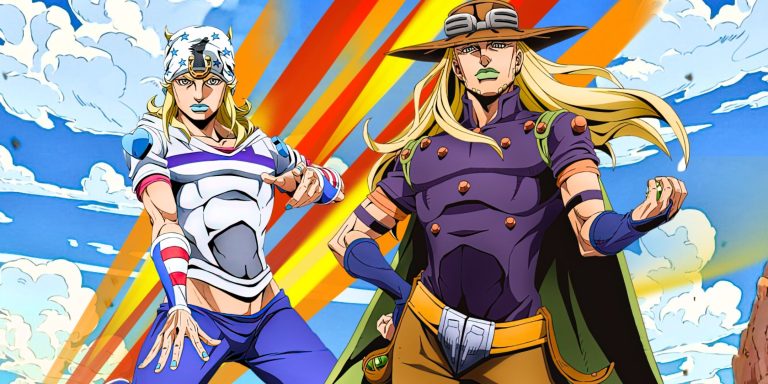
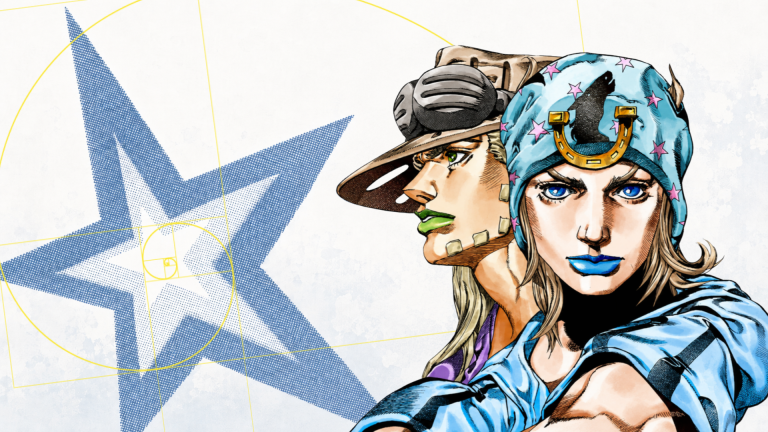
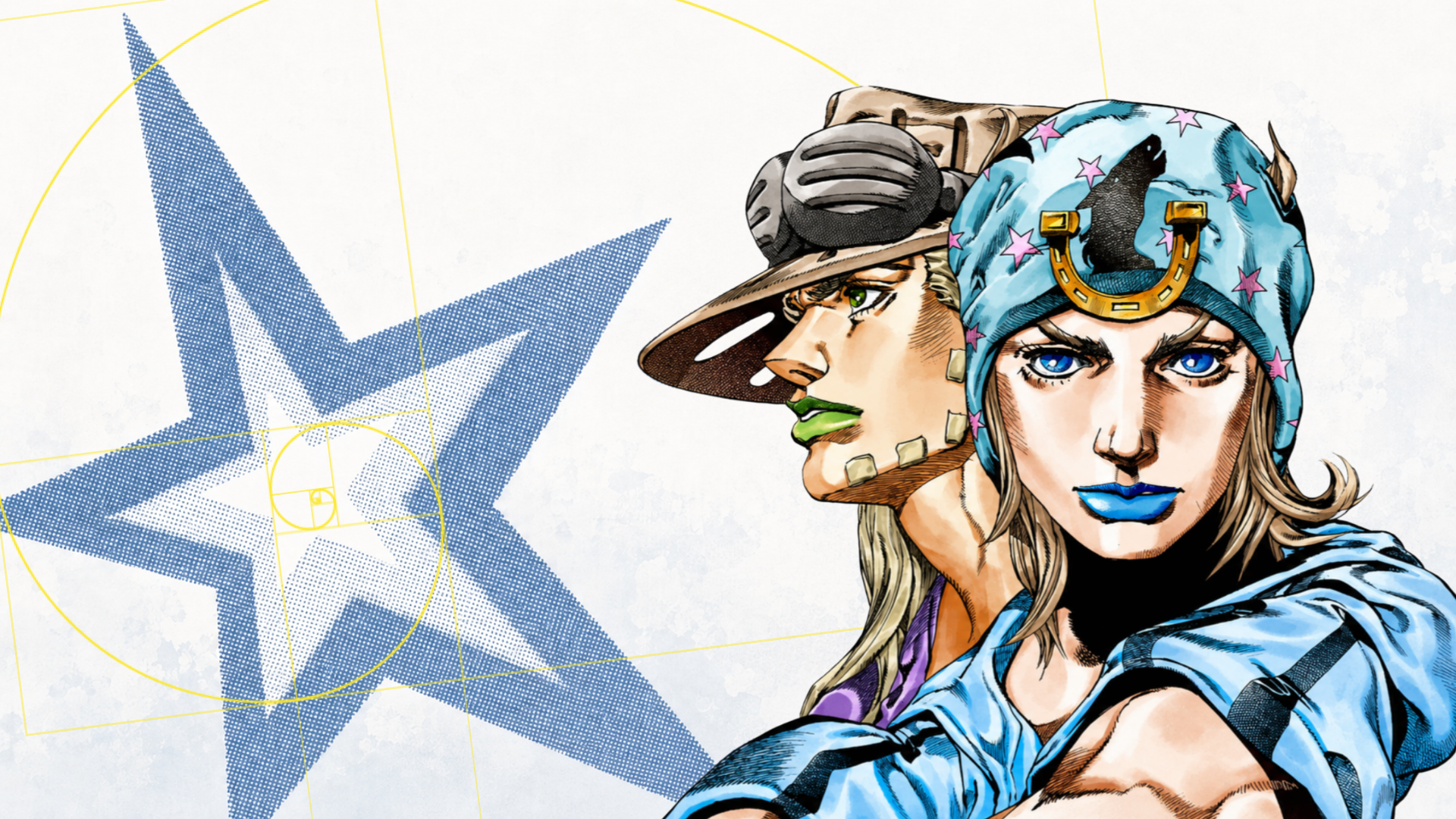
At the beating heart of Steel Ball Run is what many consider the single greatest character dynamic in modern sequential art: Johnny Joestar and Gyro Zeppeli. Unlike the charismatic, righteous paragons that came before, Johnny Joestar is fundamentally broken. A former horse-racing prodigy whose hubris cost him the use of his legs, Johnny begins his journey not out of altruism or a quest to save the world, but from a desperate, selfish desire to walk again. He is petty, ruthless, and possesses what Araki canonically describes as a “dark determination”—the pitch-black gaze of a man willing to kill without hesitation to reclaim his dignity.
The Anatomy of the Spin
Counterbalancing Johnny’s moral murkiness is Gyro Zeppeli, a disgraced Neapolitan executioner armed with mystical revolving steel orbs and a brand of eccentric charisma that instantly commands the page. While previous parts leaned heavily on punch-ghost Stand brawls, Steel Ball Run grounds its power system in “The Spin”—a forgotten martial discipline based on mathematical perfection and the Fibonacci sequence (the Golden Ratio). Through Gyro’s mentorship, Johnny’s evolving Stand, Tusk, mirrors his slow, agonizing path toward spiritual redemption.
Their camaraderie doesn’t feel like the manufactured nakama tropes common to mainstream battle manga. Instead, their bond is forged across campfire philosophy, bizarre running gags about days of the week, shared cups of Italian espresso on frozen plains, and quiet, agonizing trauma. The emotional resonance of their partnership is the engine that drives the narrative forward through hail, gunfire, and dimension-hopping terror.
The Elephant in the Stable: David Production’s Equestrian Nightmare
If the narrative pedigree of Steel Ball Run is unimpeachable, why the prolonged radio silence from Warner Bros. Japan and David Production? The answer is simple, terrifying, and four-legged: horses.
Within the commercial animation pipeline, quadrupeds—and horses in particular—are universally recognized as an animator’s nightmare. Their complex musculoskeletal anatomy, galloping gait cycles, shifting perspective foreshortening, and constant ground-contact physics require an absurd amount of drawings per second to look even marginally convincing. Multiply that by dozens of horses charging through muddy riverbeds, arid deserts, and dense timberlines across fifty-plus chapters of active racing, and the labor costs become astronomical.
David Production, celebrated for their vibrant signature color-bleeds, dramatic sound-effect kanji typography, and loyalty to Araki’s kinetic aesthetic, cannot simply copy-paste their production template from Golden Wind or Stone Ocean. A pure 2D adaptation of the race sequences would bankrupt the studio’s talent pool within two cours. Conversely, leaning entirely on cheap, jarring 3D CGI models risks alienating a fan base that has waited over a decade for this adaptation.
Industry insiders widely speculate that David Production is developing a revolutionary hybrid pipeline—blending bespoke, cel-shaded 3D assets meticulously hand-corrected by high-tier 2D key animators, similar to Orange’s work on Trigun Stampede or Wit Studio’s kinetic cavalry charges in Attack on Titan. Mastering that technology without sacrificing Araki’s intricate, hatched cross-line art style is almost certainly the primary reason Part 7 has remained behind studio doors for so long.
Cosmic Stakes and the American Dream: The Valentine Factor
Beyond the logistical nightmare of equine animation lies the psychological heavy lifting of the story’s antagonist: the 23rd President of the United States, Funny Valentine. Armed with one of the most mechanically complex Stands in the franchise—Dirty Deeds Done Dirt Cheap (D4C)—Valentine isn’t a villain obsessed with ruling the criminal underworld or achieving personal immortality. He is a hyper-nationalist driven by an uncompromising, terrifyingly pure form of patriotism: the desire to seize the ultimate fortune for America, regardless of the suffering inflicted on the rest of the world.
The philosophical clash between Valentine’s collectivist tyranny and Johnny Joestar’s individualized redemption turns the final third of Steel Ball Run into an unprecedented masterclass of tension. Translating these mind-bending spatial mechanics and high-concept multiverse shifts to the screen will test the visionary limits of any episode director David Production assigns to the helm.
Waiting at the Starting Line in San Diego
Whether JoJo’s Bizarre Adventure: Steel Ball Run manifests as a lavish multi-season television run or takes a detour through cinematic feature films for its premier arcs, the anime industry knows that failure is not an option. Part 7 is the apex of Araki’s creative trajectory—a peerless synthesis of historical period piece, metaphysical body horror, and deep, aching human drama.
When that starting gun finally fires, it will not just mark the return of anime’s most stylish franchise; it will redefine what adaptation means in the modern landscape. The race hasn’t officially begun, but across the fandom, the spin is already gaining momentum.
Are you prepared for the brutal journey across the American frontier, or do you think the animation hurdle is simply too steep for television? Let us know your dream voice cast and production theories in the comments below!