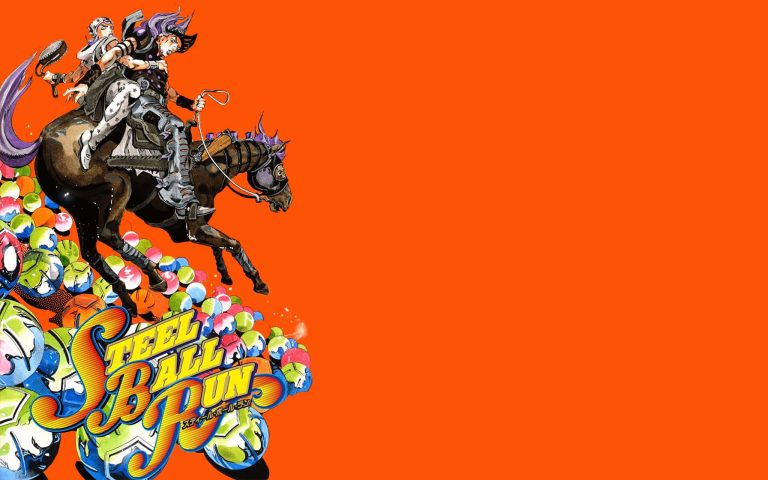
Ever since the melancholic, bittersweet notes of “Distant Dreamer” faded at the climax of Stone Ocean, a deafening, unified question has echoed across the anime community: When is David Production taking us to the American Frontier? For casual viewers, the ending of Jolyne Cujoh’s narrative was the grand punctuation mark on the generational feud between the Joestar bloodline and the shadow of DIO. But for manga acolytes and seasoned pop-culture observers, it merely marked the threshold to Hirohiko Araki’s indisputable magnum opus. JoJo’s Bizarre Adventure: Steel Ball Run is not merely another seasonal adaptation waiting in the wings; it is an epochal shift in anime history, a narrative titan that routinely sits near the absolute summit of international manga rankings alongside masterpieces like Berserk and Vagabond.
The anticipation surrounding a prospective Part 7 adaptation has reached an intoxicating fever pitch. From frantic Twitter discourse analyzing David Production’s production schedules to speculative dream-casting of voice actors, the buzz is palpable. Yet, bringing this cross-country horse race to television screens is perhaps the most audacious creative gamble the studio will ever undertake. Between revolutionary character psychology, thematic reinventions, and the terrifying logistics of equine animation, Steel Ball Run stands as the anime industry’s most tantalizing, high-stakes frontier.
The Frontier Reborn: Araki’s Shift from Shonen Spectacle to Seinen Depth
To understand the immense gravity of the Steel Ball Run discourse, one must understand its genesis. Launched in 2004, the series initially distanced itself from the mainline JoJo moniker before transitioning from the frantic, youth-oriented confines of Weekly Shonen Jump to the monthly, mature pastures of Ultra Jump in 2005. This logistical shift fundamentally transformed Araki’s storytelling. Unshackled from juvenile demographic formulas, Araki traded traditional battle shonen pacing for a gritty, atmospheric historical thriller masquerading as an apocalyptic equestrian sprint across 1890s America.
The race itself—spanning from the shores of San Diego to the bustling streets of New York City—is an exercise in pure adrenaline, but the narrative core shifts drastically toward moral ambiguity. The pursuit of the Corpse of an unnamed Holy Saint introduces an escalating game of geopolitical chess. Gone are the stark, binary lines separating heroic crusaders from cartoonishly sadistic vampires. Instead, Araki orchestrates a narrative battlefield where every participant, from President Funny Valentine to desperate competitors, operates within a suffocating vortex of conflicting, valid philosophies. In adapting this saga, David Production is not just animating a tournament arc; they are animating a sprawling, literary exploration of destiny, imperial ambition, and the American mythos.
Two Riders, One Destiny: Deconstructing Johnny Joestar and Gyro Zeppeli
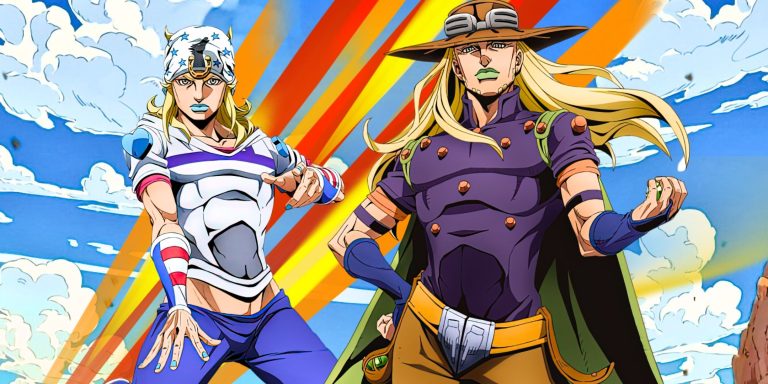
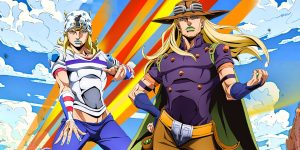
At the beating heart of Steel Ball Run lies the most meticulously constructed character dynamic in the entirety of the franchise: Johnny Joestar and Gyro Zeppeli. Their partnership completely subverts the classic protagonist-companion tropes established across earlier generations.
Johnny Joestar: The Dark Flame of Regret and Redemption
Unlike Jonathan’s immaculate chivalry or Jotaro’s impenetrable stoicism, Johnny Joestar begins his journey as an anti-hero defined by profound bitterness and physical disability. A fallen horse-racing prodigy paralyzed from the waist down due to his own vanity, Johnny does not enter the Steel Ball Run to save humanity or avenge a fallen relative. He joins out of a raw, selfish, almost obsessive desire to walk again after witnessing the supernatural effects of Gyro’s weapons. Johnny carries within him what Araki explicitly labels “the dark determination”—a terrifying, remorseless glint in his eyes that proves he is willing to commit moral atrocities to crawl out of his personal negative space. His journey from broken cynic to selfless warrior represents one of the most painfully human character arcs ever inked.
Gyro Zeppeli: Duty, Humor, and the Legacy of Executioners
Balancing Johnny’s brooding fatalism is Gyro Zeppeli, a disgraced Neapolitan executioner who serves as mentor, brother-in-arms, and the story’s comedic lifeline. Flashy, arrogant, and adorned with golden teeth spelling out “GO! GO! ZEPPELI,” Gyro is effortlessly charismatic. Yet beneath his bizarre gags and compositions about Italian cheeses lies a profound, tragic burden: he is racing to secure royal pardon for a young, wrongfully condemned shoemaker’s boy. The emotional alchemy between Gyro and Johnny—the cadence of their campfire conversations, their shared failures, and the brutal, slow-drip transfer of wisdom—is the definitive emotional pillar that the anime adaptation must capture with razor-sharp intimacy.
David Production’s Greatest Crucible: The Equine Animation Paradox
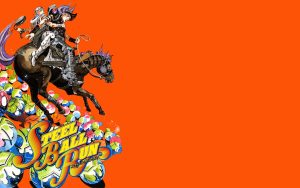
While hype continues to simmer across forums, one glaring reality looms over the production: horses are notoriously the bane of the animation industry. Drawing, rigging, and sequencing four-legged quadrupeds with realistic muscular mechanics, shifting weights, and accurate gallop cadences requires astronomical time and talent. In Steel Ball Run, horses are not secondary background props; they are essential characters constantly locked in grueling, high-speed, dynamic collisions across dusty plains, freezing blizzards, and dangerous mountain passes.
Industry veterans point to the technical struggle studios like WIT Studio faced during the cavalry skirmishes of Attack on Titan or MAPPA’s judicious use of 3D integration in modern releases. For David Production—a studio rightfully celebrated for vibrant color palettes, theatrical framing, and faithful sound-design flourishes—adapting SBR requires solving the equine paradox. Will the studio develop an unprecedented hybrid aesthetic, utilizing hyper-stylized cel-shaded 3D CG models for complex group charges while reserving hand-drawn key frames for close-up dramatic tension? Or will the prolonged wait for an announcement stem from a deliberate, monumental pre-production pipeline aimed at hand-drawing the cavalry? The studio’s technical legacy hinges squarely on how they handle this logistical mountain.
From Hamon to The Golden Spin: The Physics of Supernatural Kinetic Energy
Another fascinating dimension awaiting realization is the formal retirement of the series’ traditional power systems in favor of “The Spin.” Rather than relying purely on hereditary Stands or solar-powered Hamon, Araki crafted a cerebral, pseudo-scientific combat philosophy steeped in Renaissance geometry and the Fibonacci sequence.
Through Gyro’s steel spheres, the Spin operates as an ancient, sacred art form that harnesses kinetic rotation through the Golden Ratio. When married to Stands, the results are visually hypnotic. Johnny’s Stand, Tusk, serves as a visceral visual metaphor for his psychological resurrection. It begins as a helpless, infant-like entity tied to spinning his own fingernails (ACT 1), steadily evolving through kinetic wormholes (ACT 2 and ACT 3), until it culminates in the devastating, interdimensional powerhouse of ACT 4. Animating this progression will challenge David Production to craft mind-bending, surreal visual effects that fuse classical Western grit with cosmic, multidimensional physics.
Final Sprint: Why the World Waits for the Starting Gun
The anticipation for JoJo’s Bizarre Adventure: Steel Ball Run is far more than routine sequel anxiety. It is the collective cultural craving for what could legitimately become one of the defining television masterstrokes of the modern anime era. If David Production can conquer the physical mechanics of the race while retaining the visceral, philosophical soul of Araki’s masterpiece, Steel Ball Run will transcend its niche to conquer the mainstream landscape completely.
The stakes are astronomical, the trail is brutal, and the prize is legendary. As the global anime community watches the starting line with baited breath, only one certainty remains: when Gyro’s steel balls finally take flight and the race begins, the world of animation will never be quite the same.
What are your biggest hopes and fears for the Steel Ball Run anime? Who would you cast to voice Gyro Zeppeli, and how should David Production handle the horses? Sound off in the comments below, and stay tuned to Wibux.com for all your frontline anime breakdowns!