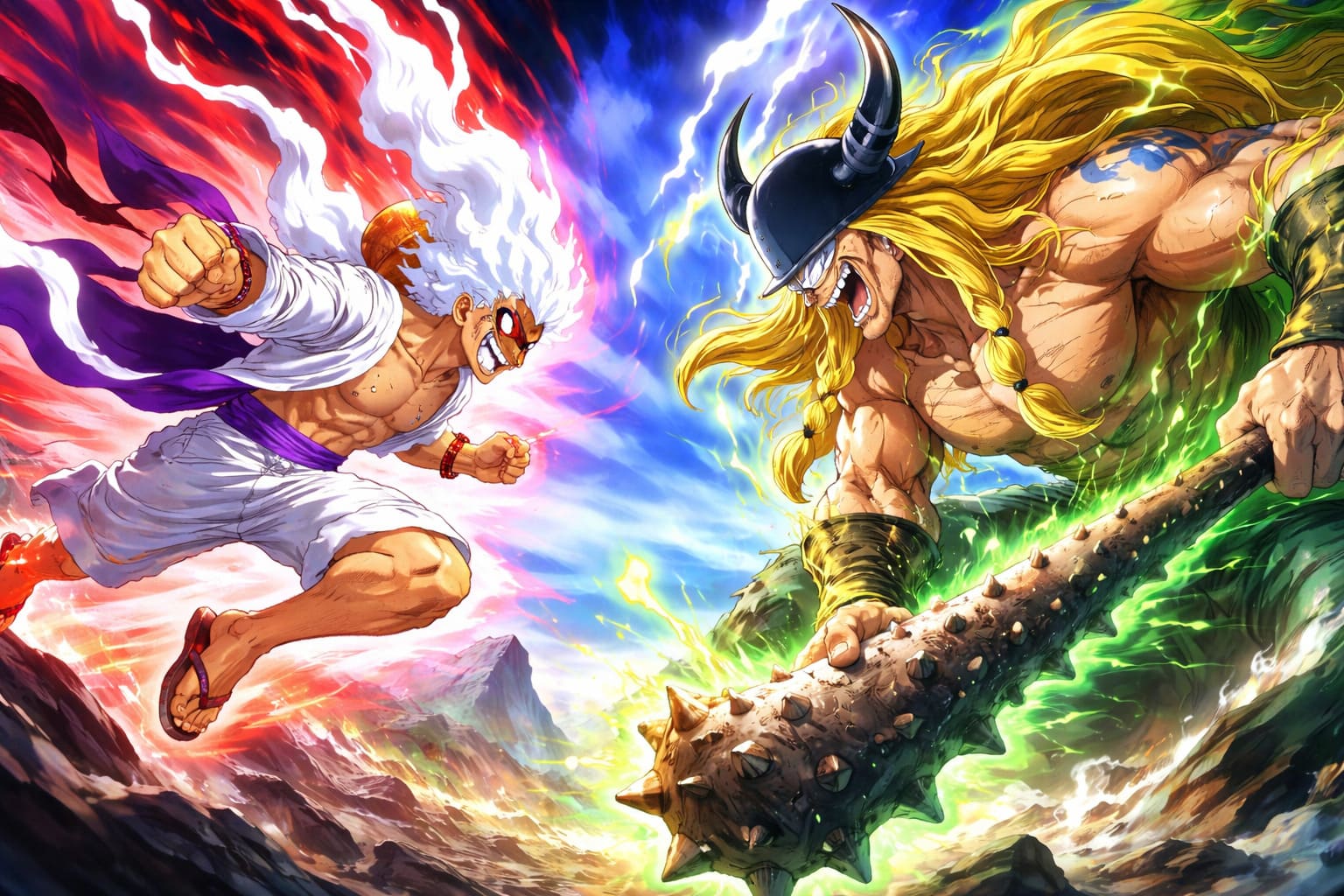
For twenty-seven years, Eiichiro Oda has operated not merely as an industry-defining mangaka, but as an architect of mythological inevitability. In the modern landscape of serialized shonen, few milestones carry the tectonic weight of a quadruple-digit chapter release. As One Piece approaches the historic threshold of Chapter 1200, the narrative gravity has shifted entirely to Warland Elbaf—the long-promised Valhalla of the Grand Line. While the surface narrative tantalizes readers with feast-hall camaraderie and long-awaited reunions, beneath the towering boughs of the Giant realm lies something vastly more terrifying: the petrified battleground of the Void Century. As theorists dissect Oda’s thematic trajectory, one prevailing theory has seized the community’s collective consciousness: Chapter 1200 will not merely be a milestone; it will trigger an apocalyptic paradigm shift. Between the enigmatic, shackled prince Loki and the ancient mechanical horrors buried in Elbaf’s subterranean roots, the story stands on the precipice of its most devastating thematic convergence yet.
The Milestone Crucible: Why Chapter 1200 Demands an Earth-Shattering Pivot
Eiichiro Oda treats century-mark chapters with liturgical reverence. Chapter 100 signaled the entrance to the Grand Line (“The Legend Begins”); Chapter 500 introduced Silvers Rayleigh while laying bare the moral rot of Celestial Dragon supremacy; Chapter 1000 canonized Monkey D. Luffy as the definitive inheritor of Joy Boy’s will; and Chapter 1100 anchored Bartholomew Kuma’s heart-wrenching tragedy against the ticking clock of Egghead Island. Historically, Oda does not squander these moments on transitional exposition. They serve as structural fulcrums designed to fundamentally alter our understanding of the series’ overarching cosmology.
Entering the heart of the Elbaf Arc, Chapter 1200 arrives at a precarious geopolitical junction. The world-shattering broadcast of Dr. Vegapunk permanently dismantled the illusion of global stability, revealing that the planet is actively drowning beneath the sea under the weight of ancient superweapons. Elbaf, an autonomous superpower that has repelled the World Government for eight centuries, is no peaceful sanctuary. It is the vault guarding the forgotten truths of the Ancient Alliance. If Oda adheres to his century tradition, Chapter 1200 will shatter the status quo, transforming Elbaf from an adventurous detour into ground zero for the final war.
The Necropolis Beneath the Roots: Ancient Kingdom War Relics
The topography of Elbaf has fascinated lore scholars for decades. The majestic crown of the kingdom echoes the cosmic Yggdrasil archetype, long suspected to be intimately tied to the legendary Treasure Tree Adam. Yet, in Oda’s world of deliberate dichotomies, where there is an Adam, an Eve cannot be far behind.
The Adam-Eve Axis and the Subterranean Vaults
For hundreds of chapters, the symbiotic contrast between the Sunlight Tree Eve (which channels oxygen and sunlight to Fish-Man Island from beneath the Red Line) and the resilient wood of the Treasure Tree Adam has occupied fan theories. If Eve channels life down into the abyss, Adam’s root network beneath Elbaf likely anchors deep into the ancient crust of the world itself. The theory asserts that Elbaf’s underworld is not simply rock and soil, but an immense, petrified necropolis—a fortified armory where the weapons of Joy Boy’s coalition were stashed following their catastrophic defeat 800 years ago.
Egghead Island revealed the Iron Giant Emet, a colossus powered exclusively by the rhythmic heartbeat of the Drums of Liberation. However, Emet was an isolated infiltrator deployed against Mary Geoise two centuries ago. What if the roots beneath Elbaf shelter the rest of that forgotten mechanized vanguard? Dormant iron leviathans, continental-stabilizing pillars, and pre-Void Century terraforming engines may lie entombed beneath the giants’ mead halls. When Vegapunk confirmed that the planet is slowly submerging, he underscored a terrifying reality: whoever controls the world’s highest elevations and these ancient technologies will dictate the terms of human survival.
Loki’s Unshackled Divine Wrath: The Subversion of the Trickster Prince
At the center of Elbaf’s domestic tragedy stands Prince Loki, a figure introduced not as a celebrated monarch, but as an ostracized, chain-bound pariah. Fandom anticipation for Loki has simmered since his silhouette cast a long shadow during the Whole Cake Island arc. Yet, Oda’s recent framing subverts traditional expectations: Loki is not merely a jilted, malevolent prince, but a mythopoetic powder keg awaiting a spark.
Psychological Isolation and the ‘Sun God’ Complex
Loki’s visual and narrative design synthesizes Norse cataclysm with psychological ruin. Bound in colossal Sea-Prism Stone chains in the frozen underbelly of Elbaf, Loki mirrors Fenrir and the bound trickster god whose violent release directly triggers Ragnarok. His crime—the murder of his own father, King Harald, to consume a legendary, cursed Devil Fruit—hints at a fractured psyche poisoned by ancient destiny.
Loki’s tragedy stems from an obsession with divine validation. Raised in a warrior culture steeped in prophecy concerning the return of the Sun God, Loki sought to mantle that apocalyptic divinity through brute force and patricide—a false savior driven to madness by the sheer weight of history. His shackled state represents the giants’ terror of his awakened power. This creates an inevitable ideological collision with Luffy. Unlike Loki, Luffy has never sought divinity, titles, or predetermined glory; he represents pure, unburdened freedom. When Chapter 1200 inevitably fractures Loki’s chains, we are poised to witness a clash between a titan who murdered his lineage to become a god and a boy who simply wants everyone to eat until they are full.
The Converging Storm: Holy Knights, Garling, and Joy Boy’s Pact
Elbaf cannot escape the escalating global firestorm. The sudden elevation of Saint Figarland Garling to the Five Elders marks a ruthless tactical realignment for the World Government. The Holy Knights, long relegated to shadowy threats operating in the upper echelon of Mary Geoise, have been deployed to reclaim or eradicate the last remaining strongholds of Void Century resistance.
Because the life spans of giants span centuries, Elbaf requires only three generations to bridge the gap between the Void Century and the current timeline. The sacred oath forged between the ancient giants and the original Joy Boy was not an abstract legend; it was a physical treaty etched into Elbaf’s architecture. As the Holy Knights mobilize toward Warland, Chapter 1200 is perfectly positioned to stage the arrival of the World Government’s ideological purgers. The convergence of Garling’s bloodthirsty doctrine, the lurking reach of Cross Guild, and the lingering presence of the Red Hair Pirates sets the stage for an unprecedented conflict.
The Final Verdict: Ragnarok Approaches
Eiichiro Oda is methodically aligning his narrative dominos. Chapter 1200 is primed to strip away the remaining ambiguities of the Grand Line, initiating the explosive opening salvo of the Final Saga’s climax. The war relics resting beneath Elbaf’s roots are not historic fossils—they are the dormant tools intended to reshape the geography of the planet itself. When Prince Loki’s shackles strike the stone floor and ancient mechanisms hum back to life, the drums of liberation will no longer merely echo across an island; they will shatter the foundation of the world.
Will Loki emerge as Luffy’s most volatile ally against the World Government, or will his unchained fury unleash the very Ragnarok Elbaf has feared for eight centuries? Share your boldest Chapter 1200 predictions and lore breakdowns in the comments below!