

When the world lost Akira Toriyama in March 2024, the shockwaves tore through the fabric of global pop culture. For four decades, Toriyama did not merely draw manga; he constructed a universal visual language of kinetic optimism, kinetic impact, and unbridled wonder. Naturally, when Dragon Ball Daima made its global premiere, it carried an almost unbearable weight of expectation. What began as a celebratory 40th-anniversary project suddenly became Toriyama’s definitive curtain call. Skeptics originally braced themselves for a regression into familiar, controversial territory—muttering comparisons to Dragon Ball GT’s infamous de-aging premise. Yet, the sprawling, cinematic premiere of Daima immediately shatters those superficial assumptions. Far from a hollow rerun, this series emerges as a vibrant, lore-dense, and deeply personal triumph that reignites the primal thrill of classic Dragon Ball.
Toriyama’s Purest Creative DNA in Decades
Unlike recent franchise installments where Toriyama supplied sparse character outlines or high-level narrative sketches while studio writers filled the blanks, Dragon Ball Daima was thoroughly shaped by the master’s hand. Toriyama penned the story, conceptualized the intricate machinery, designed the sprawling cast, and mapped the cosmological rules of this new saga before his passing. That creative fingerprint is unmistakable from the opening frames.
The premiere breathes with Toriyama’s signature blend of tactile engineering and whimsical fantasy. We see an abundance of bulbous spacecraft, quirky gadgetry, and expressive, non-humanoid alien species that echo his work on Dr. Slump and Chrono Trigger. Rather than accelerating directly into the universe-shattering power-scaling of Dragon Ball Super—where godhood and multiversal erasure became baseline stakes—Daima decelerates to focus on charm, character chemistry, and adventurous curiosity. It captures an elusive truth the franchise often forgot in its quest for higher power levels: Dragon Ball is at its absolute best when it is an odyssey across the unknown.
The Demon Realm Unveiled: Dismantling Decades of Lore Mystery
For decades, the Demon Realm (Makai) lingered in the franchise’s peripheral lore. Dabura’s brief tenure in the Majin Buu arc gave audiences a fleeting taste of this hellish underworld, but the geography, politics, and culture remained shrouded in mystery. Daima boldly rips off the veil, establishing the Demon Realm not as an abstract void of evil, but as a textured, tri-layered civilization teeming with its own ecosystem, bureaucracy, and socio-political friction.
The Demon King Vacuum and the Rise of Gomah
The premiere’s cold open delivers monumental mythos expansion. Following Dabura’s destruction on Earth, the throne of the Demon Realm falls into the hands of King Gomah, a diminutive, paranoid tyrant accompanied by Degesu—the estranged brother of Shin, the Supreme Kai. Watching historical footage of Goku and the Z-Fighters crushing Majin Buu via an eerie magical device, Gomah realizes that Universe 7’s warriors represent a cataclysmic threat to his precarious reign. Rather than wishing for raw, unbeatable strength, Gomah exploits the mystical properties of the Demon Realm Dragon Balls—overseen by ancient, armored Tamagami and crafted by the elderly Namekian Neva—to reduce Goku and his allies to helpless children.
The Namekian Revelation
Crucially, Daima executes one of the most stunning retcons in the franchise’s 40-year history: revealing that the Namekian race originally migrated from the Demon Realm itself. This single detail reorganizes decades of cosmological canon. It instantly re-contextualizes the mystic, life-creating abilities of Piccolo, Kami, and the Dragon Balls, grounding their origins in a shadowy, eldritch landscape rather than benign cosmic benevolence. It is a profound masterstroke of world-building that honors existing continuity while radically expanding its horizons.
Peak Sakuga: Grounded Martial Arts Over Planet-Busting Lasers
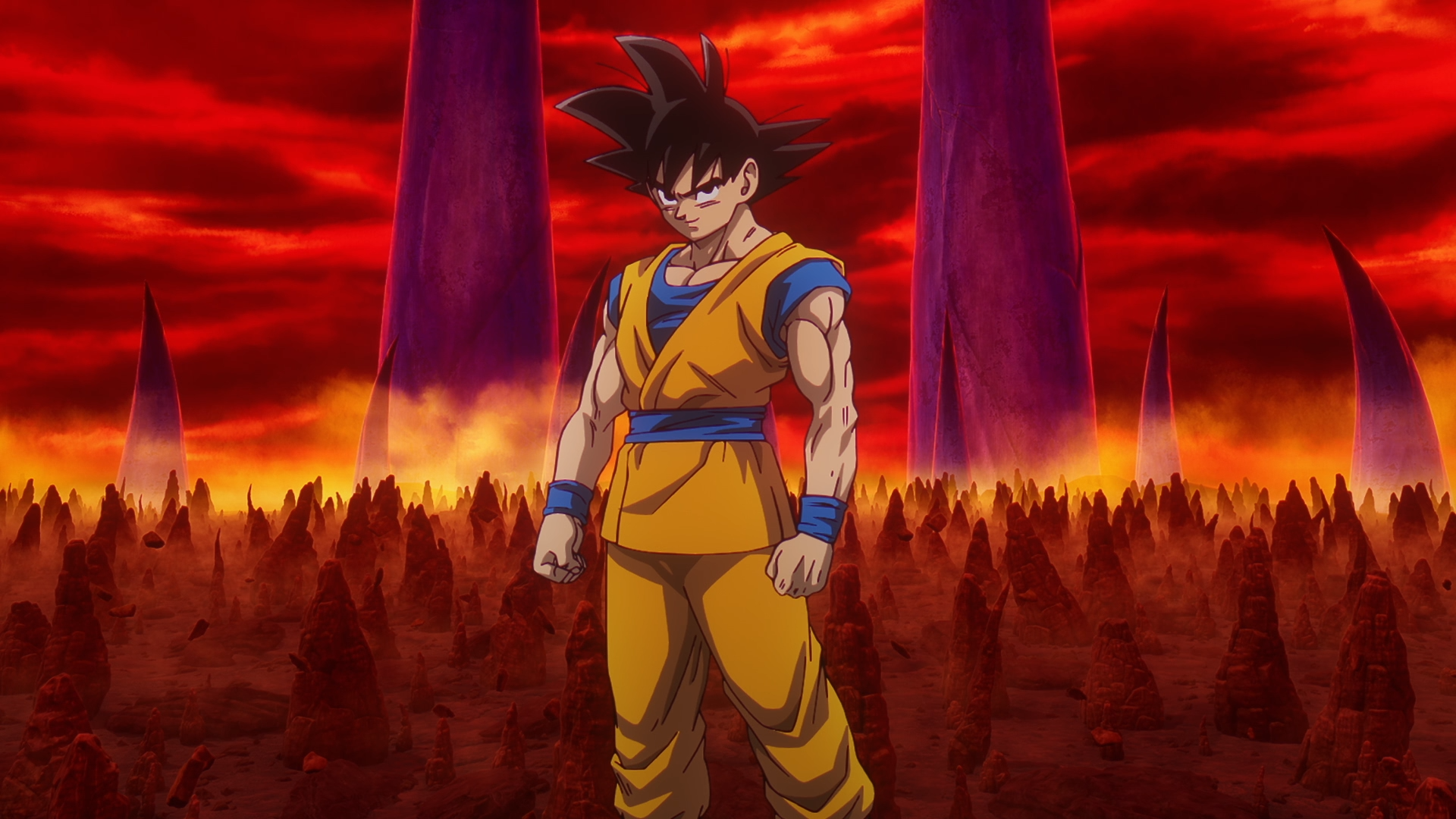
Visually, the premiere of Dragon Ball Daima is nothing short of a revelation. Directed by veteran series director Yoshitaka Yashima alongside Aya Komaki (celebrated for her visionary work on One Piece‘s Wano Country arc), the episode exhibits a production pedigree rarely afforded to weekly television anime. Working from designs refined by legendary animator Katsuyoshi Nakatsuru, the animators treat Toriyama’s character models with breathtaking reverence.
The action choreography represents a radical, intentional aesthetic pivot. For years, modern Dragon Ball battles had degenerated into visual noise—shaky cameras, blaring color-coded auras, and intergalactic laser spam. Daima forcefully course-corrects back to the tactical, grounded hand-to-hand martial arts of the 1980s. When mini-Goku tests his reduced center of gravity, every sweep, feint, and joint lock resonates with weight, clarity, and kinetic momentum.
The triumphant reintroduction of the Power Pole (Nyoibo) is more than pure fan service; it fundamentally alters Goku’s combat vocabulary. Shrinking the hero forces him to rely on reach, leverage, and momentum once again. Watching Goku wield the vermilion staff against shadowy assailants evokes an overwhelming sense of nostalgia without feeling dated. It is classic Wuxia choreography filtered through modern, high-tier Toei Animation sakuga.
Character Psychology and New Horizons: The Rise of Glorio
Transforming the cast into “minis” could have easily degenerated into cheap comedic novelty, but Daima navigates the premise with psychological authenticity. While characters like Vegeta seethe with wounded Saiyan pride and Piccolo assesses the strategic handicap, Goku greets his physical regression with unbothered, childlike joy. Goku has never fought for status or dominance; he fights for the pure, visceral challenge of kinetic mastery. Being small is simply a brand-new mechanical puzzle to solve.
Yet, the premiere injects vital new blood through Glorio, an enigmatic pilot from the Demon Realm’s Second World. Armed with a sidearm, operating a retro-futuristic hovercraft, and carrying an unsettlingly pragmatic aura, Glorio acts as the grounded, street-smart foil to Goku’s unhinged innocence. Their burgeoning dynamic recalls the early partnership between Goku and Bulma, swapping the high-concept deity worship of Whis and Beerus for the dusty, road-trip camaraderie that originally catapulted the manga to superstardom.
The 40-Year Heritage: Why Daima is the Revival We Deserved
The global fan reception following the premiere has been an eruption of euphoric relief and poignant reflection. In an era dominated by dark fantasy deconstructions and hyper-cynical narratives, Dragon Ball Daima reminds the medium of the power of earnest, boundless adventure. It does not treat its audience with condescension, nor does it lean on the crutch of superficial power-ups to manufacture tension.
Daima captures Toriyama at his absolute peak: eccentric, mechanically brilliant, playfully irreverent, and infinitely imaginative. It bridges the gap between the sun-drenched wonder of original Dragon Ball and the high-stakes narrative urgency of Dragon Ball Z, crafting an experience that feels simultaneously brand new and deeply familiar. As Goku and Glorio plunge their starship into the misty, dangerous portals of the Demon Realm, one cannot help but feel a bittersweet awe. Akira Toriyama may have taken his final bow, but his spirit remains immortal—soaring fearlessly into the unknown, Power Pole in hand.
What did you think of the Dragon Ball Daima premiere? Did the Demon Realm lore and grounded martial arts action blow you away, or are you still missing the multiversal stakes of Super? Sound off in the comments below, and keep your scouters locked to Wibux.com for our weekly episode breakdowns!