
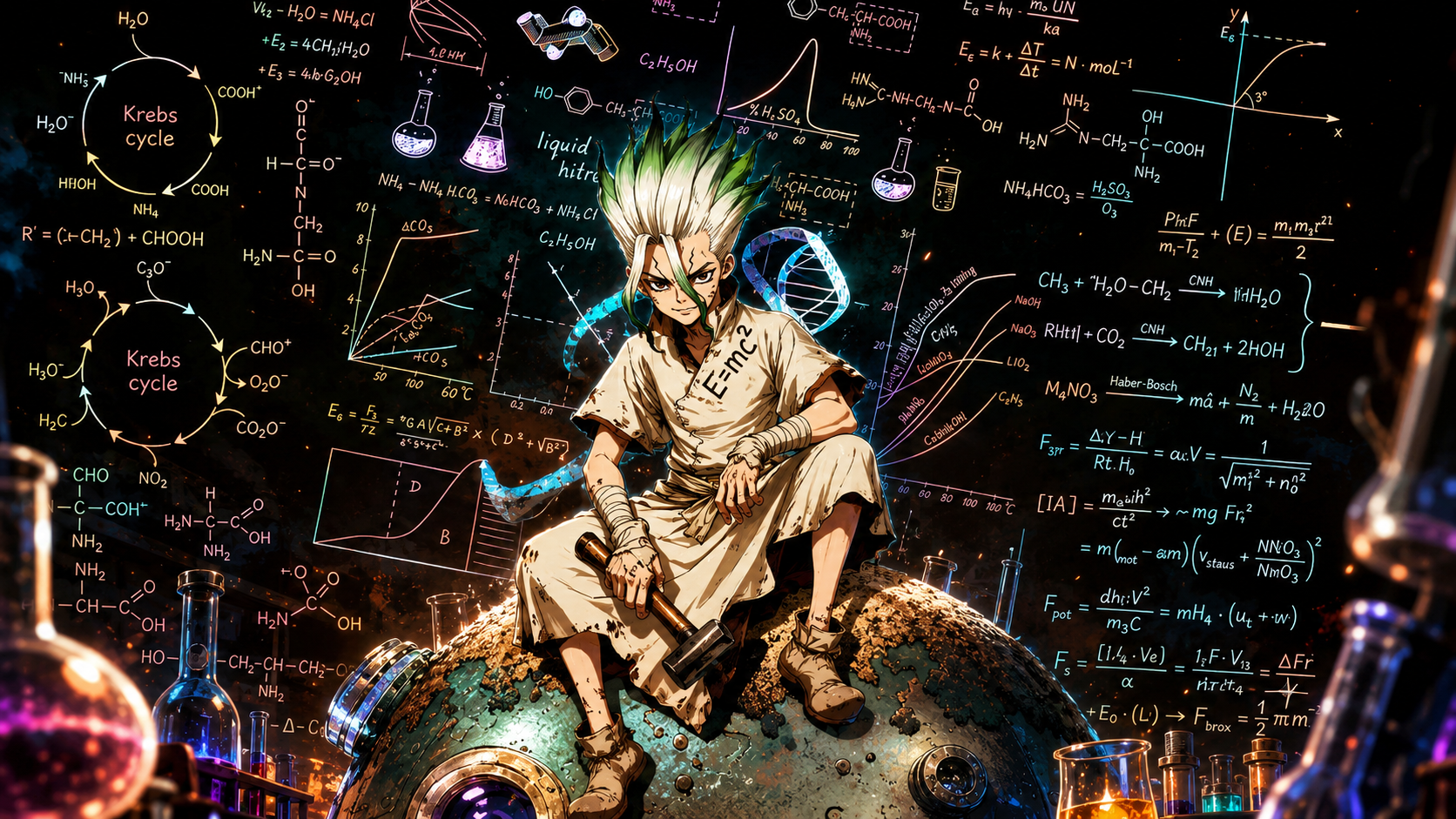
When Senku Ishigami woke up in a world where two million years of human civilization had been turned to dust and stone, his first instinct wasn’t to mourn or conquer—it was to calculate. Over three electrifying seasons, Dr. STONE proved to the anime world that the periodic table could wield more shonen hype than any cursed technique or Super Saiyan transformation. Yet, every single breakthrough—from ceramic pots and sulfurous antibiotics to cellular phones and steam engines—has quietly served as mere runway for the impossible. With the official confirmation of Dr. STONE: Science Future, the fourth and final multi-cour season from TMS Entertainment, the Kingdom of Science is stepping onto its grandest proving ground: humanity is going back to the Moon.
This isn’t merely another geographical expedition across post-petrification Earth; it is the philosophical and logistical climax of Riichiro Inagaki and Boichi’s visionary manga. At the heart of this final frontier lies the definitive answer to the enigma that kicked off the series: Why-Man, the shadowy extraterrestrial entity whose eerie Morse-code broadcasts shook the radio waves. As the anime prepares for its ultimate launch, the stakes are no longer just about survival—they are about reclaiming our cosmic birthright.
From Stone Age Knapping to the Apollo Horizon: The Audacity of the Lunar Mission
The thematic brilliance of Dr. STONE has always stemmed from its compression of time. Humanity required millennia to evolve from flint tools to rocketry; Senku and his allies have attempted the same feat in a matter of years. However, Season 4 challenges the Kingdom of Science with an engineering threshold so monstrous that no single nation, let alone a fledgling civilization, can tackle it alone.
The roadmap to the Moon requires a breathtaking industrial sprint that spans the entire globe:
- Global Infrastructure: Establishing specialized outposts worldwide—from the agricultural powerhouse of Corn City in the Americas to mining metropolises extracting rare-earth minerals and aluminum.
- Computational Breakthroughs: Moving beyond mechanical vacuum tubes to craft early silicon microprocessors, proving that software is just as critical to spaceflight as propulsion.
- Rocketry and Life Support: Developing liquid-fuel thrusters, hermetically sealed capsules, and space suits capable of surviving the vacuum of space without the luxury of industrial trial-and-error.
What makes Science Future so compelling is that it strips space exploration of its modern complacency. When Apollo 11 launched in 1969, it was backed by the GDP of a superpower. Senku’s crew must hand-weave carbon-rich fibers, formulate rocket propellants over open fires, and calculate orbital trajectories using slide rules and sheer intellect. It turns raw engineering into visceral, high-stakes drama.
Unmasking Why-Man: The Petrification Riddle and Existential Horror
Ever since the Kingdom of Science deciphered the rhythmic, synthetic repetition of “WHY WHY WHY” echoing from the lunar surface, Dr. STONE pivoted from an optimistic post-apocalyptic builder into cosmic sci-fi mystery. Why-Man represents the antithesis of Senku’s worldview. Where Senku views science as an egalitarian, collaborative light meant to lift humanity out of darkness, Why-Man used hyper-advanced technology—the Medusa devices—to plunge billions of sentient minds into petrified silence.
The Moral Ambiguity of the Medusa
Is Why-Man an alien apex predator, an artificial intelligence run amok, or something far stranger? The brilliance of Inagaki’s writing lies in subverting classic sci-fi tropes. The Medusa device is essentially a philosopher’s stone: it freezes biological decay, heals fatal trauma upon depetrification, and offers functional immortality. But at what cost? The lunar showdown forces an ideological confrontation between humanity’s messy, self-destructive drive for freedom and a cold, universal logic that demands quiet stasis. When Senku finally confronts Why-Man face-to-face, the weapon of choice won’t be a laser cannon, but a dialogue on the very purpose of existence.
TMS Entertainment’s Magnum Opus: Adapting Boichi’s Grand Scale
Adapting the final stretch of Dr. STONE is an animator’s trial by fire. Illustrator Boichi’s hyper-detailed, dynamic artwork reached its zenith during the manga’s space race, filled with complex blueprints, soaring spacecraft cross-sections, and visceral character acting. TMS Entertainment, which has steered the anime with remarkably steady hands since 2019, faces its most complex production challenge yet.
The shift from agrarian forests to industrial dry-docks and, ultimately, the airless void of space demands a profound visual evolution. Directed by Shuhei Matsushita, the creative team must balance the hyper-kinetic, comedic energy of Senku’s inner circle with the claustrophobic dread of deep space. Audio design will play an equally critical role: the transition from the bustling, percussive symphony of human manufacturing to the deafening, quiet vacuum of the Moon will make or break the emotional resonance of the climax. If early teasers are any indication, TMS is treating Science Future not just as another seasonal run, but as a studio legacy project.
Byakuya’s Ghost and Senku’s Heart: The Emotional Core of the Final Voyage
Behind the equations and the manganese-steel alloys beats the enduring legacy of Byakuya Ishigami. The series began with Byakuya and his fellow astronauts looking down on a petrified Earth from the International Space Station, preserving the flame of human culture for a son he knew would one day awaken. Senku’s journey to the Moon is, poetically, the completion of a generational relay race.
This dynamic extends outward to the supporting cast. The mission forces bitter rivals into unbreakable brotherhood: Senku’s pure scientific idealism balances Dr. Xeno’s pragmatic brilliance, while Ryusui’s boundless greed becomes the engine of human ambition. Most crucially, characters like Chrome—a child of the stone world who learned science through intuition rather than historical memory—prove that human inquiry is not an anomaly of the 21st century; it is an intrinsic biological imperative. When the chosen three-person crew boards the craft for the one-way trajectory, they carry the dreams of both the pre-collapse civilization and the primitive descendants born of its ruins.
The Final Countdown: Why Science Future Matters in Modern Anime
In an era dominated by dark fantasy deconstructions and power-scaling spectacles, Dr. STONE stands as a rare, unapologetic monument to human ingenuity and optimism. It asserts that our greatest superpower isn’t mystical lineage or unyielding rage, but our willingness to sit in the dark, observe, and ask how.
Dr. STONE: Science Future promises to deliver one of the most intellectually satisfying finales in modern anime history. It is a story where the final battle isn’t decided by who can punch harder, but by whether human civilization is worthy of stepping out of its planetary cradle. As Senku would say, it’s exhilarating to the core—ten billion percent.
Over to you, Kingdom of Science faithful: How do you think TMS Entertainment will handle the monumental pacing of the lunar landing, and what are your wildest theories regarding Why-Man’s true identity? Sound off in the comments below, and stay tuned to Wibux for our comprehensive episode reviews as the final season lifts off!