


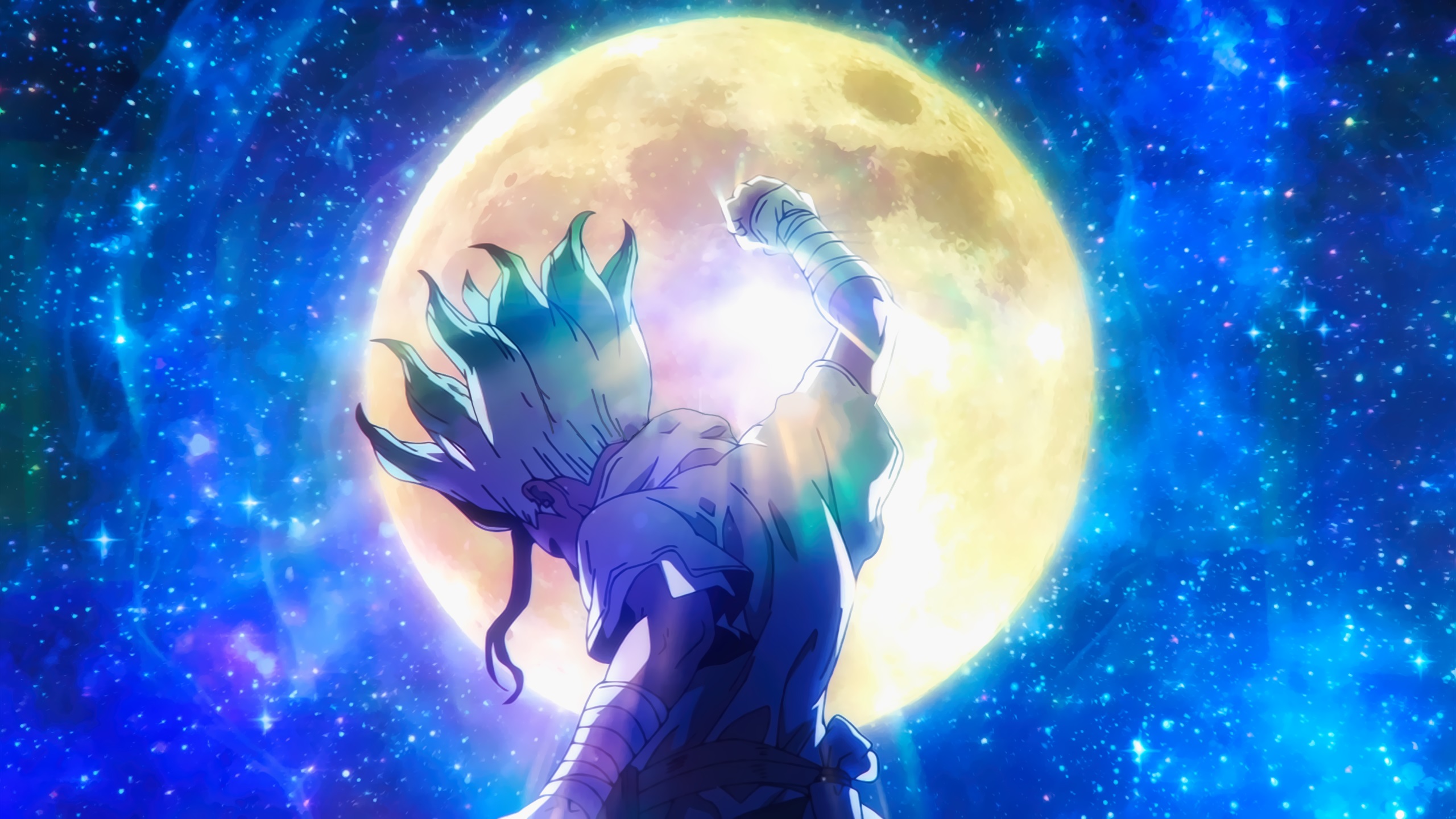
When Senku Ishigami first awoke in the year 5738, scraping together nitric acid and bat guano in a primeval jungle, few could have anticipated that Dr. STONE would culminate in the cold, silent vacuum of space. Yet here we are. With the announcement and ongoing anticipation surrounding Dr. STONE: Science Future, the fourth and final season of TMS Entertainment’s hit anime adaptation, the Kingdom of Science stands on the precipice of its ultimate gambit. The series has consistently rejected the mystical power-scaling common to the Weekly Shonen Jump pantheon, trading magical awakening for the grueling, step-by-step triumph of human ingenuity. Now, that philosophical manifesto faces its definitive trial: a crewed voyage to the Moon to confront Why-Man, the enigmatic entity responsible for freezing human civilization in petrified stasis for over three millennia.
Operation Moonshot: Engineering the Impossible on a Primitive Earth
The progression of Dr. STONE has always operated on an audacious narrative curve, but the final leg of Senku’s journey demands an unprecedented logistical leap. Leaving Earth’s gravity well is not merely a matter of discovering a new formula; it requires the reconstitution of an entire industrial ecosystem. To put three astronauts on lunar soil, the Kingdom of Science must develop precision rocketry, multi-stage solid and liquid propulsion systems, heat shields capable of surviving atmospheric reentry, and real-time electronic telemetry.
The Industrial Web and the Global Roadmap
What makes Science Future uniquely compelling is its refusal to hand-wave the monumental labor of modern aerospace engineering. Viewers are witnessing the synthesis of global resources—amassing silicon for microchips, mining aluminum and rare earth elements across continents, and engineering functional integrated circuits from scratch. The narrative introduces high-stakes computational hurdles that bridge the physical and digital worlds, elevating secondary geniuses like Sai Nanami, whose peerless mathematical acumen provides the trajectory calculations once handled by monolithic NASA mainframes. This is shonen storytelling transformed into a sprawling industrial drama, where every single screw, valve, and circuit board carries the emotional weight of humanity’s collective legacy.
Decoding Why-Man: Shonen’s Most Unconventional Antagonist
For hundreds of chapters and three electrifying anime seasons, the shadow of Why-Man has loomed like a cosmic guillotine over the series. First introduced as a bone-chilling, synthesized Morse code signal echoing across radio waves—incessantly repeating the single English word “WHY”—this entity represents an entirely different class of antagonist for shonen anime. Why-Man is not a warmonger driven by petty territorial ambition like Tsukasa, nor a megalomaniac cloaked in religious rhetoric like Ibara.
The Philosophy of the Petrification Beam
Without diving into explicit narrative-breaking spoilers for anime-only viewers, the confrontation with Why-Man radically shifts Dr. STONE from an optimistic survival story into hard science fiction grappling with the Fermi Paradox. The Medusa devices—the double-loop petrification apparatuses—are not malevolent curses; they are technological artifacts that operate under strict physical laws. The dialogue between Senku and Why-Man serves as an ideological dialectic: stagnation versus evolution, biological mortality versus crystalline immortality, and cosmic apathy versus the stubborn, irrepressible human drive to explore the unknown. It subverts the traditional “beat the villain into submission” climax, replacing it with an intellectual, existential negotiation where human curiosity is tested against the terrifying silence of the cosmos.
TMS Entertainment’s Crucible: Adapting Boichi’s Mechanical Grandeur
From an animation standpoint, Dr. STONE: Science Future presents TMS Entertainment with its most demanding aesthetic challenge to date. The final arcs of Riichiro Inagaki’s manga feature illustrative artist Boichi operating at the absolute peak of his craft. His hyper-detailed cross-sections of orbital mechanics, the terrifying vastness of the lunar surface, and the grotesque, mesmerizing geometry of thousands of hovering Medusa devices demand meticulous visual execution.
Director Shinya Iino and the visual team must balance two radically different visual languages: the comedic, hyper-deformed character antics that keep the series grounded, and the photorealistic, stark grandeur of deep space. Early production hints and promotional materials suggest that the studio is leaning heavily into dynamic, physics-accurate lighting to emphasize the isolation of the lunar mission. The contrast between the lush, green Earth that Senku fought to restore and the monochromatic, dead surface of the Moon is visually poetic, framing humanity’s return to the stars not as an escape, but as a hard-earned homecoming.
The Generational Relay: Byakuya’s Ghost and the Pale Blue Dot
Beneath the formulas and comedic reactions beats an intensely sentimental heart. The lunar mission is not simply Senku’s victory; it is the culmination of a promise passed down through thousands of years. The emotional specter of Byakuya Ishigami, Senku’s adoptive father who founded the astronaut-survivor colony that preserved human language and culture, hangs over every weld of the spacecraft.
Byakuya left the Soyuz capsule and a message recorded on glass as a foundational gift for a son he knew he would never see again. By launching back into space, Senku symbolically closes the circle that began when the International Space Station crew watched the petrification wave swallow Earth from orbit. It reinforces the central thesis that has sustained Dr. STONE across its entire serialization: individual humans may wither and turn to dust, but science is an unbroken relay race of accumulated knowledge that defies the second law of thermodynamics.
The Post-Stone Era: A Legacy of Uncompromising Optimism
As Weekly Shonen Jump transitions through a generational changing of the guard—with titan franchises like My Hero Academia and Jujutsu Kaisen closing their curtains—Dr. STONE occupies a singular, highly respected position. While contemporaries leaned heavily into dark fantasy, visceral trauma, and ideological deconstruction, Inagaki and Boichi championed a radical, unabashed optimism. They posited that humanity’s greatest superpower is not the capacity for violence, but the stubborn refusal to surrender to ignorance.
The community anticipation for Science Future reflects this distinct legacy. Fans are not merely waiting to see who wins a brawl; they are waiting to see human intellect triumph over existential oblivion. It is an educational, philosophical, and emotional journey that validated the idea that a high school scientist with an abrasive laugh and an obsession with carbonization could become one of modern anime’s most enduring heroes.
The Countdown to Touchdown
As the Kingdom of Science lights the engines and sets its sights on the pale luminescence of the Moon, Dr. STONE: Science Future promises an explosive, intellectually satisfying crescendo for a modern classic. Senku Ishigami began this story wearing animal skins, armed with nothing more than raw cognitive endurance and a dream to drag seven billion people out of the stone age. Now, strapped into a cockpit soaring toward the creator of their petrification, the kingdom prepares to demand an answer to that haunting, lingering question: Why?
How do you feel about Senku’s final journey into the cosmos? Do you believe the anime adaptation can fully capture the sheer scale of Boichi’s lunar artwork? Sound off in the comments below, and keep your browsers locked to Wibux.com for exhaustive episode breakdowns and science-fact analyses as Science Future unfolds!